
What Should Buyers Expect From a Silicone Baby Tableware OEM Manufacturer?
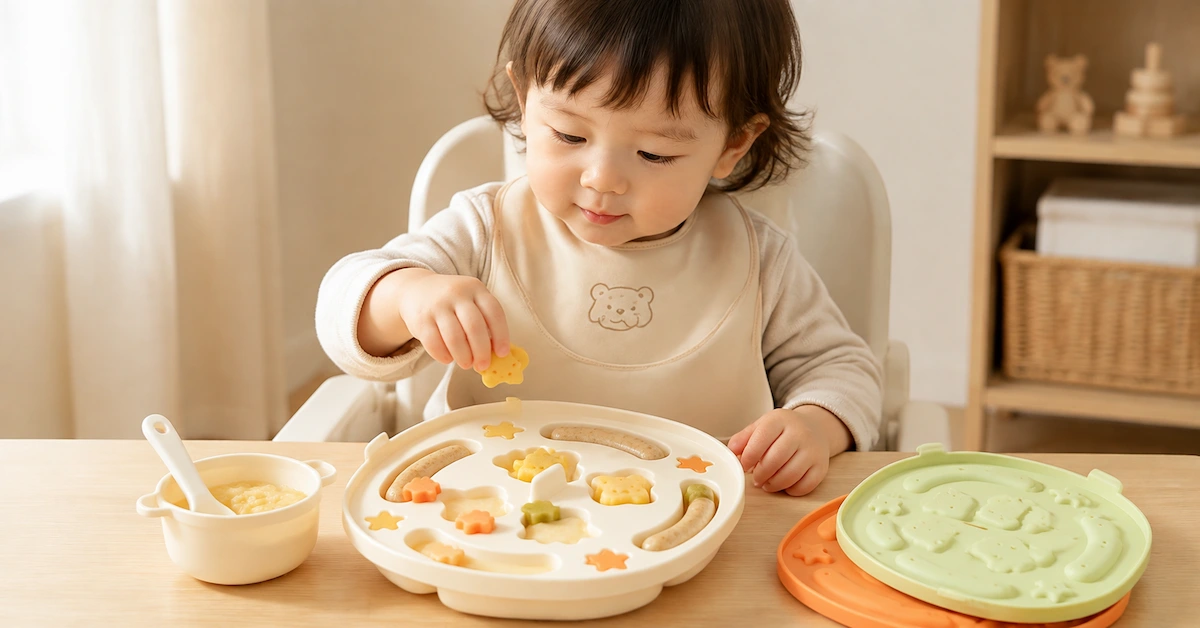
Finding a silicone baby tableware OEM manufacturer is not difficult. The harder part is finding a manufacturing partner that can turn a product requirement into a repeatable commercial product.
For baby brands, distributors, importers, retailers, and private-label sellers, OEM sourcing normally involves more than silicone molding.
A complete project can include:
-
product requirement analysis;
-
existing-product evaluation;
-
structural design;
-
material selection;
-
mold development;
-
sampling;
-
Pantone color matching;
-
logo customization;
-
food-contact documentation;
-
mass production;
-
quality control;
-
private-label packaging;
-
final inspection;
-
shipment preparation.
The most common sourcing mistake is asking for a unit price before defining these requirements.
Two silicone baby plates may look nearly identical in a product photo, yet differ significantly in product weight, silicone formulation, suction structure, tooling, packaging, inspection requirements, and final cost.
A professional OEM project therefore starts with the product specification rather than the quotation.
Leadonex supports both OEM and ODM silicone product development and more detailed custom silicone manufacturing, including product development, tooling, molding, color, branding, packaging, inspection, and production.
For buyers, the first question should be simple:
Do you need a private-label version of an existing product, a modified product, or a completely new design?
Choose the Right OEM Development Route Before Tooling
The level of customization determines development cost, project risk, differentiation, and lead time.
Existing Mold With Private Label Customization
This is usually the most practical option for brands testing a new market or expanding quickly.
A buyer starts with an existing product and customizes selected elements such as:
-
silicone color;
-
logo;
-
packaging;
-
product combinations;
-
labels;
-
instruction cards.
The core product geometry remains unchanged.
This approach can reduce tooling investment and simplify the sample process because the product already has an established manufacturing route.
Buyers can review the current Leadonex product range to identify products that may be suitable as a private-label starting point.
When This Route Makes Sense
Existing molds are particularly useful when:
-
the product concept is already proven;
-
speed to market is important;
-
expected first-order volume is limited;
-
tooling investment is difficult to justify;
-
packaging and branding provide sufficient differentiation.
However, an existing mold does not remove the need for product approval.
The buyer should still confirm:
-
material;
-
dimensions;
-
product weight;
-
color;
-
logo;
-
packaging;
-
relevant documentation;
-
functional requirements.
Modified Existing Product
A second option is to start with an existing design but change selected structural elements.
Possible modifications include:
-
compartment configuration;
-
suction-base design;
-
handle structure;
-
lid structure;
-
external dimensions;
-
product thickness;
-
logo position;
-
surface texture;
-
product combination.
Some changes may be relatively simple. Others may affect the mold and require new tooling.
A manufacturer should therefore perform a manufacturability review before confirming cost.
Why Small Design Changes Can Become Large Manufacturing Changes
A buyer may request:
“We only want to make the plate slightly deeper.”
But that modification can influence:
-
product weight;
-
silicone consumption;
-
mold cavity;
-
demolding;
-
packaging size;
-
carton quantity;
-
shipping volume.
OEM decisions should be evaluated as part of the entire production system rather than as isolated cosmetic changes.
Fully Custom Silicone Baby Tableware
A fully custom program is suitable for brands seeking proprietary product geometry or stronger market differentiation.
Development may begin from:
-
sketches;
-
reference products;
-
CAD drawings;
-
3D files;
-
physical samples;
-
functional requirements.
A typical development path includes:
-
requirement analysis;
-
structural design;
-
material selection;
-
manufacturability review;
-
tooling;
-
trial molding;
-
sample evaluation;
-
revision;
-
final approval;
-
mass production.
This approach gives buyers more control over product identity but also increases development complexity.
The most important principle is to resolve structural questions before mold manufacturing whenever possible.
Which Silicone Baby Tableware Products Are Suitable for OEM Development?
A baby tableware range should normally be designed as a product system instead of a group of unrelated products.
Common categories include:
-
silicone suction plates;
-
divided plates;
-
baby bowls;
-
training cups;
-
silicone bibs;
-
baby spoons;
-
forks;
-
feeding sets;
-
placemats;
-
baby food storage containers;
-
freezer trays.
Each product serves a different commercial and functional purpose.
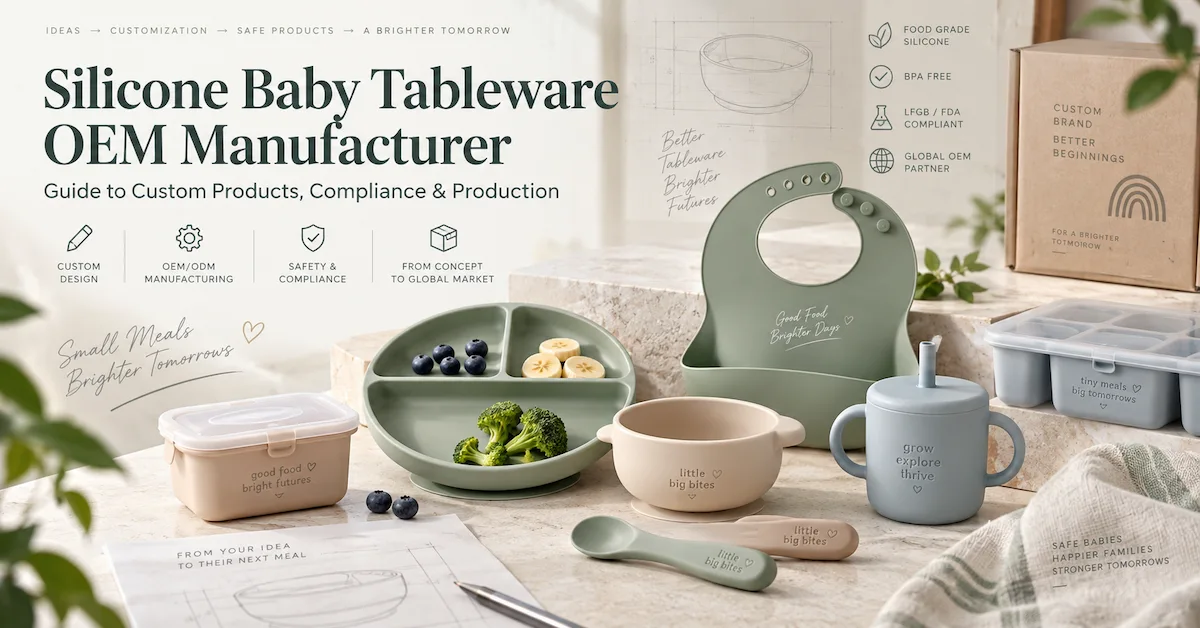
Silicone Baby Feeding Sets
Feeding sets allow brands to combine several functions into one coordinated retail product.
The current 8-piece silicone baby feeding set includes a bib, divided suction plate, suction bowl, straw cup, wooden-handle spoon and fork, and training utensils.
For OEM buyers, a feeding set creates additional specification questions.
These include:
-
Should every component use the same color?
-
Should some products use contrasting colors?
-
Which products carry the brand logo?
-
Is the logo molded, printed, or placed only on packaging?
-
Which products require separate documentation?
-
How should the set be arranged in the retail box?
-
How should replacement orders maintain color consistency?
A set can increase retail value, but it also requires stronger SKU and quality management.
Silicone Suction Plates
Suction plates are important products in baby-led-weaning and self-feeding categories.
The current 4-compartment silicone baby suction plate is listed as a one-piece liquid silicone product measuring 23.5 × 17 × 4 cm with four food compartments and an integrated suction base.
Leadonex also lists a frog-shaped silicone baby suction plate with three compartments, dimensions of 21 × 18 cm, height of 3.2 cm, product weight of 233 g, and a published temperature range of -40°C to 230°C.
These examples demonstrate why “silicone baby plate” is not a complete OEM specification.
Buyers should define:
-
external dimensions;
-
compartment quantity;
-
compartment geometry;
-
rim height;
-
suction-base structure;
-
target weight;
-
surface finish;
-
intended tray dimensions;
-
logo position;
-
color;
-
packaging.
Suction Performance Must Be Evaluated in Real Use Conditions
A common mistake is requesting “strong suction” without defining the surface.
Suction performance can vary according to:
-
table material;
-
surface smoothness;
-
cleanliness;
-
suction-base size;
-
silicone flexibility;
-
plate geometry.
Smooth, clean high-chair trays or similar surfaces may provide a different result from textured or porous tables.
OEM product claims should reflect intended use conditions rather than promising identical suction performance on every surface.
Silicone Baby Food Storage Products
Baby feeding categories also include meal preparation and food storage.
The current silicone baby food storage container is listed with a 120 ml capacity, airtight lid, food-grade silicone construction, and a published operating temperature range of -40°C to 230°C.
The product page also lists customization options for color, size, logo, and packaging.
The 7-cavity silicone baby food freezer tray extends the product range into portioning and freezing complementary foods.
For brands, these products can support a broader feeding system:
-
prepare food;
-
portion food;
-
freeze food;
-
store food;
-
serve food;
-
support self-feeding.
This creates more merchandising opportunities than selling one plate alone.
Product Engineering Details That Affect OEM Performance
A professional silicone baby tableware OEM program converts general product ideas into measurable specifications.
Statements such as “soft silicone,” “strong suction,” or “premium quality” are too vague for manufacturing control.
Suction Base Design
Suction behavior is affected by several variables:
-
suction-base diameter;
-
suction depth;
-
silicone flexibility;
-
product weight;
-
base flatness;
-
surface condition.
The requirement should describe the expected use condition.
For example:
The plate should remain stable during normal toddler feeding on a clean and smooth high-chair tray.
This gives the manufacturer a more meaningful basis for evaluation.
Rim Height
Rim height affects:
-
spill resistance;
-
food scooping;
-
product volume;
-
cleaning;
-
packaging height.
Higher is not automatically better.
For young children learning to use utensils, the rim should help guide food without making access unnecessarily difficult.
Compartment Geometry
A divided plate may contain:
-
two compartments;
-
three compartments;
-
four compartments;
-
asymmetric sections;
-
character-shaped sections.
Compartment geometry influences both appearance and manufacturing.
Changes can affect:
-
product weight;
-
material consumption;
-
mold complexity;
-
cleaning;
-
demolding;
-
structural stiffness.
Wall Thickness
Product thickness influences:
-
flexibility;
-
rigidity;
-
weight;
-
material cost;
-
user perception.
A thick plate may feel stable but consume more silicone.
A thin product may reduce material usage but become overly flexible.
The appropriate structure depends on the product function.
A bib, bowl, spoon, cup, freezer tray, and suction plate should not all be designed using identical wall-thickness logic.
Lid and Component Fit
Products containing lids or multiple components require dimensional control.
Examples include:
-
baby food containers;
-
training cups;
-
straw cups;
-
storage boxes.
Important questions include:
-
How tightly should the lid fit?
-
Is the lid intended to prevent spills or provide a full sealing function?
-
Does the lid need to be removable by an adult?
-
Does the product contain a straw?
-
Are handles molded into the product?
-
Are multiple materials assembled?
These requirements should be documented before sample approval.
Logo Position and Branding Method
Logo design can influence both appearance and tooling.
Possible methods include:
-
molded logo;
-
embossed logo;
-
debossed logo;
-
printed logo;
-
packaging-only branding.
A molded logo normally affects mold design.
Printing introduces an additional manufacturing operation.
Packaging-only branding can simplify the molded product but provides less permanent product identification.
The branding method should therefore be selected before the tooling stage.
Food-Contact Silicone Requires More Than a “Food Grade” Claim
For baby tableware, material safety is a major purchasing concern.
However, buyers should avoid treating the term “food grade silicone” as a complete compliance strategy.
A more useful evaluation considers:
-
intended food contact;
-
temperature conditions;
-
target market;
-
silicone formulation;
-
pigments;
-
additional materials;
-
finished product structure;
-
relevant testing;
-
documentation.
FDA and European Food-Contact Requirements Are Different Issues
For the U.S. market, silicone and rubber food-contact products may need to be evaluated according to applicable FDA food-contact requirements depending on their material and intended use.
For the European market, food-contact products operate within a different regulatory framework, and buyers may also request LFGB-related testing for silicone products depending on their market requirements.
The important sourcing principle is:
Do not use one compliance term as a substitute for a complete product review.
Factory Certification Is Not Product Certification
Buyers should distinguish between:
-
factory management certification;
-
social compliance audits;
-
material documentation;
-
chemical testing;
-
finished-product testing.
A factory certificate tells you something about the manufacturer or management system.
A food-contact test report tells you something about the sample and test scope stated in that report.
These are different types of evidence.
Leadonex publishes factory and material-related information on its custom silicone manufacturing page, while individual product pages provide more product-specific information.
For example, some baby tableware pages refer to FDA-related test reports and indicate that LFGB-related documentation can be handled according to project requirements.
An OEM buyer should still confirm the documentation for the exact product being purchased.
Questions to Ask About Test Reports
Before relying on a report, verify:
-
Which product was tested?
-
Which material was tested?
-
Which color was tested?
-
When was the report issued?
-
Which laboratory issued it?
-
What test method or standard was used?
-
Does the tested sample match the final product?
-
Does the report apply to the destination market?
The purpose is traceability.
A test report from another product should not automatically be treated as evidence for a new custom SKU.
Mixed-Material Baby Feeding Sets Need Extra Attention
Not every feeding set is made entirely from silicone.
A product may include:
-
silicone;
-
wood;
-
stainless steel;
-
plastic;
-
printed decoration;
-
packaging materials.
Each material can create different quality or compliance considerations.
For a mixed-material set, buyers should identify:
-
which parts contact food;
-
which materials are used;
-
which reports cover each component;
-
whether coatings or printing are involved;
-
whether the final combination differs from the tested sample.
This is more reliable than collecting unrelated certificates without checking their scope.
Silicone Compression Molding vs LSR Molding
Silicone baby tableware can be produced using different manufacturing methods.
Leadonex lists both silicone compression molding and liquid silicone rubber molding among its custom manufacturing capabilities.
The correct process depends on the individual product.
Compression Molding
Compression molding may be suitable for many solid silicone baby products.
Manufacturing considerations can include:
-
material preparation;
-
mold design;
-
cavity layout;
-
curing;
-
demolding;
-
trimming;
-
inspection.
The suitability depends on product geometry and production requirements.
Liquid Silicone Rubber Molding
LSR molding can be appropriate for certain silicone products requiring specific geometry, repeatability, or process conditions.
However, LSR should not automatically be considered superior simply because the process is more technically specialized.
Buyers should ask:
Which manufacturing process is most appropriate for this specific product, target volume, geometry, and commercial requirement?
The correct answer should be based on engineering and production logic.
Post-Processing
Depending on the product, post-processing may include:
-
trimming;
-
secondary curing;
-
cleaning;
-
printing;
-
logo application;
-
assembly;
-
inspection;
-
packaging.
Not every product requires every process.
A project-specific manufacturing flow is more useful than a generic list of factory capabilities.
A Practical OEM Workflow From RFQ to Mass Production
Leadonex describes a broader product-development and manufacturing workflow on its customization page.
For buyers, the process can be simplified into a series of commercial approval stages.
Step 1: Prepare a Product Brief
Before requesting a quotation, define:
-
product category;
-
target customer;
-
target market;
-
expected dimensions;
-
product function;
-
initial order quantity;
-
annual volume estimate;
-
color;
-
logo;
-
packaging;
-
required documentation;
-
target launch date.
The manufacturer can quote more accurately when fewer assumptions are required.
Step 2: Confirm the Development Route
Determine whether the project uses:
-
an existing mold;
-
a modified product;
-
a completely new mold.
This decision affects nearly every later stage.
Step 3: Engineering Review
For a custom product, review:
-
dimensions;
-
geometry;
-
wall thickness;
-
suction design;
-
parting line;
-
demolding;
-
lid fit;
-
logo position;
-
surface finish.
Design corrections are generally easier before mold manufacturing than after.
Step 4: Confirm Material and Market Requirements
Define:
-
material direction;
-
color requirements;
-
food-contact use;
-
target market;
-
required documentation;
-
additional components.
This should happen before final sample approval.
Step 5: Tooling
If custom tooling is required, clarify:
-
product covered by the mold;
-
number of cavities;
-
logo structure;
-
mold modifications;
-
mold ownership terms;
-
revision policy;
-
maintenance expectations.
Important commercial terms should be documented instead of assumed.
Step 6: Sample Approval
Samples should be evaluated against a written specification.
Depending on the product, inspect:
-
dimensions;
-
weight;
-
color;
-
surface;
-
logo;
-
suction;
-
flexibility;
-
lid fit;
-
edge quality;
-
assembly;
-
packaging compatibility.
The sample should not be approved only because it “looks good.”
Step 7: Establish a Golden Sample
Once the product is approved, retain a final reference sample.
The golden sample helps define expectations for:
-
appearance;
-
color;
-
dimensions;
-
function;
-
branding;
-
workmanship.
It becomes an important reference for mass-production inspection and repeat orders.
Step 8: Approve Packaging
Packaging is a separate production component and should receive its own approval.
Check:
-
artwork;
-
dimensions;
-
barcode;
-
warning information;
-
labels;
-
product arrangement;
-
master carton;
-
carton markings.
Packaging errors can delay a shipment even when the silicone product is correct.
Step 9: Mass Production
Production should follow the approved:
-
specification;
-
sample;
-
color;
-
logo;
-
packaging;
-
quality standard.
Changes should not be introduced without buyer approval.
Step 10: Final Inspection and Shipment Release
Before shipment, verify:
-
SKU;
-
quantity;
-
color;
-
packaging;
-
logo;
-
product quality;
-
carton markings;
-
documentation.
Only products matching the approved requirements should be released.
What Quality Control Should Include for Silicone Baby Tableware
“Strict quality control” is not enough for a purchasing specification.
Buyers should define what needs to be checked.
Incoming Material Control
Incoming material checks can help confirm:
-
correct silicone material;
-
correct batch;
-
correct pigment;
-
correct component;
-
relevant material documentation.
First-Article Inspection
At production startup, initial products should be checked against the approved sample and specification.
Typical points include:
-
dimensions;
-
color;
-
logo;
-
shape;
-
surface;
-
fit;
-
function.
This can help identify setup problems before larger quantities are manufactured.
In-Process Inspection
Common silicone molding issues may include:
-
flash;
-
bubbles;
-
incomplete molding;
-
surface contamination;
-
irregular shape;
-
inconsistent color;
-
deformation;
-
damaged edges.
Leadonex describes inspection during the custom production process for issues including bubbles, irregularities, color differences, and shape inconsistencies.
Dimensional Inspection
Dimensions become particularly important when products contain:
-
lids;
-
fitted components;
-
defined high-chair dimensions;
-
packaging inserts;
-
multiple assembled parts.
The buyer and manufacturer should agree which dimensions are critical.
Functional Inspection
Inspection depends on product function.
Suction Plates
Check:
-
base flatness;
-
suction structure;
-
stability;
-
deformation.
Storage Containers
Check:
-
lid fit;
-
closure;
-
product shape;
-
dimensional compatibility.
Cups
Check:
-
lid fit;
-
straw fit where applicable;
-
handle structure;
-
assembly.
Utensils
Check:
-
edge condition;
-
surface;
-
flexibility;
-
connection points where multiple materials are used.
Color Inspection
Color is especially important for baby product collections.
A private-label range may contain:
-
plates;
-
bowls;
-
cups;
-
bibs;
-
spoons.
If these products are sold as one coordinated collection, noticeable color differences can create a poor retail impression.
Pantone references and approved color samples can help create a clearer control standard.
Logo Inspection
Inspect:
-
size;
-
position;
-
orientation;
-
molded detail;
-
print quality;
-
color where applicable.
Branding errors can make otherwise acceptable goods commercially unusable.
Packaging Inspection
Final packaging inspection should verify:
-
correct SKU;
-
correct color;
-
correct packaging;
-
correct label;
-
barcode;
-
quantity;
-
carton marking.
This is particularly important for collections with several similar products.
How Should Buyers Evaluate Factory Capacity?
Large factory numbers can be useful, but they should not replace SKU-specific production planning.
Leadonex currently publishes factory-level information including:
-
approximately 15,300 m² of factory space;
-
135 employees;
-
overall production capacity of up to 38,000 sets per day.
These figures describe overall factory capability.
They do not mean that every custom silicone baby tableware SKU can be produced at 38,000 sets per day.
Actual production capacity depends on:
-
product size;
-
product weight;
-
mold cavity count;
-
molding cycle;
-
manufacturing process;
-
trimming;
-
secondary processing;
-
printing;
-
assembly;
-
packaging;
-
current factory schedule.
A better procurement question is:
Based on this exact product, mold configuration, order quantity, packaging, and required delivery date, what production schedule can the factory commit to?
This gives the buyer a project-specific answer.
For broader supplier evaluation, buyers can also read the silicone baby tableware factory sourcing guide.
What Determines Silicone Baby Tableware OEM Cost?
OEM cost is built from multiple variables.
Product Weight
Silicone consumption influences material cost.
Increasing product thickness or dimensions normally increases material use.
Mold Complexity
Tooling cost can vary according to:
-
product size;
-
geometry;
-
cavity number;
-
parting structure;
-
logo details;
-
surface finish;
-
number of components.
A simple plate and a multi-component cup do not have the same tooling requirements.
Existing Mold or New Mold
Existing products can reduce tooling investment.
A proprietary design normally requires additional engineering and mold development.
Silicone Color
Custom colors require color matching and approval.
Multi-color collections can create additional production and inventory complexity.
Branding
Cost may vary between:
-
molded logo;
-
printing;
-
labels;
-
customized packaging.
A molded logo may influence tooling, while printing creates an additional production step.
Packaging
Packaging can significantly affect total landed cost.
Options can include:
-
OPP bag;
-
paper sleeve;
-
retail box;
-
gift box;
-
custom insert;
-
multipack packaging.
Packaging also changes carton volume and shipping efficiency.
Testing and Documentation
If project-specific testing is required, it should be included in the development plan.
Changing the material, color, structure, or destination market after testing may create additional requirements.
What Determines MOQ?
There is no responsible universal MOQ for every silicone baby tableware OEM project.
MOQ may vary according to:
-
existing mold or new tooling;
-
product weight;
-
color;
-
pigment preparation;
-
printing;
-
packaging;
-
component sourcing;
-
number of SKUs;
-
production efficiency.
A general question such as:
“What is your MOQ?”
does not provide enough information.
A more useful request is:
“What is the MOQ for this existing-mold silicone suction plate in one Pantone color, with an embossed logo and custom retail box?”
Leadonex does not publish one universal MOQ that should be applied to every baby tableware project.
Buyers should request a quotation for the exact configuration.
What Determines Lead Time?
Lead time also depends on the project type.
Existing Product Projects
Typical stages may include:
-
product confirmation;
-
color sample;
-
logo approval;
-
packaging development;
-
production;
-
inspection.
Custom Mold Projects
Additional stages may include:
-
product engineering;
-
mold manufacturing;
-
trial molding;
-
sample revision;
-
final sample approval;
-
testing;
-
mass production.
Rather than asking only:
“What is the lead time?”
buyers should request a milestone schedule covering:
-
drawing approval;
-
tooling;
-
first sample;
-
revisions;
-
final approval;
-
production;
-
inspection;
-
shipment.
This makes launch planning more reliable.
How to Prepare an RFQ for Silicone Baby Tableware OEM Production
A detailed RFQ helps the manufacturer provide a more accurate quotation and reduces later misunderstandings.
Include the following information.
| RFQ Requirement | Information to Provide |
|---|---|
| Product type | Plate, bowl, cup, bib, feeding set, container |
| Product reference | Photo, sample, drawing, or 3D file |
| Dimensions | Required size or target dimensions |
| Features | Suction, lid, compartments, handle, straw |
| Material | Intended food-contact silicone requirement |
| Color | Pantone reference if available |
| Logo | Artwork and preferred branding method |
| Packaging | Retail box, gift box, sleeve, bag, label |
| Quantity | Initial quantity per SKU and color |
| Annual demand | Estimated repeat volume |
| Target market | USA, EU, UK, other market |
| Documentation | Required test reports or documents |
| Schedule | Target sampling and launch date |
Example of a More Effective RFQ
Instead of:
Please quote your silicone baby feeding products.
Use:
We are developing a private-label silicone baby feeding collection for the European market. The initial range will include a divided suction plate, bowl, training cup, spoon, fork, and bib in three Pantone colors. We require an embossed logo and retail gift-box packaging. Please evaluate which existing molds may be suitable, whether any new tooling is needed, MOQ by color, sample requirements, available food-contact documentation, packaging options, and a realistic production schedule.
This gives the manufacturer enough information to evaluate the project commercially and technically.
Buyers can submit project requirements through the Leadonex contact page.
Common OEM Sourcing Mistakes That Increase Cost and Risk
Asking for Price Before Defining the Product
A unit price without specification context may not be comparable.
The quotation should be based on defined:
-
product;
-
material;
-
dimensions;
-
weight;
-
color;
-
logo;
-
packaging;
-
quantity.
Approving Appearance but Not Function
A product may look correct while failing the intended use.
Functional approval can include:
-
suction;
-
lid fit;
-
product stability;
-
utensil handling;
-
cleaning;
-
tray compatibility.
Considering Compliance Too Late
Target-market requirements should be considered before mass production.
Late compliance changes can affect:
-
material;
-
testing;
-
packaging;
-
product claims;
-
documentation.
Treating “Food Grade” as Complete Documentation
“Food grade” should not replace product-specific evidence.
Buyers should review the documentation applicable to the final SKU and market.
Developing Packaging Too Late
Packaging can affect:
-
product arrangement;
-
carton size;
-
labeling;
-
logistics;
-
retail presentation.
It should be developed alongside the product.
Not Creating a Golden Sample
A final approved sample provides a physical benchmark for production.
Without a reference sample, disagreements about appearance and workmanship become more difficult to resolve.
Ignoring Repeat-Order Control
The real value of an OEM supplier appears in repeat production.
A fifth order should still match the approved:
-
geometry;
-
color;
-
logo;
-
packaging;
-
quality expectation.
Version-controlled product specifications help maintain consistency.
How to Build a Scalable Private-Label Baby Tableware Range
Launching every possible product at once is rarely necessary.
A more controlled strategy is to build the range in stages.
Start With Core Feeding Products
A basic collection may include:
-
suction plate;
-
bowl;
-
training cup;
-
spoon;
-
fork;
-
bib.
These cover the main daily feeding functions.
Add Bundled Sets
Once individual products are established, brands can create:
-
feeding starter sets;
-
baby-led-weaning sets;
-
gift sets;
-
travel sets.
The existing 8-piece silicone baby feeding set illustrates how several feeding products can be combined into a single retail package.
Expand Into Food Preparation and Storage
Later-stage products may include:
-
placemats;
-
storage containers;
-
freezer trays;
-
additional feeding accessories.
This creates a more coherent customer journey.
Build a Controlled Color System
Instead of choosing unrelated colors for every product, define a brand palette.
For example:
-
three core colors;
-
one seasonal color;
-
one neutral gift color.
Each color should be approved before production.
The goal is to create consistency across:
-
plate;
-
bowl;
-
cup;
-
bib;
-
utensils;
-
packaging.
Standardize Logo Placement
Create rules for:
-
logo dimensions;
-
position;
-
orientation;
-
embossing;
-
printing;
-
packaging branding.
This makes a multi-product collection look like one coordinated brand.
Standardize Packaging
A common packaging architecture can improve:
-
visual identity;
-
retail recognition;
-
design efficiency;
-
inventory control.
Related products can use consistent:
-
typography;
-
colors;
-
information layout;
-
imagery;
-
brand hierarchy.
Existing Mold vs Custom Mold: Which Is Better?
Neither option is universally better.
The correct decision depends on commercial objectives.
| Requirement | Existing Mold | Custom Mold |
|---|---|---|
| Faster market entry | Strong advantage | Longer development |
| Lower upfront tooling cost | Strong advantage | Higher investment |
| Product exclusivity | Limited | High |
| Structural customization | Limited | Extensive |
| Market validation | Suitable | May be unnecessary |
| Proprietary brand design | Limited | Suitable |
| Engineering work | Lower | Higher |
| Development risk | Lower | Higher |
Choose an Existing Mold When
-
demand is not yet proven;
-
launch speed matters;
-
branding provides enough differentiation;
-
tooling budget is limited;
-
you want to test several products.
Choose a Custom Mold When
-
product structure is part of your competitive advantage;
-
annual demand supports tooling investment;
-
existing market products are too similar;
-
proprietary geometry supports brand recognition;
-
you need specific functionality.
OEM strategy should be based on return on investment rather than the assumption that fully custom products are always superior.
What Should You Ask Before Choosing a Silicone Baby Tableware OEM Manufacturer?
Before placing an order, ask questions that reveal how the manufacturer actually manages OEM projects.
Product and Engineering Questions
-
Can you support existing-mold and fully custom projects?
-
Which molding method is suitable for my product?
-
What files or samples do you need?
-
Can you review the product for manufacturability?
-
Which dimensions will be treated as critical?
-
Can the structure be modified after the first sample?
Material and Compliance Questions
-
What silicone material is proposed?
-
What food-contact documentation is available?
-
What documentation applies to the exact product?
-
What should be considered for my target market?
-
Will a material or color change affect testing requirements?
Tooling Questions
-
Is a new mold required?
-
How many cavities are proposed?
-
How are mold modifications handled?
-
How is mold ownership defined?
-
How is the tooling maintained?
Sample and QC Questions
-
What is the sample approval process?
-
Can we retain a golden sample?
-
What defects are checked during production?
-
How are dimensions controlled?
-
How is color consistency managed?
-
How is final inspection performed?
Commercial Questions
-
What is the MOQ for this exact configuration?
-
What costs are excluded from the unit price?
-
What packaging options are available?
-
What is the production schedule for the specified quantity?
-
How are repeat orders controlled?
Clear answers to these questions are generally more useful than a generic promise of “best quality and competitive price.”
Why OEM Project Management Matters as Much as Manufacturing Equipment
Manufacturing equipment produces parts.
Project management keeps the commercial product correct.
A baby tableware OEM project may involve:
-
sales;
-
engineering;
-
mold development;
-
production;
-
quality;
-
packaging;
-
logistics.
If these departments use different versions of a specification, mistakes can occur even when each team performs its own work correctly.
A controlled project should identify:
-
current drawing;
-
revision number;
-
Pantone color;
-
approved sample;
-
logo file;
-
packaging artwork;
-
SKU code;
-
quality standard.
This becomes increasingly important as a buyer expands from one product to a complete range.
A manufacturer that can produce one good sample is useful.
A manufacturer that can maintain the same approved standard across multiple orders is a stronger long-term OEM partner.
Leadonex Capabilities for Silicone Baby Tableware OEM Projects
Leadonex positions its manufacturing services around custom silicone product development in addition to existing finished products.
Its published custom silicone manufacturing capabilities include areas such as:
-
product design;
-
material selection;
-
prototypes and samples;
-
mold development;
-
silicone compression molding;
-
LSR molding;
-
color customization;
-
logo and pattern customization;
-
labels and packaging;
-
product inspection;
-
storage and shipping.
The same page currently publishes approximately:
-
15,300 m² of factory space;
-
135 employees;
-
overall production capacity reaching up to 38,000 sets per day.
The production-capacity figure should be understood as an overall factory-level capability.
It should not be interpreted as a guaranteed daily output for every individual silicone baby tableware SKU.
Actual production planning depends on the specific product, mold, process, quantity, packaging, and production schedule.
Buyers can use the Leadonex product center to review existing silicone products or use the OEM/ODM service page when evaluating deeper customization.
For a new project, there are two practical starting points:
Route 1: Existing Product Private Label
Select an existing product and define:
-
color;
-
logo;
-
packaging;
-
quantity;
-
target market.
This can reduce development complexity.
Route 2: Custom Product Development
Provide:
-
drawing;
-
concept;
-
physical sample;
-
3D file;
-
required function.
The project can then be evaluated for engineering, tooling, material, samples, documentation, production, and packaging.
FAQ About Silicone Baby Tableware OEM Manufacturing
What Is a Silicone Baby Tableware OEM Manufacturer?
A silicone baby tableware OEM manufacturer produces baby feeding products according to a buyer's defined requirements.
The work may range from customizing an existing product with color, logo, and packaging to developing a completely new product and mold.
What Baby Tableware Products Can Be Customized?
Common products include:
-
suction plates;
-
divided plates;
-
bowls;
-
cups;
-
bibs;
-
spoons;
-
forks;
-
feeding sets;
-
placemats;
-
food containers;
-
freezer trays.
Available customization depends on the product structure and project requirements.
Can I Start With an Existing Mold?
Yes.
Using an existing mold can reduce development cost and speed up market entry.
Buyers can still customize elements such as:
-
color;
-
logo;
-
packaging;
-
product combination.
Structural changes may require mold modification or new tooling.
Can I Develop a Completely New Product?
Yes.
A new project may begin from:
-
sketches;
-
drawings;
-
3D files;
-
samples;
-
functional requirements.
The product should undergo engineering and manufacturability review before tooling.
What Is the MOQ for Silicone Baby Tableware OEM?
There is no single MOQ that applies to every project.
MOQ may depend on:
-
product;
-
mold;
-
color;
-
packaging;
-
printing;
-
component sourcing;
-
SKU quantity.
Request MOQ for the exact product configuration.
What Documentation Should I Request?
Required documentation depends on:
-
product;
-
material;
-
target market;
-
intended use.
Buyers should confirm which reports and documents relate to the exact final product rather than relying only on general factory statements.
Does One FDA or LFGB-Related Report Cover Every Product?
Not necessarily.
Testing relates to a specific test sample and defined test scope.
Buyers should check whether the report corresponds to the product, material, color, and intended market being purchased.
How Long Does a Custom OEM Project Take?
The schedule depends on project complexity.
Existing-mold private-label projects can require fewer development steps.
New products can additionally require:
-
engineering;
-
tooling;
-
sampling;
-
revisions;
-
testing;
-
packaging development.
Ask for a milestone-based project schedule.
What Information Is Needed for a Quotation?
Provide:
-
product reference;
-
dimensions;
-
features;
-
material requirement;
-
color;
-
logo;
-
packaging;
-
quantity;
-
target market;
-
documentation requirement;
-
launch schedule.
More complete information normally results in a more meaningful quotation.
How Can I Start a Silicone Baby Tableware OEM Project With Leadonex?
First decide whether you need an existing product or a new custom design.
Prepare your:
-
reference product or drawing;
-
dimensions;
-
estimated quantity;
-
target market;
-
colors;
-
logo;
-
packaging requirements;
-
documentation requirements.
You can then review the OEM/ODM service, explore the customization process, or send the project requirements through the Leadonex contact page.
Conclusion
Choosing a silicone baby tableware OEM manufacturer should start with a clear specification, not the lowest quoted unit price.
Define the product, target market, material, tooling route, sample standard, documentation, QC requirements, packaging, and expected order volume before mass production. For private-label projects, existing molds can reduce development risk; for differentiated brands, custom tooling can provide stronger product ownership.
To evaluate a project, send your product reference or drawing, quantity, target market, Pantone colors, logo, packaging, and documentation requirements through the Leadonex contact page.