
What Does Silicone Cookware B2B Mean for Professional Buyers?
For a professional buyer, silicone cookware B2B sourcing is not simply about finding inexpensive silicone kitchen products. It involves selecting the right product categories, defining food-contact requirements, evaluating manufacturing methods, controlling product consistency, planning customization, and building a supply chain that can support repeat orders.
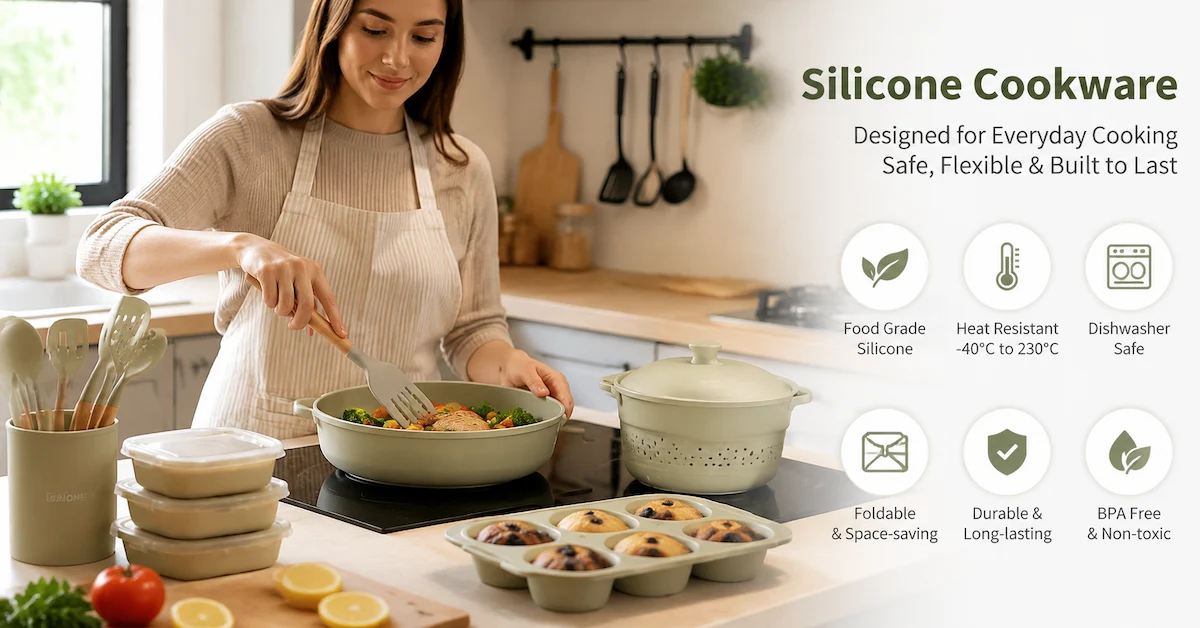
In this guide, “silicone cookware” is used in the broader B2B sourcing sense to cover silicone products used for food preparation, baking, storage, serving, and related kitchen applications.
Typical categories include:
- Silicone baking molds
- Silicone cake and muffin molds
- Silicone food containers
- Foldable lunch boxes
- Silicone kitchen tools
- Silicone storage accessories
- Custom molded kitchenware
Leadonex's current Kitchenware & Molds section prominently includes silicone cake molds, food containers, and multiple foldable lunch box designs. For buyers developing proprietary products, Leadonex also provides custom silicone manufacturing covering product design, mold development, molding, branding, and packaging.
For B2B buyers, the real question is therefore not simply:
“Which silicone cookware product should I buy?”
It is:
“Which product, material, manufacturing process, compliance plan, and supplier model will work for my target market?”
Who Should Use This Silicone Cookware B2B Guide?
This guide is primarily written for commercial buyers rather than individual household consumers.
Kitchenware Brands
Brands normally need more than a standard catalog item. Their priorities often include:
- Custom Pantone colors
- Proprietary shapes
- Brand logos
- Retail-ready packaging
- Stable repeat-order quality
- New mold development
- Market-specific food-contact documentation
Importers and Distributors
Importers and distributors generally focus on:
- Product breadth
- Stable bulk supply
- Compliance documentation
- Consistent specifications
- Shipping efficiency
- Replacement and repeat-order availability
- Competitive total landed cost
Wholesalers
Wholesalers frequently prefer products that can serve multiple retail channels without excessive complexity.
Their priorities may include:
- Proven product structures
- Multiple color options
- Practical packaging
- Reasonable order quantities
- Fast replenishment
- Consistent production
Private Label and E-Commerce Brands
Amazon sellers, online kitchenware brands, and other private label businesses usually need stronger product differentiation.
That may involve:
- Exclusive color combinations
- Logo customization
- Product bundles
- Retail packaging
- Gift sets
- New product structures
- Smaller initial market tests followed by larger repeat orders
Product Managers and Product Designers
For development-driven projects, the buyer may have only:
- A sketch
- Reference sample
- 2D drawing
- 3D file
- Functional idea
- Existing product requiring improvement
In this situation, supplier engineering and tooling capability become more important than catalog size.
If you already have a concept rather than a finished product, the Leadonex customization service is the more relevant starting point.
Which Silicone Cookware Products Make Sense for B2B Product Lines?
A successful product range should be built around use scenarios and buyer demand, not around adding as many SKUs as possible.
| Product Category | Main Selling Point | Typical Channel | Customization Potential |
|---|---|---|---|
| Silicone baking molds | Flexible release and varied shapes | Baking brands, retailers, e-commerce | High |
| Cake and muffin molds | Multiple cavity and shape options | Baking stores, private labels | High |
| Silicone food containers | Reusable food storage | Retail, supermarket, online | High |
| Foldable lunch boxes | Space-saving portability | Office, travel, outdoor retail | High |
| Silicone kitchen tools | Daily cooking applications | Kitchenware distributors | High |
| Custom molded cookware | Product differentiation | Brands and OEM projects | Very high |
Silicone Baking Molds
Baking molds are particularly suitable for B2B customization because shape itself can become a product differentiator.
A buyer can potentially customize:
- Overall dimensions
- Number of cavities
- Cavity geometry
- Wall thickness
- Surface texture
- Color
- Branding
- Packaging
This makes baking molds attractive to baking brands, kitchenware retailers, promotional product businesses, and private label sellers.
Explore Leadonex's silicone kitchenware and molds for existing product directions.
Silicone Food Containers
Food containers address a different purchasing need: storage, portability, reuse, and space efficiency.
Foldable designs can be relevant for:
- Meal preparation
- Office lunches
- Student meals
- Refrigerator storage
- Travel
- Camping
- Small kitchens
From a B2B perspective, buyers should evaluate more than visual appearance. Lid fit, folding structure, wall thickness, stability, odor control, ease of cleaning, packaging volume, and repeated-use performance can all affect customer satisfaction.
Custom Silicone Kitchen Products
A custom project becomes more relevant when an existing product cannot deliver enough differentiation.
For example, a brand may require:
- A proprietary cavity layout
- A specific storage volume
- A unique folding mechanism
- A branded surface texture
- A particular handle geometry
- A multi-color product
- Custom retail packaging
This is where supplier capability shifts from simple product supply to OEM/ODM development.
Food-Grade Silicone: What B2B Buyers Should Actually Verify
“Food grade” should never be treated as a marketing phrase alone.
For professional silicone cookware B2B sourcing, buyers should verify the material and finished-product requirements relevant to the intended market and use conditions.
U.S. Market Considerations
The U.S. Food and Drug Administration regulates substances used in food-contact applications. FDA requirements depend on factors including the substance, intended use, and conditions of use.
Buyers selling into the United States should therefore avoid relying only on a supplier saying:
“This material is FDA approved.”
Instead, request appropriate documentation and confirm that the material and intended application are covered by the applicable requirements.
The official FDA Food Contact Substances resources provide information for assessing food-contact materials.
European Market Considerations
For products placed on the EU market, food-contact material requirements need to be evaluated against applicable European rules.
The European Commission's Food Contact Materials guidance explains the general regulatory framework.
For kitchenware specifically, the European Union Reference Laboratory for Food Contact Materials also publishes testing conditions for kitchenware, including silicone and rubber articles.
For B2B buyers, this means compliance planning should begin before mass production, not after the products arrive at the destination market.
What Material Specifications Should Buyers Define?
Different silicone cookware products may require different material properties.
Important purchasing variables can include:
| Specification | Why It Matters |
| Silicone type | Influences processing method and product design |
| Hardness | Affects flexibility, rigidity, and handling |
| Tensile strength | Relevant to mechanical durability |
| Tear strength | Important for thin edges and repeated flexing |
| Temperature requirement | Depends on the intended use |
| Color | Important for brand consistency |
| Food-contact requirement | Depends on target market |
| Odor requirement | Important for consumer acceptance |
| Surface finish | Influences appearance and cleaning |
Leadonex states that its engineers can recommend liquid silicone rubber or solid silicone according to product requirements and can develop materials around properties such as tensile strength, tear strength, and applicable food-contact standards.
Its customization information also lists a general silicone operating range of approximately -40°C to +230°C. However, professional buyers should confirm the actual specification for the exact material formulation and finished product rather than applying one generic temperature claim to every SKU.
LSR vs Compression Molding for Silicone Cookware
The manufacturing process should follow the product design rather than the other way around.
Silicone Compression Molding
Compression molding is commonly relevant to solid silicone products with relatively straightforward molded structures.
Potential advantages include:
- Mature processing
- Flexible tooling options
- Suitability for many kitchenware shapes
- Practical economics for many molded products
It can be relevant for products such as molds, mats, plates, containers, and other solid silicone kitchenware depending on design.
Liquid Silicone Rubber Molding
Liquid Silicone Rubber, or LSR, is more appropriate for certain high-precision or complex products.
It can offer advantages when buyers require:
- High repeatability
- Complex geometry
- Controlled molding
- Fine features
- Consistent high-volume production
Which Process Is Better?
Neither process is universally better.
| Buyer Requirement | Likely Direction |
| Conventional solid silicone mold | Compression molding |
| Complex precision geometry | Consider LSR |
| Tight dimensional consistency | Consider LSR |
| Cost-sensitive simple molded item | Evaluate compression molding |
| High-volume automated project | Evaluate LSR |
| Existing proven product | Match existing validated process |
Leadonex lists silicone rubber compression molding, LSR molding, precision co-injection drip molding, and additional silicone processing capabilities within its custom manufacturing services.
The correct decision should be made after evaluating geometry, tolerance, expected annual quantity, tooling investment, material requirements, and target cost.
How Does Custom Silicone Cookware Move from Idea to Production?
A capable OEM partner should have a defined development workflow.
A typical project can move through the following stages.
1. Product Requirement Definition
The buyer should define:
- Intended application
- Target market
- Dimensions
- Material
- Hardness
- Color
- Functional requirements
- Expected quantity
- Compliance requirements
- Packaging
- Target launch date
2. Design and Engineering Review
The manufacturer evaluates whether the design is practical for silicone molding.
Possible adjustments may involve:
- Wall thickness
- Draft
- Parting lines
- Structural support
- Product flexibility
- Mold cavities
- Demolding
- Logo position
3. Prototype or Sample Development
Samples allow both parties to evaluate:
- Size
- Appearance
- Function
- Flexibility
- Color
- Assembly
- Packaging compatibility
This stage is especially important for completely new products.
4. Mold and Tooling Development
For proprietary silicone cookware, new tooling may be required.
Important questions include:
- How many cavities are needed?
- What production volume is expected?
- Who owns the tooling?
- How are tooling modifications handled?
- How is the mold maintained?
- How are approved dimensions controlled?
5. Silicone Molding
After material and tooling approval, the product moves into the selected molding process.
6. Post-Processing and Branding
Depending on product design, this may include:
- Trimming
- Surface finishing
- Secondary curing
- Printing
- Laser marking
- Molded branding
- Assembly
Leadonex's published production process states that some inspected products undergo secondary curing for approximately 2–4 hours, while certain LSR products may use different processing requirements.
7. Final Inspection and Packaging
The finished product should be inspected against the approved specification before packing and shipment.
What Should Silicone Cookware Quality Control Include?
For B2B purchasing, sample quality is not enough. The more important issue is whether bulk production consistently matches the approved standard.
A practical QC plan can include:
Incoming Material Control
Check:
- Raw material specification
- Batch information
- Color formulation
- Required documentation
In-Process Inspection
Monitor:
- Dimensions
- Shape
- Surface quality
- Color consistency
- Bubbles
- Flash
- Deformation
- Incomplete molding
Functional Inspection
Depending on the product, test:
- Lid fit
- Folding performance
- Suction
- Flexibility
- Tear resistance
- Stability
- Assembly
Final Product Inspection
Before shipment, confirm:
- Appearance
- Quantity
- Packaging
- Labels
- Carton marks
- Product specification
- Buyer-approved reference sample
Leadonex states that its custom production system includes initial QC, post-processing, final quality control, packaging inspection, and dedicated quality teams.
Certifications and Documentation: What Should Buyers Ask For?
A common purchasing mistake is assuming that one certificate automatically covers every product, material, factory, and destination market.
These are separate issues.
Buyers may need to distinguish between:
Factory Management Certifications
These evaluate management or social/compliance systems.
Leadonex currently lists certifications or audits including:
- ISO 9001
- ISO 14001
- BSCI
- SEDEX
- SA8000
- BRC
The exact scope and current validity should be confirmed from the certificate itself before being used in a buyer's compliance file.
Material or Product Testing
Depending on the project, buyers may ask about requirements related to:
- FDA food-contact requirements
- LFGB-related testing
- REACH
- RoHS
- Phthalates
- PAHs
- Migration testing
The safest procurement approach is simple:
Define the target country first, then define the required test and documentation plan.
Do not build the product first and ask about compliance later.
What Determines Silicone Cookware B2B Cost?
There is no reliable universal price per silicone cookware item because cost is influenced by the complete project structure.
Material
Material formulation and required compliance can influence cost.
Product Weight
More silicone generally means higher material consumption.
Product Complexity
Complex geometry can increase:
- Engineering work
- Mold complexity
- Processing difficulty
- Inspection requirements
Tooling
A completely new product may require upfront mold investment.
Tooling cost may depend on:
- Product dimensions
- Number of cavities
- Mold complexity
- Precision
- Expected production volume
Quantity
Higher order quantities can distribute tooling, production setup, printing, and packaging costs over more units.
Branding
Logo options may include:
- Molded logo
- Embossed or debossed logo
- Printing
- Laser marking
- Other secondary processes
Packaging
Packaging can range from basic bulk packing to:
- OPP bags
- Sleeves
- Color boxes
- Gift boxes
- Custom inserts
- Retail-ready sets
The best B2B purchasing decision should therefore evaluate total landed and commercialization cost, not factory unit price alone.
Common Silicone Cookware Sourcing Risks
Low-price sourcing can become expensive if major risks are not controlled before production.
Risk 1: Material Does Not Match the Target Market
Problem: The material may not meet the intended food-contact requirement.
Prevention: Define the market and required documentation before sampling.
Risk 2: Bulk Color Does Not Match Approved Samples
Problem: Color inconsistency can damage a private label product line.
Prevention: Use defined Pantone references and approved production standards.
Risk 3: Product Deformation
Problem: Incorrect material, wall thickness, curing, or molding conditions may affect shape.
Prevention: Validate samples and functional requirements before production.
Risk 4: Silicone Odor
Problem: Odor complaints can lead to poor consumer reviews.
Prevention: Review raw material, curing, post-curing, storage, and packaging conditions with the manufacturer.
Risk 5: Packaging Problems
Problem: A good silicone product can still fail commercially because of weak packaging, incorrect labels, or oversized shipping volume.
Prevention: Approve packaging together with the product rather than treating it as the final step.
Risk 6: Supplier Cannot Scale
Problem: A supplier may successfully make samples but struggle with larger repeat orders.
Prevention: Evaluate factory equipment, quality systems, production planning, tooling capability, and capacity before committing to a long-term product line.
How to Evaluate a Silicone Cookware B2B Supplier
A useful supplier evaluation should cover more than quotations.
| Evaluation Area | Questions to Ask |
| Manufacturing | Which processes are done in-house? |
| Materials | Can material documentation be supplied? |
| Tooling | Can you develop and maintain custom molds? |
| Engineering | Can you review 2D/3D designs? |
| Sampling | How are prototypes approved? |
| QC | Which defects and dimensions are inspected? |
| Compliance | Can testing be arranged for my market? |
| Branding | Which logo processes are available? |
| Packaging | Can you provide private label packaging? |
| Capacity | Can production scale with repeat orders? |
| Communication | Who manages engineering and production changes? |
| Traceability | How are specifications and revisions controlled? |
A low quotation should not compensate for weak engineering, unclear documentation, inconsistent QC, or limited communication.
Why OEM/ODM Matters for Silicone Cookware Brands
Standard wholesale products are suitable when the goal is speed and relatively low development complexity.
OEM/ODM becomes more valuable when the goal is product differentiation.
Leadonex supports customization involving:
- Material
- Size
- Structure
- Shape
- Function
- Pantone colors
- Logos
- Printing
- Labels
- Packaging
- New molds
The company also describes a process covering concept development, 3D structure, material selection, prototyping, mold development, molding, inspection, post-processing, branding, packaging, and shipment.
Its overall factory information lists approximately 15,300 m² of factory space, 135 employees, and daily capacity of up to 38,000 sets across its production operations. These figures should be treated as factory-level capability rather than a guaranteed capacity for one individual cookware SKU.
Learn more about the company's manufacturing background on the Leadonex About Us page.
How to Get a More Accurate Silicone Cookware B2B Quote
The quality of a quotation depends heavily on the quality of the information provided by the buyer.
Before requesting pricing, prepare:
- Product name or reference image
- 2D or 3D drawings if available
- Product dimensions
- Target silicone material
- Required hardness if known
- Pantone color
- Logo method
- Packaging requirement
- Estimated initial order quantity
- Estimated annual quantity
- Target country or market
- Required testing or documentation
- Target delivery date
A vague inquiry such as:
“How much is a silicone lunch box?”
cannot produce a reliable OEM quotation.
A better inquiry is:
“We need a 1,200 ml collapsible food container for the EU market, custom Pantone color, embossed logo, color-box packaging, initial quantity 5,000 units, with applicable food-contact testing requirements.”
The second inquiry gives the manufacturer enough information to evaluate material, production, tooling, packaging, compliance, and commercial feasibility.
To discuss a project, buyers can contact Leadonex with their product specifications and target market.
FAQ About Silicone Cookware B2B Sourcing
1. What products are normally included in silicone cookware B2B sourcing?
Typical products include silicone baking molds, cake molds, food containers, foldable lunch boxes, kitchen tools, storage accessories, and custom molded kitchenware.
2. Can silicone cookware be private labeled?
Yes. Depending on the product and manufacturing process, private label projects can include custom colors, molded or printed logos, labels, product combinations, and retail packaging.
3. Is all silicone automatically food grade?
No. Buyers should verify the specific material, intended food-contact application, use conditions, target market, and supporting documentation rather than assuming every silicone formulation is suitable for food contact.
4. Should I ask for FDA or LFGB documentation?
That depends on the target market and product. U.S. and European requirements are different, so compliance specifications should be defined before production.
5. What is the MOQ for custom silicone cookware?
There is no single MOQ that applies to every silicone cookware project. MOQ depends on product size, molding method, material, colors, tooling, printing, packaging, and production efficiency. Buyers should request a project-specific quotation.
6. Do I need a new mold for OEM silicone cookware?
Not always. Existing products can often be customized with color, logo, or packaging. A new mold is normally required when you change core dimensions, geometry, functions, cavities, or product structure.
7. What information should I send for a custom silicone cookware quotation?
Send drawings or reference images, dimensions, material requirements, color, logo, packaging, quantity, target market, testing requirements, and expected schedule.
8. What is the difference between OEM and ODM silicone cookware?
OEM normally follows a buyer's existing design or specification. ODM involves more product-development support, such as concept evaluation, structure design, material selection, prototyping, and mold development.
9. How can I reduce sourcing risks before bulk production?
Approve material requirements, drawings, colors, samples, functional tests, packaging, compliance documentation, and inspection criteria before mass production. Keep an approved reference sample for comparison with bulk goods.
10. How should I choose a silicone cookware B2B supplier?
Evaluate engineering capability, silicone molding processes, tooling, materials, compliance support, QC procedures, customization, capacity, communication, and repeat-order reliability—not only price.
Conclusion
Successful silicone cookware B2B sourcing requires much more than choosing an attractive product and negotiating the lowest unit price.
Professional buyers should evaluate the entire commercialization chain:
Product positioning → material → design → molding → tooling → compliance → sampling → QC → branding → packaging → bulk production → delivery.
For standard products, existing silicone cookware and kitchenware designs can reduce development complexity and shorten the path to market. For brands that need stronger differentiation, OEM/ODM development can create proprietary structures, colors, logos, packaging, and molds.
Leadonex provides food-grade silicone product manufacturing together with product development, compression and LSR molding, mold development, quality inspection, branding, and private label packaging support.
Explore the Leadonex product range, review its custom silicone manufacturing capabilities, or contact Leadonex with your drawings, product concept, estimated quantity, target market, and packaging requirements to evaluate your next silicone cookware B2B project.