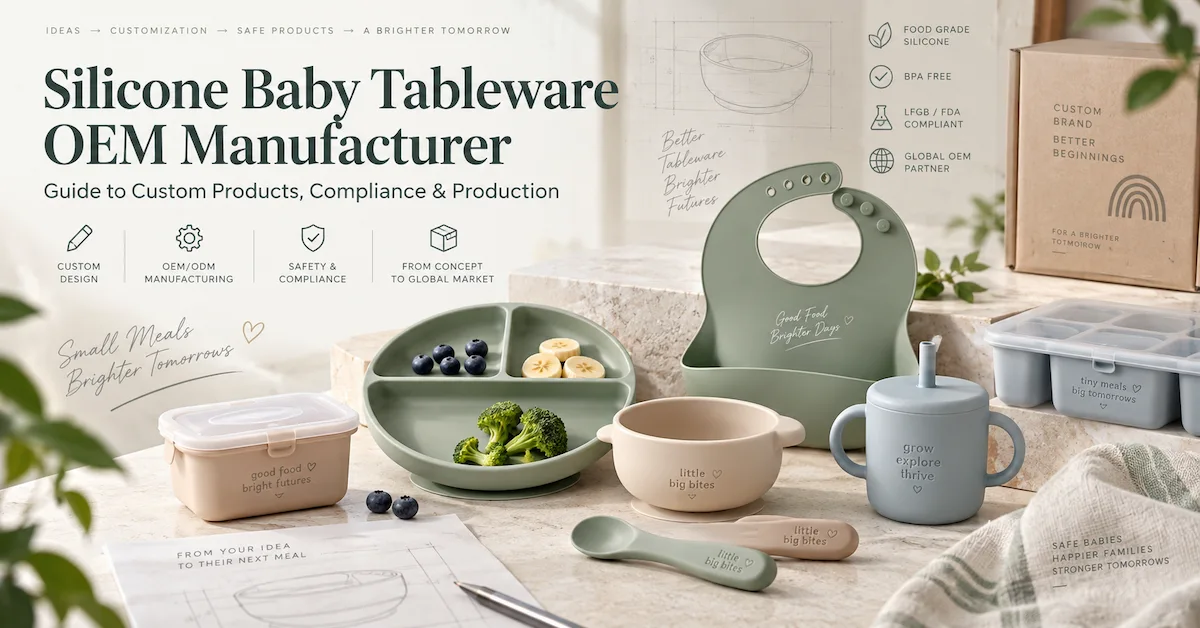

What does a silicone baby tableware OEM manufacturer need to prove?
A silicone baby tableware OEM manufacturer is expected to do more than mold a bowl or print a logo. For a brand owner, the supplier must connect four decisions: what the child will use, what material will touch food, how the part will be manufactured, and what evidence the importer can keep for its market. This is why a product-line approval is more reliable than approving one attractive sample in isolation.
The buyer question behind this article is specific: How should a baby-product brand qualify an OEM partner before approving samples, paying for tooling, and placing a production order? That is a supplier-comparison and RFQ question. The answer requires an auditable workflow, not a list of generic advantages about silicone.
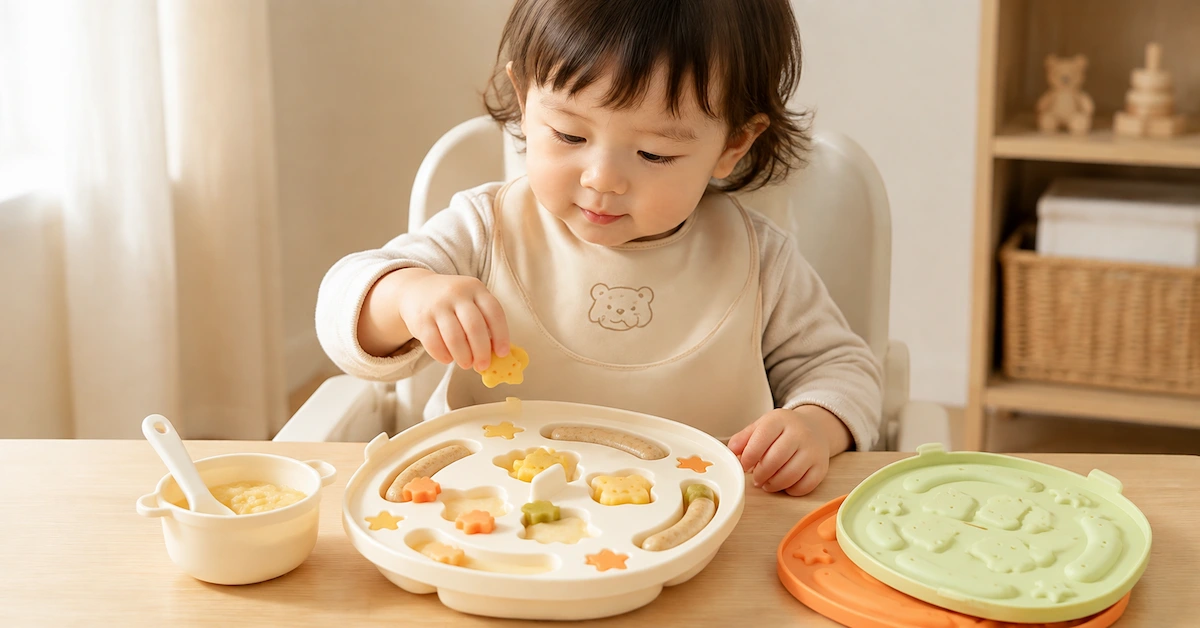
Use the guide when you are sourcing a divided plate, suction bowl, training cup, spoon, bib, food storage container, or feeding set. It also applies when you plan to combine several items under one private-label range and need to keep colors, packaging, age guidance, and claims consistent.
The four layers of proof
| Layer | Buyer decision | Evidence to keep |
|---|---|---|
| Product | Does the design work for the intended age, food, surface, and cleaning routine? | Approved sample, drawing, dimensions, photos, revision number, and use notes |
| Material | Is the material and food-contact evidence appropriate for the destination market? | Material description, SKU-specific reports, declarations, and any requested grade |
| Process | Can the factory repeat the approved part at production scale? | Tooling review, first-article record, inspection plan, defect standard, and change control |
| Commercial | Can the item arrive, be labeled, and be sold without avoidable packaging or documentation risk? | Packaging dieline, carton data, labeling checklist, packing photos, and shipping documents |
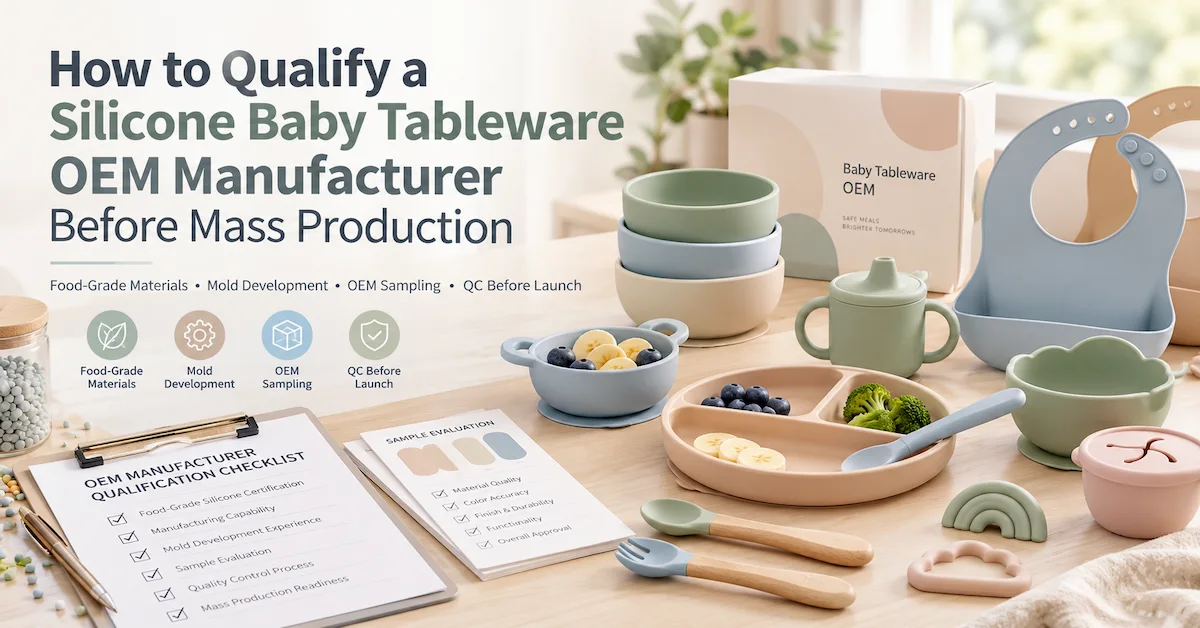
Step 1: Define the product line before comparing factories
Many RFQs fail because the buyer asks for “a silicone baby feeding set” without specifying what the set must do. The manufacturer then prices a different component mix, assumes different dimensions, or compares a standard item with a custom design. Start with the product line and its use case before requesting a quote.
Build a component-level matrix
Separate each item even when you intend to sell it as a set. A suction plate has different functional risks from a spoon. A lid introduces a fit and sealing question that a simple bowl does not. A bib needs a different cleaning and comfort review. A food storage container adds capacity, lid, and temperature-use decisions.
| Component | Questions for the product brief | Approval evidence |
|---|---|---|
| Divided plate | How many compartments, what portion geometry, what surface is the base intended for, and is a lid included? | Top and side dimensions, compartment layout, base behavior, lid fit, and cleaning review |
| Suction bowl | What foods, serving volume, rim shape, and table surfaces are expected? | Sample on the intended surface, rim inspection, dimensional check, and user-scenario notes |
| Training cup | Does the buyer need handles, a straw, a lid, or a spill-control feature? | Component fit, drinking flow, handle comfort, lid engagement, and cleaning access |
| Spoon or fork | What head size, handle length, softness, and age positioning are required? | Edge and tip review, dimensions, weight, grip, and age guidance review |
| Bib | What neck adjustment, pocket depth, folding behavior, and wipe-clean expectation apply? | Fastening sample, comfort review, material finish, and care instructions |
| Storage container | What capacity, lid style, stacking need, and home or travel environment apply? | Capacity measurement, lid fit, leakage observation, and temperature-use confirmation |
Use a clear market and age definition
“Baby” is not a complete technical specification. The buyer should state the intended age range, feeding stage, market, language requirements, and selling channel. A product sold through a specialist baby retailer may require a more detailed evidence pack than a promotional item, while a product sold across several countries may need separate labeling and food-contact reviews.
Also define the actual environments: high-chair tray, smooth dining table, daycare, travel bag, refrigerator, freezer, microwave, or hand-washing only. Do not assume that a material range printed on one product page automatically applies to every item in a proposed collection. Confirm the statement for each SKU, construction, and market.
Step 2: Verify material and food-contact evidence by SKU
“Food-grade silicone” is a useful starting description, but it is not a complete approval decision. A buyer should request the exact material description, applicable market standard, report scope, sample or model reference, date, and laboratory details. The evidence needs to match the product that will be shipped, including pigments, coatings, printed areas, lids, inserts, and any multi-material component.
What the published Leadonex pages show
Leadonex positions itself as a food-grade silicone product OEM/ODM manufacturer. Its published baby product pages use food-grade silicone wording and, on selected items, state FDA-standard wording or that LFGB is available upon custom request. For example, the published silicone baby suction plate with spoon holder lists food-grade silicone, FDA-standard wording, an optional LFGB request, a stated temperature range of -40°C to 230°C, a 24 cm by 20.5 cm plate size, and a 13.8 cm by 3.4 cm spoon size. Those details are product-page evidence for that listed model; they should not be copied as universal specifications for every future design.
The published silicone baby food storage container page lists a 120 ml capacity, food-grade silicone, FDA-standard wording, BPA-free wording, a stated temperature range of -40°C to 230°C, and microwave, refrigerator, and freezer use. Again, the buyer should verify the final lid construction, color, size, and report scope before placing an order.
| Evidence request | Why it matters for a baby tableware RFQ | Do not assume |
|---|---|---|
| Material name and grade for each component | Confirms that a plate, lid, spoon, valve, or insert is included in the intended specification. | One material statement covers every SKU or accessory. |
| Applicable food-contact or market report | Connects the evidence to the destination market and product configuration. | “FDA” or “LFGB” in a product description is the same as a current report for your final item. |
| Color and pigment confirmation | Supports color consistency and checks whether the tested construction matches the ordered colorway. | All colors have identical test scope without written confirmation. |
| Temperature-use statement | Helps align microwave, refrigerator, freezer, serving, and care instructions with the actual item. | A range printed for one product automatically applies to the entire collection. |
| Revision and sample reference | Prevents a report for an older mold or different shape being used for the production item. | The latest sample and the report are the same version without traceable references. |
Important distinction: The website lists selected certifications and reports, including ISO9001, BSCI, and an FDA test report on several product pages. Public pages do not provide every certificate number, expiry date, report file, product scope, or applicable market. Request current copies and confirm their scope during your own approval process.
Step 3: Approve the sample as a working product, not a photo
A sample approval should answer the question: “Would our team accept this exact construction for production?” A product photograph cannot show suction behavior, edge comfort, lid engagement, cleaning access, odor, dimensional tolerance, or how the item behaves after repeated handling. Build a written sample protocol and record the result against a sample revision.
Check function at the point of use
- Surface interaction: Test a suction plate or bowl on the surfaces that match the intended use. Record whether the base engages, how easily an adult can release it, and whether crumbs, moisture, texture, or a tray edge changes the result. Treat “suction base” as a design feature, not a promise that no child can move the item.
- Geometry: Measure the outside dimensions, compartment dimensions, rim height, base thickness, lid fit, handle spacing, and spoon or fork length. Compare the results with the approved drawing rather than a visual impression.
- Edges and transitions: Inspect the rim, corners, divider walls, spoon head, handle junctions, and any logo or textured area. The objective is a smooth, cleanable surface with no unexpected flash, sharp transition, exposed insert, or difficult-to-clean recess.
- Fit and closure: For lids, cups, and storage containers, check alignment, opening force, seal engagement, vent or straw fit if present, and cleaning access. A lid that closes in a studio sample may still be difficult for a caregiver to use one-handed.
- Cleaning: Run the intended hand-washing or dishwasher review if the product will be sold with that instruction. Note trapped food, staining, drying time, and whether the logo or surface finish changes. Do not publish a cleaning claim until the final care instruction is decided.
- Handling: Weigh the item, check stackability, observe how it fits into the proposed packaging, and review whether a child or caregiver can hold it comfortably. Weight and footprint affect shipping, shelf presentation, and parent experience.
Use product-page specifications as a starting record
Leadonex publishes concrete specifications for selected baby tableware models. The suction plate with spoon holder lists a plate net weight of 252 g and spoon net weight of 19 g. The five-compartment suction plate with lid lists a 22.5 cm by 17.5 cm by 4 cm size and 670 g net weight. The bear suction bowl with lid lists a 16 cm by 11.6 cm footprint, a 5 cm height, a 143 g bowl weight, and an 81 g lid weight. These are useful starting points for a buyer comparison sheet, but the final approved sample should control the purchase order.
Other published models show how a product line can be segmented: a frog-shaped plate is listed with three compartments and a 21 cm by 18 cm by 3.2 cm size; a four-compartment divided plate is listed as liquid silicone with a 23.5 cm by 17 cm by 4 cm size; and an eight-piece feeding set combines a bib, divided plate, suction bowl, straw cup, spoon and fork, and training utensils. The set description identifies the published components, but it does not prove that every component has identical material, test, or packaging documentation. Request a component-level evidence pack.
Step 4: Review the OEM/ODM workflow before approving tooling
The difference between a useful silicone baby tableware OEM manufacturer and a trading contact is often visible in the handoff between design, sample, tooling, production, and inspection. The published Leadonex OEM/ODM workflow has six stages: requirement analysis, design and development, sample making, mass production, quality inspection, and delivery service. Use that public workflow as a discussion framework, then ask what document is created at each stage.
| Published workflow stage | Buyer should request | Approval gate |
|---|---|---|
| Requirement analysis | Written product brief, destination market, target user, component list, color, logo, packaging, and evidence requirements | Both sides agree on the same RFQ baseline |
| Design and development | Dimensioned drawing or 3D file, material proposal, structure review, and design-for-molding questions | Design is feasible and the commercial specification is complete |
| Sample making | Sample revision, measurement record, function notes, and changes from the original brief | Buyer signs one clearly identified sample version |
| Mass production | Tooling status, approved color reference, production plan, and change-control contact | Only the approved construction and artwork enter production |
| Quality inspection | Inspection standard, sampling plan, defect photos, material checks, and final report | Release criteria are written before shipment |
| Delivery service | Packing list, carton information, shipping documents, and after-sales escalation route | Goods and documents match the order |
Ask what “custom” includes
Leadonex’s customization pages describe support for material, size, structure, shape, function, color, logo, pattern, packaging, and labels. That breadth is relevant to private-label sourcing, but “customization available” still needs to be translated into an itemized quotation. Ask whether each requested change affects a new mold, an insert, a printing step, a color development, a packaging plate, or only an existing standard option.
The same principle applies to manufacturing methods. Leadonex publicly lists silicone compression molding, LSR molding, precision co-injection drip molding, and silicone fabric coating and curing on its customization information. The correct process depends on the design, material, geometry, and volume. Ask the engineering contact to explain which process is proposed for each component, where the parting line will be, how flash will be controlled, and what inspection points matter most.
Before paying for tooling, clarify ownership, storage, maintenance, modification approval, cavity count, expected replacement conditions, and what happens if the product is revised. These are commercial controls that protect the buyer from approving a beautiful sample without controlling the production version.
Step 5: Audit quality control with records you can use
Quality language becomes meaningful when it is tied to a record. Leadonex’s public service information describes raw-material testing, dimensional measurement, physical-performance testing, environmental aging testing, and full-process inspection from raw material to finished product. During supplier qualification, ask how those activities are applied to your SKU and what report the buyer receives.
Use four inspection points
| Inspection point | What to inspect | Record that reduces dispute risk |
|---|---|---|
| Incoming material | Material identity, color compound, packaging labels, and lot traceability | Material or incoming inspection record tied to a lot |
| First article | Dimensions, weight, flash, surface, color, fit, and function against the approved sample | First-article checklist with photos and revision number |
| In-process | Critical dimensions, molding appearance, parting line, inserts, assembly, and logo placement | Process inspection frequency and nonconformance record |
| Final release | Quantity, appearance, packaging, labels, carton marks, and agreed sampling criteria | Final inspection report and packing photos before shipment |
Define defects before production. A buyer should distinguish critical, major, and minor issues for the actual product: exposed sharp flash, an incomplete lid seal, a missing compartment wall, a wrong color, a visible logo error, a packaging mismatch, and a small cosmetic mark do not have the same commercial impact. The factory and buyer should use the same photos, samples, and written limits.
Do not turn a supplier’s general quality statement into a guaranteed defect rate. Do not publish a test result unless it belongs to the final product, market, material, and revision. A good RFQ asks for the evidence required; a good approval file shows which evidence was received and accepted.
Step 6: Compare packaging, labels, and retail readiness
Packaging is part of the product specification because it protects the item, communicates the brand, and can change the total landed cost. Several Leadonex baby product pages show a default single OPP bag and state that a custom color box can be requested. That gives the buyer a clear starting point for an RFQ: compare the default packing with the retail package, then confirm the quantity per inner carton, carton dimensions, protective inserts, artwork, and labeling responsibilities.
Packaging questions for the approval file
- Does the package protect suction bases, lids, handles, and soft edges from deformation during transport?
- Does each SKU have the correct product name, color, quantity, barcode, country-of-origin information, and importer details required by the destination market?
- Are age guidance, care instructions, temperature-use statements, and warnings supported by the final product evidence?
- Does the packaging artwork describe a standard item, a custom item, or a feeding-set combination? The contents must match.
- Has the final box, bag, insert, and carton mark been approved against the same product revision as the sample?
Keep marketing language conservative. “Food-grade silicone,” “BPA-free,” “microwave safe,” or “easy to clean” should be used only when the claim is supported for the exact product and market. A product page may show a claim for a specific model; it should not be expanded to every item in a new collection without evidence.
Step 7: Use a buyer-side supplier comparison score
A quote comparison should separate technical readiness from price. Score each potential silicone baby tableware OEM manufacturer against the same criteria, and write down what is verified, what is promised, and what is still missing. The goal is not to create a false mathematical certainty. The goal is to keep a low price from hiding an incomplete product brief or a weak approval trail.
| Category | Suggested buyer question | Evidence status |
|---|---|---|
| Product fit | Can the supplier explain the use case, age positioning, dimensions, function, and limitations? | Confirmed / partial / missing |
| Material evidence | Can the supplier provide SKU-specific material and food-contact documentation? | Confirmed / partial / missing |
| Design and tooling | Are drawings, mold responsibilities, revisions, and process assumptions written down? | Confirmed / partial / missing |
| Sample control | Is the approved sample measurable, labeled, and linked to the quote and purchase order? | Confirmed / partial / missing |
| Quality records | Are incoming, first-article, in-process, and final inspection records available? | Confirmed / partial / missing |
| Packaging | Can the supplier match the retail pack, carton plan, labels, and artwork revision? | Confirmed / partial / missing |
| Communication | Is there one accountable contact for engineering changes, evidence, and shipment release? | Confirmed / partial / missing |
| Commercial clarity | Are tooling, color development, packaging, inspection, and shipping assumptions itemized? | Confirmed / partial / missing |
What is publicly verifiable about Leadonex?
For a fair supplier comparison, separate the company identity from the buyer’s own verification. The Leadonex website identifies the business as WUYI JUCHENG INDUSTRY AND TRADE CO.,LTD and positions it as a food-grade silicone product OEM/ODM manufacturer. The contact page lists No.2, Huangguo Road, Wuyi, Jinhua, Zhejiang, China. The company’s public OEM/ODM service describes support from requirements and design through samples, mass production, inspection, and delivery.
The customization page publicly states a factory area of 15,300 square meters, 135 employees, up to 38,000 sets per day, and nearly 100 million in annual output value, and it refers to more than 10,500 customized silicone projects. These are website claims with an undefined scope. They should be used as questions for verification, not converted into a guaranteed capacity for one baby tableware SKU or one production window.
The public website also lists quality or social-compliance references such as ISO9001, ISO14001, BSCI, SEDEX, BRC, FCCA, SA8000, and other standards or test references in different areas. The public pages do not provide every certificate number, expiry date, scope, or report file. The prudent buyer action is to request current documentation for the actual factory, product, material, and destination market.
Official fact: Leadonex publishes baby tableware models with product-level descriptions, dimensions, weights, temperature statements, packaging options, and selected certification or test references.
Buyer-side recommendation: Use those pages to create a starting RFQ and sample matrix, then obtain current SKU-specific reports, drawings, packaging proofs, and inspection records before final approval.
Not established by public pages alone: A universal MOQ, a guaranteed lead time, a guaranteed defect rate, a certificate validity period, a universal material grade for every SKU, or a guaranteed capacity allocation for your order.
What should a buyer include in the RFQ?
A useful RFQ makes it easier for a supplier to answer accurately and easier for the buyer to compare responses. Send one brief per SKU, then add a collection brief for the common elements. The following checklist can be copied into an inquiry email or sourcing form.
- Company and market: buyer company, destination country or countries, sales channel, target launch window, and importer or compliance contact.
- Product: item name, use case, intended age range, component list, reference photos or drawings, dimensions, capacity, weight target, and functional requirements.
- Material: requested silicone description or grade, color system, pigment limitations, food-contact evidence needed, and whether other materials are allowed.
- Customization: logo method, pattern, color references, surface finish, lid or insert requirements, packaging, labels, barcode, and instruction language.
- Approval: sample quantity, measurement method, testing responsibility, report scope, approval contact, revision-control method, and what constitutes a change.
- Order planning: target order quantity, annual demand estimate, assortment mix, replenishment pattern, delivery destination, and packing assumptions. Ask the supplier to state MOQ and lead time for the specific configuration instead of assuming a generic number.
- Commercial response: tooling, sampling, color development, packaging, inspection, payment, shipping, and other cost items shown separately.
If the supplier cannot answer the entire RFQ immediately, ask for a gap list. A clear “we need to confirm the report scope” is more useful than a vague statement that every requirement is available.
FAQ: silicone baby tableware OEM manufacturer qualification
What is the first question to ask an OEM manufacturer?
Ask whether the supplier can review a complete product brief by component and return a written response covering material, structure, tooling, sample, evidence, packaging, and production assumptions. This reveals whether the conversation is being handled as an engineered product or only as a catalog request.
Is food-grade silicone enough for a baby tableware approval?
No. It is a material description, not a complete market approval file. The buyer should match the final product, color, components, intended use, destination market, and applicable food-contact evidence. Ask for current documents that identify the sample or model under review.
Should I approve the sample before paying for the mold?
For a custom product, the buyer should agree on a design and tooling plan before authorizing production tooling, and then approve a clearly identified sample before mass production. The exact sequence depends on the mold and sampling arrangement. Put revision control, tooling ownership, modifications, and approval gates in writing.
Can one supplier handle a complete silicone feeding set?
It can be possible, but the buyer should verify each component separately. Leadonex publishes an eight-piece silicone baby feeding set with a bib, divided plate, suction bowl, straw cup, spoon and fork, and training utensils. That published set is evidence of a listed product configuration, not proof that every future set will use the same components, packaging, or evidence scope.
Does a suction base guarantee that a child cannot move a plate?
No. Suction performance depends on the surface, moisture, food residue, geometry, force, and user behavior. Approve the base for the intended environment and describe the feature accurately. Avoid an absolute no-spill or child-proof claim unless the destination-market evidence supports it.
What capacity information is publicly available?
Leadonex’s customization page states up to 38,000 sets per day and provides other factory figures, but the public page does not define the production mix or allocation for a specific baby tableware order. Treat these as published company claims to verify during the RFQ, not as a guaranteed production promise.
What should I do if a supplier shows certificates but not the reports?
Request the certificate or report files, number, issue date, expiry date where applicable, issuing body, factory address, product or material scope, and destination-market relevance. Keep the received document in the approval file and check that it matches the final construction and colorway.
Conclusion
Choosing a silicone baby tableware OEM manufacturer is a product-approval decision as much as a supplier decision. The strongest sourcing process starts with a component-level brief, verifies material and food-contact evidence, tests the sample in its intended environment, documents the tooling and revision path, and sets inspection and packaging gates before mass production.
Leadonex’s public website provides a useful starting point for this conversation: it presents the company as WUYI JUCHENG INDUSTRY AND TRADE CO.,LTD, publishes an OEM/ODM workflow, lists customization and molding capabilities, and shows product-level examples such as suction plates, bowls with lids, feeding sets, and food storage containers. The buyer should still request current, SKU-specific evidence for the final design and market.
Send the product brief, target market, component list, reference dimensions, material and evidence requirements, packaging direction, and expected order plan. That gives the manufacturer enough context to respond with a quote and an approval path that can be reviewed by purchasing, engineering, quality, and compliance teams.