
What does a silicone kids placemat OEM project include?
The short answer is a coordinated product, branding, evidence, and packaging program for a children's mealtime mat. OEM can mean manufacturing to a buyer's drawing, adapting an existing platform, or developing a new shape and tool. For an importer, baby-product brand, retailer, restaurant-supply distributor, or private-label team, the important issue is not the label used for the service. It is whether the supplier can state exactly what is being made, how it will be checked, and what will remain unchanged on the next order.
A placemat looks simple, but a few millimeters can change table coverage and pack fit. The underside can move on one table and stay stable on another, while a printed illustration may need a different approval after cleaning. These are specification questions, not decorative details.
| Project layer | Buyer must define | Supplier response should show |
|---|---|---|
| Product geometry | Finished length and width, corner treatment, edge profile, thickness target, flexibility, and any raised spill boundary. | Drawing or 3D review, critical dimensions, tolerances, and manufacturability comments. |
| Surface and grip | Top texture, underside texture, table types, wet or dry use, and acceptable movement. | Proposed texture or structure and a practical sample test method. |
| Decoration | Logo, artwork, print area, color reference, molded pattern, and child-contact restrictions. | Decoration route, artwork proof, decorated sample, and acceptance criteria. |
| Material and evidence | Target market, food-contact parts, colorants, coatings, accessories, and claims. | Material proposal and documents matched to the final configuration. |
| Retail presentation | Flat, rolled, or folded pack; box or sleeve; labels; barcode; language; and carton plan. | Pack-out drawing, packed sample, and variant-level packaging record. |
Leadonex's public customization page lists material, function, size, structure, shape, texture, color, logo, pattern, packaging, and labels as customization areas. That is a useful starting point for the RFQ. It is not a promise that every combination is available for every placemat without engineering review. A clear project brief lets the manufacturer separate a straightforward catalog adaptation from a new product development job.
How should the buyer set size and geometry?
Start with the table and use case, then specify the product. Do not copy a nominal size from another listing without measuring usable area, edge behavior, and package fit. A custom silicone kids placemat may sit under a plate, bowl, cup, and utensils; on a high-chair tray; on a restaurant table; or in a travel bag. Each context changes the balance between coverage, flexibility, storage, and retail presentation.
Define the finished footprint
Record overall length and width at the finished, relaxed state. If the shape has ears, tabs, pockets, raised borders, or an animal outline, define the measuring points. State whether the dimension includes the border or only the central dining area. For a round or cloud shape, identify the maximum width and the usable area. If the buyer needs the mat to fit a specific tray or shelf, provide the tray opening or shelf dimension as a reference.
Control thickness and flexibility
Thickness affects rollability, stiffness, edge curl, handling, and pack volume. Instead of asking for "thick" or "thin," state the intended behavior: lie flat after unpacking, roll into a sleeve, fold without a permanent crease, or resist movement when pulled. Confirm the measurement locations because one average reading may not describe a mat with a raised rim.
Review corners, edges, and raised features
Rounded corners reduce snagging, while a raised edge can contain small spills. Define any pocket opening and depth, and ask the supplier to identify draft, parting, flash, and cleaning implications before releasing the mold.
| Geometry field | Buyer wording to use | Sample acceptance question |
|---|---|---|
| Overall size | Dimensioned drawing with measuring points and relaxed-state condition. | Does the sample fit the target table, tray, or retail package? |
| Usable area | Area intended for plate, cup, utensils, and child's activity. | Does the artwork or dining zone remain clear in actual use? |
| Thickness | Target, tolerance, measurement location, and behavior requirement. | Does it roll, lie flat, and pack as expected? |
| Edge and corners | Radius, raised border, pocket, cutout, and cosmetic limits. | Are there sharp transitions, flash, edge curl, or residue traps? |
| Storage behavior | Flat, rolled, folded, nested, or supported during transport. | Does the product recover its intended form after the agreed storage test? |
Leadonex's catalog includes a silicone kids placemat and a cartoon silicone kids placemat. These pages do not prove universal dimensions, hardness, packaging, or print performance for a new OEM design.
How should a buyer evaluate grip and anti-slip behavior?
"Non-slip" is not a complete specification. A mat can feel stable on a dry smooth table and move on a textured, wet, dusty, or laminated surface. A child may also pull an exposed corner, lift the edge, or push a bowl across the top. The buyer should define the movement that matters and the surfaces that represent the real sales environment.
Specify the underside design
Possible design variables include a smooth contact surface, molded texture, ribs, dots, channels, a perimeter structure, or a locally reinforced edge. The choice affects contact area, cleaning, print or mold complexity, and how the mat behaves when rolled. Avoid choosing texture from a render alone. Ask for the actual underside sample and inspect whether particles or moisture can remain in the pattern.
Use a simple comparative test
For early development, compare the candidate mat with a retained reference on at least the table materials that matter to the business. Record dry and lightly wet conditions, the direction of the applied force, the load on top, and whether the edge lifts before the body moves. This is not a laboratory friction coefficient. It is a buyer acceptance test that makes the word "stable" observable. If the destination market or retailer requires a formal test, specify the method and laboratory separately.
| Grip question | What to record | Why it matters |
|---|---|---|
| Where will it be used? | Home table, high-chair tray, daycare table, restaurant table, travel surface, or other. | Surface material and contamination change movement. |
| What movement is unacceptable? | Sliding under a bowl, corner lift, rotation, edge curl, or full mat displacement. | A clear failure mode is easier to approve than a general "anti-slip" claim. |
| What is on top? | Plate, bowl, cup, utensils, food, or an empty mat. | Load and contact area change the result. |
| How will it be cleaned? | Wipe, hand wash, dishwasher process, or another declared method. | Residue and surface wear can alter later behavior. |
Do not publish a numerical anti-slip claim unless the final configuration has a matching method and result. For a silicone kids placemat OEM project, the practical goal is a documented design choice and a repeatable sample check, not an impressive adjective.
What printing and decoration route should be selected?
A printed placemat is a product with a decoration layer that needs its own controls. The right route depends on artwork size, surface texture, logo location, child-contact area, color count, expected cleaning, and the buyer's claim requirements. A printed silicone placemat manufacturer should be asked to show the method on the actual surface, not only on a flat paper proof.
Compare the decoration options
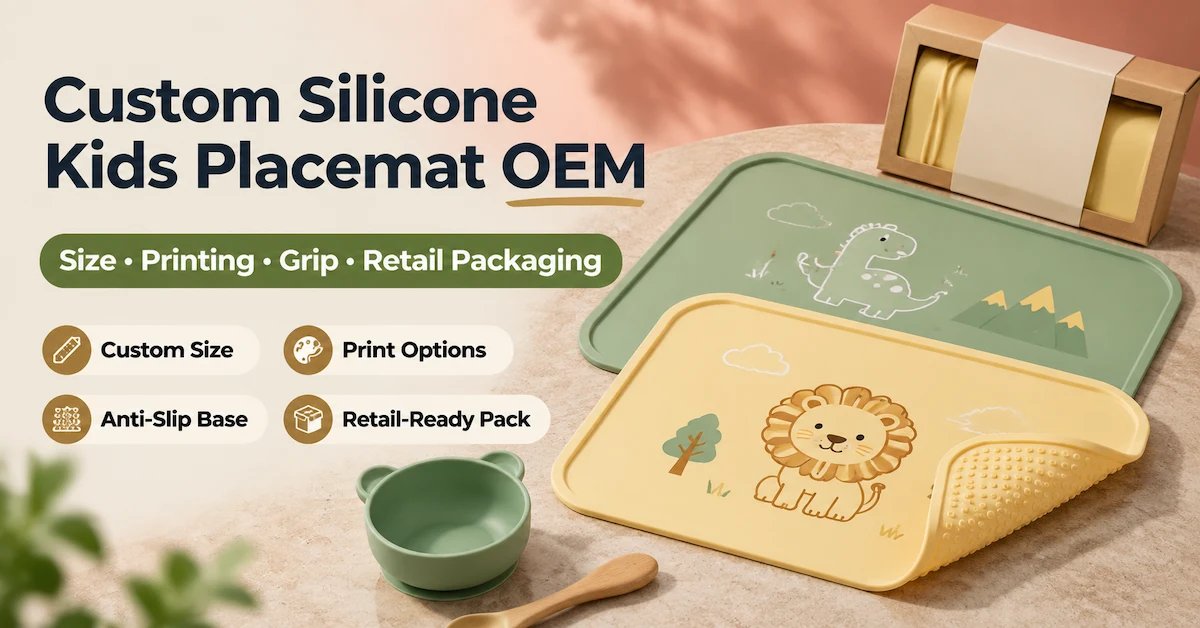
Screen printing can suit bold graphics and defined areas when the surface and ink system are compatible. Pad printing can reach selected curved or smaller areas but may not be the best answer for a large illustration. Embossing or debossing creates a molded brand element and avoids a separate printed layer, but it changes the tool and the visual character. A molded texture or pattern can support the design when the artwork is simple and the brand wants a durable tactile feature.
Identify whether decoration sits under food, beside a plate, on a child's hand-contact area, or only on the border. Request a decorated sample, define registration, color variation, edge quality, and acceptable wear, then test it using the intended care instructions.
| Decoration route | Useful when | Questions before approval |
|---|---|---|
| Screen or pad printing | Brand artwork needs a visible color or logo on a defined surface. | Which ink system, surface preparation, location, cleaning test, and contact evidence apply? |
| Embossed or debossed logo | Brand identity can be expressed through molded relief or recessed detail. | Does the tool change affect cleaning, edge quality, or readability at production scale? |
| Molded pattern | The design relies on a repeatable tactile or graphic feature in the silicone geometry. | Can the feature demold consistently and remain clear after cleaning? |
| Unprinted colorway | The brand can use color, shape, and package to create recognition. | What color reference and batch-to-batch visual tolerance will be approved? |
For a private label silicone placemat, artwork control should include the editable source file, color reference, placement drawing, revision number, and a photo or physical sample signed by the approver. Screen colors are not a sufficient production standard. Keep the decorated sample with the product golden sample so a later reorder is compared against the same reference.
What food-contact and child-use evidence should be requested?
Food-contact wording must match the final product, not just the silicone family. For a children's mat, identify the surface that may contact food, the pigments used for each color, any printed area, coatings, labels, inserts, or accessories, and the destination market. If the product is marketed for children, also define the use age, care instructions, warnings, and any retailer documentation requirements.
Leadonex's public information references ordinary silicone rubber, food-grade silicone rubber, medical silicone rubber, HTV solid silicone, and LSR liquid silicone rubber. Its public materials also reference FDA, LFGB, DGCCRF, RoHS-related wording, REACH, PAHs, and phthalates testing. These are website-level references and should be treated as a starting point for document review. They do not establish that every placemat, color, print, or package is covered by every listed reference.
| Evidence layer | Buyer question | Match it to | Do not assume |
|---|---|---|---|
| Material identity | What material route and grade are proposed? | Actual SKU, color, components, market, and intended use. | A generic material name proves the finished product claim. |
| Decoration | Is the print, pigment, or molded detail included? | Final artwork, color, location, contact condition, and care method. | The silicone body document automatically covers a print layer. |
| Finished product | Which sample or configuration does the report cover? | Dimensions, SKU, date, test method, result, and destination market. | A similar product is evidence for the new design. |
| Claim and label | Which wording can appear on the package or listing? | Market requirement, responsible party, evidence, and approved claim. | "Certified" can be used without scope, number, validity, or matching product. |
Ask the supplier to mark each document as available, to be arranged, not applicable, or requiring buyer confirmation. This prevents a visually approved product from relying on a report for an unprinted sample in another color.
How should retail packaging be engineered?
Packaging is part of the finished SKU. Flat, rolled, folded, or supported presentation changes shelf footprint, edge recovery, print visibility, and distortion risk. Sample the package with the exact product and artwork.
Flat, rolled, or folded presentation
Flat packaging protects shape but uses more shelf space. Rolled packaging requires a defined roll direction, diameter, sleeve method, and recovery check. Folded packaging requires an agreed crease location and recovery expectation; a raised edge or molded pocket may make folding unsuitable.
Label and carton controls
Record box or sleeve dimensions, language, barcode, care instructions, age guidance, brand marks, inner quantity, carton quantity, carton dimensions, protection, artwork ownership, and proof-change rules.
The official Leadonex customization information includes packaging and labels among the customization areas. The public site does not publish one universal placemat packing standard or carton configuration. Require a packed sample and written pack-out record before shipment.
How should the first sample be approved?
Sample approval should be a release gate with separate checks for product, function, decoration, evidence, and package. Do not approve a sample with a single sentence such as "looks good." That phrase does not tell production which dimensions, color, grip behavior, or artwork version is frozen.
| Sample gate | Practical check | Record to retain |
|---|---|---|
| Identity | SKU, drawing revision, color, material route, dimensions, and components match the RFQ. | Sample ID, date, photographs, drawing, and approver. |
| Geometry | Measure footprint, thickness locations, corner radius, raised features, and package fit. | Measurement method, values, tolerance, and deviations. |
| Grip | Compare dry and lightly wet conditions on representative table materials. | Surface, load, force direction, movement result, and acceptance decision. |
| Decoration | Inspect registration, color, edge quality, contact location, and cleaning result. | Artwork revision, decorated sample, defects allowed, and sign-off. |
| Evidence | Match documents and claims to the final color, print, components, and target market. | Document status, scope, test method, date, and owner. |
| Packaging | Pack the actual item and inspect recovery, protection, label, barcode, and carton fit. | Signed pack artwork, packed sample, and carton record. |
Keep one signed golden sample in the buyer's file and one agreed production reference with the supplier. Record any accepted deviation instead of relying on memory. If the artwork changes after the sample, update the revision number and decide whether the change affects material evidence, print testing, package labels, or a new sample.
What should a comparable OEM quotation include?
Send the same RFQ to each supplier and separate one-time and recurring costs. A plain stock mat is not comparable with a custom tool, printed artwork, retail sleeve, inspection, and market documents. Compare an approved, packed, repeatable SKU rather than the lowest visible unit price.
| Quote line | Ask the supplier to state | Why it matters |
|---|---|---|
| Product | Model, dimensions, material route, color, print, weight if used, and accepted variation. | Small specification changes can create a different cost and evidence scope. |
| Tooling | Existing mold, modification, new mold, cavity plan, revision, maintenance, and ownership terms. | A logo-only program and a new shape are different investments. |
| Sampling | Sample type, correction rounds, decoration, package sample, testing, and courier assumptions. | The first sample may not prove the final retail configuration. |
| Quantity | MOQ and price by shape, color, artwork, and package variant. | A large total order may still fragment into small variant quantities. |
| Evidence | Existing documents, new test scope, laboratory, responsibility, and cost. | Required evidence can otherwise appear after the quote is accepted. |
| Packaging | Unit pack, inner pack, carton, label, barcode, and protection. | Packaging changes landed cost and retail readiness. |
| Delivery | Production milestone, inspection release, shipment basis, and destination assumptions. | "Lead time" is incomplete without a start point and scope. |
Leadonex's public OEM/ODM workflow describes Requirement Analysis, Design & Development, Sample Making, Mass Production, Quality Inspection, and Delivery Service. The customization information also lists design, tooling, compression and LSR molding, printing, assembly, packaging, and inspection. These capabilities support an engineering conversation; they do not substitute for a project-specific quote.
The public website does not state a universal placemat MOQ, tooling fee, sample fee, price, production lead time, or print durability result. Ask the supplier to mark every commercial field as confirmed, estimated, assumed, or open. That classification is more useful than a polished quotation with hidden exclusions.
How should the product range and repeat orders be controlled?
Every shape, color, artwork, and package can become a separate inventory and approval line. Start with one anchor SKU, a small core assortment, and limited test variants. Ask for MOQ and price by combination rather than assuming the total order quantity applies to every variant. Define the retained sample, drawing, artwork, and evidence record that makes a reorder the "same SKU."
Require written notice before changes to silicone grade, colorant, material source, mold repair, underside texture, print method, artwork, package, production source, or subcontractor. The buyer can then decide whether the change needs document review, dimensional inspection, a decorated sample, a packed sample, or retesting. This protects appearance, food-contact evidence, grip, cleaning behavior, and pack fit without automatically repeating every approval.
What does Leadonex publicly offer for this type of project?
Leadonex identifies the company as WUYI JUCHENG INDUSTRY AND TRADE CO.,LTD and describes silicone OEM/ODM, design, mold manufacturing, molding, post-processing, packaging, and quality inspection. Listed quality categories include raw-material, dimensional, physical-property, aging, and full-process inspection.
The customization information states up to 38,000 sets of daily production capacity, a 15,300 square meter factory area, and 135 employees; OEM/ODM information states 25+ years of expertise and 120 testing instruments and production equipment. These are page-specific website claims, not placemat-specific capacity, lead time, or test results.
For an initial discussion, send the product reference, dimensioned drawing or sketch, child age and use environment, target market, color references, logo artwork, grip expectation, print location, packaging format, quantity by variant, launch date, and required documents. The published OEM/ODM process can then be compared with the actual project stages. Use the baby tableware and toys category to review the relevant product family before you request a custom route.
RFQ checklist for a silicone kids placemat OEM quote
Copy these fields into the first supplier message. They are more useful than "Please send price and MOQ" because they make supplier responses comparable.
- Buyer company, sales channel, destination market, and intended user age range.
- Use environment: home, high-chair tray, daycare, restaurant, travel, or another defined setting.
- Reference product, sketch, 2D drawing, 3D file, or physical sample.
- Finished dimensions, usable dining area, thickness behavior, corner radius, raised edge, pocket, and storage form.
- Material preference, food-contact scope, target-market documents, color references, and care instructions.
- Underside grip requirement, table surfaces, wet/dry conditions, and proposed acceptance test.
- Logo or artwork file, print or molded-decoration preference, placement, colors, and revision owner.
- Retail pack format, language, barcode, labels, care text, inner quantity, carton quantity, and protection.
- First-order quantity by shape, color, artwork, and package; annual estimate; and reorder expectation.
- Required sample gates, inspection scope, evidence documents, launch date, and approval contact.
- Ask the supplier to separate existing-mold, modified-platform, and new-tooling options if more than one route is possible.
- Ask the supplier to mark MOQ, price, tooling, sample timing, mass-production timing, and document scope as confirmed or project-specific.
The checklist turns a visual idea into an auditable commercial SKU and explains why two quotations may differ. A supplier should clarify the table, print, package, and market before defining the final configuration.
FAQ: silicone kids placemat OEM procurement
What is included in a silicone kids placemat OEM service?
It can include design or adaptation, material and color selection, tooling, molding, decoration, packaging, inspection, and delivery. Confirm the exact deliverables in the quote.
What size should a children's silicone placemat be?
There is no universal size. Start with the table or tray, dining area, storage method, package, and target age; then approve a dimensioned sample.
How can anti-slip behavior be checked?
Define the surfaces, wet/dry condition, top load, force direction, and unacceptable movement. Do not publish a coefficient without a matching method and final-product result.
Is printed silicone safe for children?
It depends on the final material, print system, location, contact condition, cleaning method, market, and evidence. A silicone-body document does not automatically cover the decoration.
Can a private label silicone placemat use an existing mold?
Yes, if the buyer accepts the geometry and changes color, logo, artwork, or package. Confirm what is customized and whether any exclusivity is written into the agreement.
Does Leadonex publish a placemat MOQ?
No universal MOQ is published for every project. Confirm it by shape, color, artwork, package, tooling route, and order assumptions.
Does Leadonex publish a universal placemat production lead time?
No universal mass-production lead time is publicly stated. Request a schedule for approval, tooling, sampling, evidence, production, inspection, packing, and shipment.
What packaging details should be included in the quotation?
Include presentation form, unit pack, box or sleeve, language, barcode, care text, carton data, protection, and the approved packed sample.
What should the first sample prove?
It should prove identity, dimensions, thickness behavior, grip, decoration, evidence scope, pack fit, and labeling. Link a golden sample to drawing and artwork revisions.
What should I send when asking for a quotation?
Send the use environment, market, drawing, dimensions, material evidence, color, artwork, grip requirement, package, quantity by variant, launch date, and required documents.
Conclusion
A successful silicone kids placemat OEM program controls size, grip, decoration, evidence, packaging, and repeat orders. Compare suppliers by the quality of those controls rather than by a product photo or unexplained unit price.
Leadonex's public information supports an initial discussion about silicone product customization, OEM/ODM development, molding, printing, packaging, and inspection. Send the RFQ fields above and ask the team to confirm which options, documents, quantities, and schedule apply to your actual placemat design.