
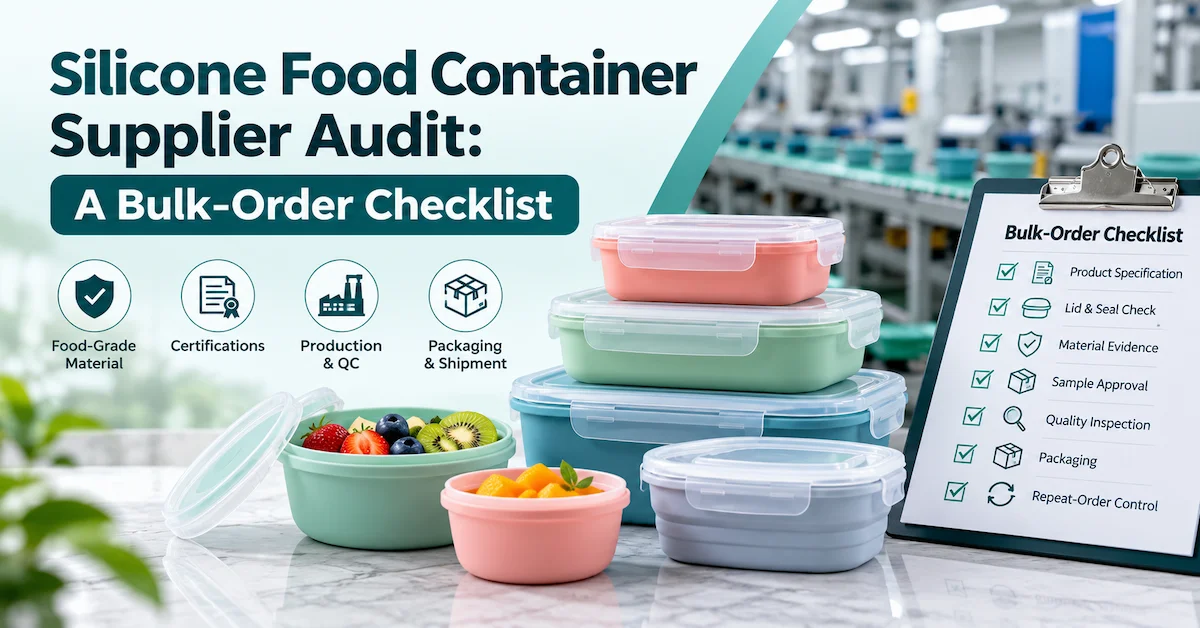
Direct answer: Before approving a bulk order, qualify a silicone food container supplier against one controlled specification, not against a product photograph or a low unit price. The minimum review should cover the container body, lid and closure, material by component, intended food-contact conditions, leak and handling checks, sample approval, quality inspection, export packaging, and the method used to repeat the approved product on future orders.
Who Should Use This Supplier Audit?
This audit is most useful for kitchenware importers, food-storage distributors, private-label brands, supermarket buyers, e-commerce operators, baby-feeding brands, and product managers who expect to reorder a successful SKU. It also helps a buyer decide whether a standard catalog item is enough or whether the project requires OEM/ODM development.
| Buyer type | What usually matters most | Evidence to request |
|---|---|---|
| Importer or distributor | Stable specifications, documentation, carton planning, and repeat-order control | Approved sample, component list, inspection plan, packaging drawing, and commercial terms |
| Private-label kitchenware brand | Shape differentiation, color, logo, retail packaging, and market-specific claims | Artwork approval, color reference, logo method, packaging proof, and applicable test records |
| Baby-food product buyer | Direct food contact, portion size, lid behavior, cleaning, and use conditions | Exact SKU specification, food-contact evidence, temperature conditions, and sample-based checks |
| Retail or online launch team | Shelf presentation, parcel protection, clear claims, and predictable replenishment | Retail pack sample, carton information, label review, and reorder change-control process |
1. Freeze the Product Definition Before Comparing Prices
"Silicone food container" can describe a small baby puree cup, a meal-prep box, a foldable lunch box, a freezer tray with a lid, a compartment container, or a custom storage vessel. These products may share a material family while having very different tooling, component, packaging, and testing requirements. A buyer should therefore define the intended product before requesting a final quote.
Define the body and the use case
Start with the food, portion, and environment. Is the container intended for baby puree, sauces, meal preparation, office lunches, frozen portions, refrigerator storage, outdoor carrying, or a mixed retail collection? The answer affects the required capacity, opening size, wall structure, lid design, stacking behavior, cleaning instructions, and packaging volume.
Leadonex's public product catalog shows why SKU-level definition matters. Its silicone baby food storage container page lists a 120 ml capacity, a product size of 8 cm wide by 4 cm high, and a net weight of 87 g. The page describes the product as suitable for baby complementary food and sauces, with use in microwave steaming, refrigerators, and freezers. These values are useful as a concrete reference point, but they should not be copied into a different container listing or treated as a universal specification for the category.
Define every component
Write down the body, lid, closure, vent, divider, handle, utensil, insert, label, and any reinforcement separately. A product can be described as silicone while still containing components made from other materials. Component-level definition matters because food-contact status, cleaning instructions, fit, odor, color, and mechanical behavior may differ between the body and the accessories.
For a foldable format, add expanded dimensions and folded dimensions. For a compartment format, add the number of sections and whether the divider is integral or removable. For a lid, add whether it is a loose cover, an airtight design, a snap closure, a vented lid, or a lid with a separate seal. Never let a supplier quote a "similar model" without identifying the exact reference sample or drawing.
Use a specification freeze
A specification freeze is a dated document that captures the version approved for sampling or mass production. It should include drawings, dimensions and tolerances, capacity method, material grade, color reference, logo artwork, lid and closure details, intended use conditions, packaging, label language, quantity, and inspection points. The document is not a substitute for testing. It is the reference that makes testing and inspection meaningful.
Have a container reference, drawing, or target capacity?
Send Your RFQ Brief2. Audit the Lid, Seal, and Leak-Handling Claim
For food containers, the lid is not a minor accessory. It is often the part that determines whether a product works in a bag, refrigerator, freezer, lunch kit, or retail demonstration. A supplier may describe an airtight lid or a design that helps prevent leakage, but the buyer still needs to define the conditions under which the claim is expected to hold.
Separate four different questions
- Does the lid fit the body? Check the perimeter, corner geometry, overlap, and whether the fit remains consistent around the full opening.
- Does the closure retain the lid? Check snap points, side closures, elastic recovery, and whether the lid can be removed without damaging the product.
- Does the seal control liquid? Check the actual liquid, fill level, orientation, temperature, and time defined for the intended use.
- Does the claim match the packaging and instructions? A product that prevents ordinary spills is not automatically a pressure-rated vessel or a guarantee against leakage in every transport condition.
The Leadonex 120 ml product page describes an airtight lid design intended to prevent leakage and keep food fresh. It also publishes a product-level temperature range and food-contact information. This is useful evidence for that product page. It is not a reason to extend the same claim to every container in the catalog without confirming the exact lid and body configuration.
Build a buyer-side leak protocol
Buyer recommendation, not a published Leadonex test result: Create a written leak protocol before sampling. Identify the liquid or semi-liquid test substance, fill percentage, lid-closing method, waiting time, storage temperature, orientations, handling movement, and pass/fail definition. A simple protocol may include upright, side, inverted, and movement conditions, followed by an inspection of the lid edge, closure points, outer surface, and packaging. If the container is intended for hot filling, microwave heating, or freezer use, those conditions should be addressed separately rather than being inferred from a room-temperature test.
3. Validate Foldable Structure and Repeated Handling
Foldability is a commercial feature, but it is also a mechanical design requirement. A collapsible container must recover its intended shape, remain stable when filled, fold without damaging the lid relationship, and fit the buyer's packaging and use instructions. "Flexible" alone does not answer those questions.
What to inspect on a foldable container
- Expanded height, width, length, and usable capacity
- Folded height and the amount of space saved in the intended package
- Base stability when empty and when filled
- Fold lines, corners, wall transitions, and areas that may be stressed repeatedly
- Lid fit in both the expanded and stored condition
- Recovery after cleaning, refrigeration, freezing, or normal carrying
- Whether the product can be opened, folded, and closed without tools
- Whether the retail instructions explain the correct folding and storage method
Buyer recommendation: Do not invent a "thousands of folds" claim unless a defined test supports it. Ask the supplier to agree on a cycle-validation plan that reflects the product's intended use. The number of cycles, loading condition, inspection interval, and acceptance criteria should be approved as part of the project, not added after a complaint.
4. Verify Food-Contact Evidence by Product and Market
Food-contact language is one of the most important places to separate an official fact from a marketing shortcut. "Food grade" describes an intended material or use claim, but a buyer still needs to know which material, component, test, market, food type, temperature, and time conditions are covered.
What Leadonex publicly states
The official customization page lists FDA, LFGB, and ROSH among material-related statements and says REACH, PAHS, and phthalates are tested by SGS. The same page lists factory and social or management certifications. The official product page for the 120 ml baby food storage container identifies food-grade silicone meeting an FDA standard, says LFGB can be made available on request, and lists an ISO9001 quality system, BSCI certification, and an FDA test report for that product page.
These statements should be read with scope. The public pages do not show certificate numbers, expiry dates, complete report files, laboratory conditions, or a document proving that every SKU carries every listed certification. A buyer should request the current document set for the exact product, material, components, and destination market before printing a compliance claim on packaging.
| Evidence item | What to match | Publication boundary |
|---|---|---|
| Material statement | Silicone grade, curing or physical form, colorants, and all food-contact components | Do not assume one material statement covers a different SKU or accessory |
| Food-contact test or declaration | Exact product, test conditions, standard, laboratory, date, and report identity | A general "FDA" or "LFGB" label is not a complete evidence file |
| Market requirement | Destination country, food type, temperature, contact time, and intended use | Buyer and importer remain responsible for confirming the market claim |
| Packaging claim | Wording, symbols, instructions, warnings, and language version | Do not print a broader claim than the approved evidence supports |
5. Confirm the Material and Component Specification
Material selection affects mold behavior, flexibility, recovery, surface feel, color, odor, tear performance, and food-contact evidence. A professional silicone food container supplier should be able to discuss material selection in relation to the product rather than offer one undifferentiated material for every application.
Leadonex's OEM page distinguishes food-grade silicone rubber from ordinary and medical silicone rubber, and it describes both HTV solid silicone and LSR liquid silicone rubber. It also says its engineers can recommend material based on requirements such as tensile strength, tear strength, applicable standards, and the chosen product. For a food-container project, ask the supplier to identify the selected material for the body and each relevant component, together with the evidence that supports the intended use.
Questions to put into the material brief
- What is the material for the body, lid, seal, closure, and accessory parts?
- Which part is in direct contact with food?
- Which food-contact standard or test basis applies to the target market?
- What temperature and cleaning conditions are intended for the final product?
- Is the colorant or pigment included in the food-contact review?
- What material change-control rule applies after sample approval?
- Will the same material and color reference be used for replenishment?
The word "silicone" does not describe hardness, thickness, wall geometry, closure force, or component compatibility. Those variables must be defined through the drawing, approved sample, and quotation.
6. Review the Supplier's OEM and Manufacturing Route
A catalog supplier and an OEM/ODM manufacturing partner are not evaluated in exactly the same way. A catalog supplier may be appropriate when the product, color, packaging, and quantity already match the buyer's needs. A development project requires more: engineering input, mold ownership or responsibility, sampling, design revision, inspection, packaging development, and a documented transition to mass production.
Leadonex presents a six-step OEM/ODM process: Requirement Analysis, Design and Development, Sample Making, Mass Production, Quality Inspection, and Delivery Service. The customization page also describes material, structure, shape, size, color, logo, pattern, packaging, and labeling as project variables. These are useful public signals that a buyer can ask the supplier to map to the proposed container project.
Match the process to the buyer's decision gates
| Supplier stage | Buyer decision | Record to keep |
|---|---|---|
| Requirement analysis | Confirm application, market, product type, capacity, components, quantity, and target claim | RFQ brief and questions requiring supplier confirmation |
| Design and development | Approve structure, lid geometry, logo method, color, and packaging direction | Drawing, artwork, color reference, and revision history |
| Sample making | Check fit, capacity, leak behavior, handling, cleaning, and appearance | Signed or otherwise identifiable sample approval |
| Mass production | Release production only after the agreed specification and evidence are complete | Production version, material record, and order confirmation |
| Quality inspection | Agree inspection points and nonconformity handling | Inspection report, photos, sampling basis, and corrective actions |
| Delivery service | Confirm packaging, shipping documents, carton data, and after-sales contact | Packing list, carton marks, shipment file, and reorder notes |
The process should be specific to the container being purchased. A general description of OEM capability is helpful for initial screening, but it is not a substitute for a project plan.
7. Use Factory Capability as Context, Not as a Product Guarantee
Leadonex's customization page states that the factory has a daily production capacity of up to 38,000 sets, an annual output value of nearly 100 million, a 15,300 square meter factory area, and 135 employees. Its About Us page also describes 120 pieces of testing instruments and production equipment. These are official website statements and can help a buyer understand the company's stated operating context.
They do not, by themselves, prove that one specific container SKU can be produced at that rate or that a particular delivery date is guaranteed. The public pages do not provide a universal MOQ, price, tooling fee, sample fee, or container-specific mass-production lead time. Ask for those values against the exact configuration, quantity, packaging plan, and target date.
8. Set Quality Control Points Before Production
Quality control is strongest when it is defined before the order is released. Leadonex's public manufacturing pages describe raw-material testing, dimensions and physical performance checks, environmental aging testing, inspection from raw material through finished product, and a professional quality management and inspection team. Those statements provide a reasonable basis for a buyer to request a project-specific inspection plan.
Suggested inspection points
- Incoming material: identify the material, color batch, relevant documentation, and change status.
- First article: compare dimensions, capacity method, wall form, lid fit, closure function, logo, and color with the approved record.
- In-process molding: review flash, bubbles, surface marks, incomplete fill, deformation, and color consistency.
- Assembly: confirm that lids, closures, vents, dividers, and accessories match the approved configuration.
- Functional checks: use the agreed leak, fit, fold, handling, cleaning, and temperature-related checks where applicable.
- Final inspection: check appearance, dimensions, quantity, packaging, labels, carton marks, and sample records before shipment.
Buyer recommendation: Define a defect classification and a sampling method with the supplier or inspection agency. Do not use a generic "AQL passed" statement as the only definition of product quality if the critical risk is a leaking lid or a missing component. The inspection file should make clear which defects are critical, major, or minor for this product and how a failure is handled.
9. Approve the Golden Sample for Repeat Orders
Many purchasing problems occur after the first order, when a buyer assumes that "same product" means the same material, dimensions, color, lid, packaging, and performance. A golden sample or controlled approval sample gives both sides a physical reference. It should be linked to a specification, a drawing, an artwork file, a packaging version, and the agreed inspection points.
For a silicone food container, the approved sample should show the body and lid together, not just the body. Keep records of dimensions, capacity, weight, color, logo appearance, closure operation, and packaging. If the buyer approves a change, issue a new version rather than relying on a message that says "use the new lid next time."
Repeat-order change control
Ask the supplier to notify the buyer before changing a material source, pigment, mold, cavity, closure, surface treatment, packaging component, or inspection method. A change may be technically reasonable and still alter the product claim or customer experience. Reorder stability is not the absence of all engineering changes; it is the ability to identify, evaluate, approve, and record a change before it reaches the market.
10. Audit Export Packaging and Retail Readiness
Packaging has two jobs: protect the product through handling and communicate the correct product information at the point of sale. The package also affects carton utilization, freight cost, warehouse space, barcode application, and the first impression of a private-label product.
The Leadonex product page for the 120 ml silicone baby food storage container states that the default packaging is a single OPP bag. It also says gift packaging boxes can be customized. This is useful SKU-level information. It does not mean that every food container is supplied in the same packaging or that the default package is automatically sufficient for a particular retailer, marketplace, or export route.
Packaging questions for an RFQ
- What is the default individual package for the exact SKU?
- Can the buyer use a color box, sleeve, insert, label, barcode, or multi-piece set?
- What are the packed dimensions and gross weight per carton?
- How are lids, closures, and small accessories protected from deformation or loss?
- What languages, warnings, care instructions, and country-of-origin information are required?
- Is the package designed for retail shelves, parcel delivery, bulk distribution, or a combination?
- Which packaging elements are included in the quoted price and which are optional?
Do not add a "leak-proof," "microwave safe," "freezer safe," "FDA," or temperature statement to a retail package until the wording and evidence have been checked for the exact version. The container, lid, use condition, and market requirement should all be aligned.
Need a custom color, logo, structure, or package?
Review Customization OptionsSupplier Comparison Table for a Silicone Food Container Project
Use the following table during supplier calls or quotation review. The "pass" column is a buyer-side recommendation, not an official Leadonex performance claim.
| Audit area | A strong answer includes | Warning sign |
|---|---|---|
| Product identity | SKU, drawing, body and lid configuration, capacity method, and revision number | Only a photograph or an unnumbered "similar item" |
| Material evidence | Component-level material information and documents matched to the target market | A broad "food grade" statement with no scope |
| Seal and function | Agreed leak, fit, closure, fold, and use-condition protocol | "Leak-proof" with no test method or pass/fail rule |
| Sampling | Identifiable sample, change history, and written approval before production | Mass production begins before the buyer checks the final version |
| Quality control | Raw material, first article, in-process, final, and packaging checks | Only a general factory certificate or verbal promise |
| Packaging | Individual pack, carton data, labels, instructions, and retail requirements | Packaging discussed only after the price is accepted |
| Commercial clarity | MOQ, sample and tooling terms, production lead time, payment, shipping basis, and change terms | A very low quote with undefined scope |
What to Include in a High-Quality RFQ
A useful inquiry allows a silicone food container supplier to quote the same project that the buyer intends to launch. Send the information in one structured brief whenever possible.
- Product type and reference image, drawing, or 3D file
- Expanded dimensions, folded dimensions if relevant, usable capacity, and tolerance expectations
- Body, lid, closure, vent, divider, utensil, and accessory configuration
- Food type, application, target user, and intended market
- Material preference or request for a supplier recommendation
- Temperature, freezer, microwave, cleaning, and carrying conditions to be claimed
- Color reference, logo method, artwork, label language, and package direction
- Initial order quantity, estimated annual quantity, and replenishment expectations
- Required testing, declaration, certification, or buyer audit documents
- Target sample date, production date, and shipping destination
- Inspection requirements, approved-sample process, and change-control expectations
Also ask the supplier to identify what is not included in the quote, such as a color box, new mold, printed artwork, special testing, or an inspection visit.
Public-information boundary for this article
The Leadonex website does not publish one universal MOQ, price, mold fee, sample fee, or mass-production lead time for all silicone food containers. It also does not publish certificate numbers and expiry dates for every claim listed across its pages. These details should be requested and confirmed for the selected SKU, quantity, market, and packaging plan.
What Leadonex Publicly Confirms and What You Should Still Request
| Publicly stated on the official website | How to use it | Still request before ordering |
|---|---|---|
| Food-grade silicone product OEM/ODM and customization | Use as an initial fit signal for a custom container project | Project-specific drawing, material proposal, tooling plan, and quotation |
| Compression molding, LSR molding, co-injection and other silicone processes are described | Ask engineering which process fits the selected body and lid design | Process parameters, tooling responsibility, cycle plan, and sample result |
| A 120 ml baby food storage container page lists food-grade silicone, -40 deg C to 230 deg C, dimensions, weight, packaging, and product-level certifications | Use the page as an evidence example for that SKU | Confirm the same fields for the chosen container and target market |
| The customization page states factory-level capacity, area, employees, equipment, and listed certifications | Use as company context, with the website's stated scope | SKU allocation, MOQ, lead time, certificates, reports, and current validity |
For a buyer who needs a current quotation, the next step is to send the RFQ rather than infer the missing terms from a blog post. The Leadonex OEM/ODM page describes the development route, while the silicone food container category can be used to review the public product direction. The final commercial and technical scope still needs confirmation for the selected product.
Frequently Asked Questions
What should I ask a silicone food container supplier first?
Start with the exact product identity: body, lid, closure, capacity, dimensions, material, intended food, market, packaging, quantity, and required documents. Then ask how the supplier will sample, test, inspect, and repeat that configuration.
Does Leadonex publish a universal MOQ for silicone food containers?
No universal MOQ for all food containers is stated in the public pages reviewed for this article. MOQ should be requested for the selected SKU, customization level, tooling requirement, packaging, and order quantity.
What food-contact information is published for the 120 ml container?
The official product page identifies food-grade silicone meeting an FDA standard, states that LFGB can be made available on request, and lists an ISO9001 quality system, BSCI certification, and an FDA test report. Request the current supporting documents and confirm their scope before using a claim in a target market.
Can a silicone container be called leak-proof?
Only when the claim is supported by a defined product-specific test and the intended conditions are clear. The Leadonex 120 ml page describes an airtight lid designed to help prevent leakage. A buyer should still approve the exact lid and agree on a leak protocol for the product being ordered.
Can the size, structure, color, logo, and packaging be customized?
Leadonex's customization and OEM/ODM pages state that product size, structure, shape, function, color, logo, printing, labels, packaging, and other variables can be customized. The final feasibility, tooling, cost, and schedule should be confirmed against the buyer's drawing and quantity.
Does the website publish a universal lead time?
No universal production lead time for every silicone food container is established in the public product information reviewed here. Ask for a project-specific schedule covering sample approval, tooling if required, production, inspection, packaging, and shipping.
What is the best evidence that a supplier can support repeat orders?
The best evidence is a controlled specification, an identifiable approved sample, a documented inspection plan, material and packaging records, and a clear change-notification process. Factory size or a general statement of experience can provide context, but it cannot replace those project records.
Where can I send a silicone container RFQ?
Use the Leadonex contact page and include the product reference, drawings or photos, capacity, dimensions, material, color, logo, packaging, quantity, target market, testing requirements, and target schedule. A structured brief gives the supplier enough information to respond with a useful technical and commercial proposal.
Conclusion
Choosing a silicone food container supplier is less about finding the broadest catalog and more about controlling the exact product that will reach the market. Define the container body and every component. Treat the lid, seal, closure, and folding structure as engineered features. Match food-contact evidence to the specific SKU and market. Approve a sample against a written specification. Set quality checkpoints before production. Confirm individual and export packaging. Then create a repeat-order record so that the next shipment is not based on memory or a product photograph.
Ready to compare a container project with a real specification?
Send the body, lid, capacity, market, quantity, branding, packaging, and evidence requirements for a project-specific review.
Request a Silicone Container Quote