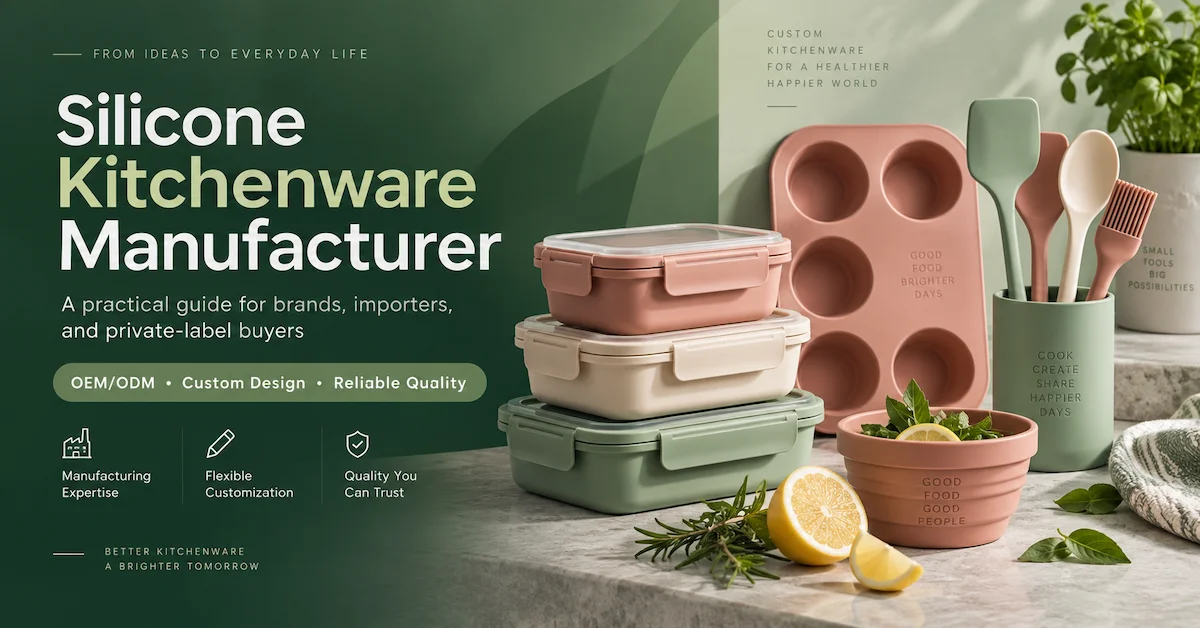

What does silicone kitchenware for brands involve?
Silicone kitchenware for brands combines decisions that are easy to separate in a catalog but connected in production. The brand must decide what the customer will use, how the product will be differentiated, which silicone route fits the design, which components contact food, how the item will be inspected, and how it will be presented on the shelf or in an e-commerce channel. A product that looks correct in a photograph can still be difficult to reproduce if its wall thickness, lid interface, logo method, color, packaging, or inspection standard is not defined.
This guide is for silicone kitchenware for brands, importers, distributors, retail buyers, e-commerce operators, product managers, and design teams preparing a new collection. It compares standard private-label, OEM, and ODM routes.
Leadonex's public Kitchenware and Molds product range gives buyers a starting point for reviewing food containers, lunch boxes, baking molds, kitchen accessories, and related silicone products.
The short answer for a brand buyer
Choose a manufacturing partner that can connect product selection, engineering, material review, mold development, sampling, inspection, packaging, and repeat production. Then submit one controlled RFQ that states the intended application, product family, dimensions, components, colors, logo, packaging, destination market, quantity by variant, required evidence, and schedule. This gives the supplier enough context to recommend an appropriate route instead of quoting an isolated product with unclear assumptions.
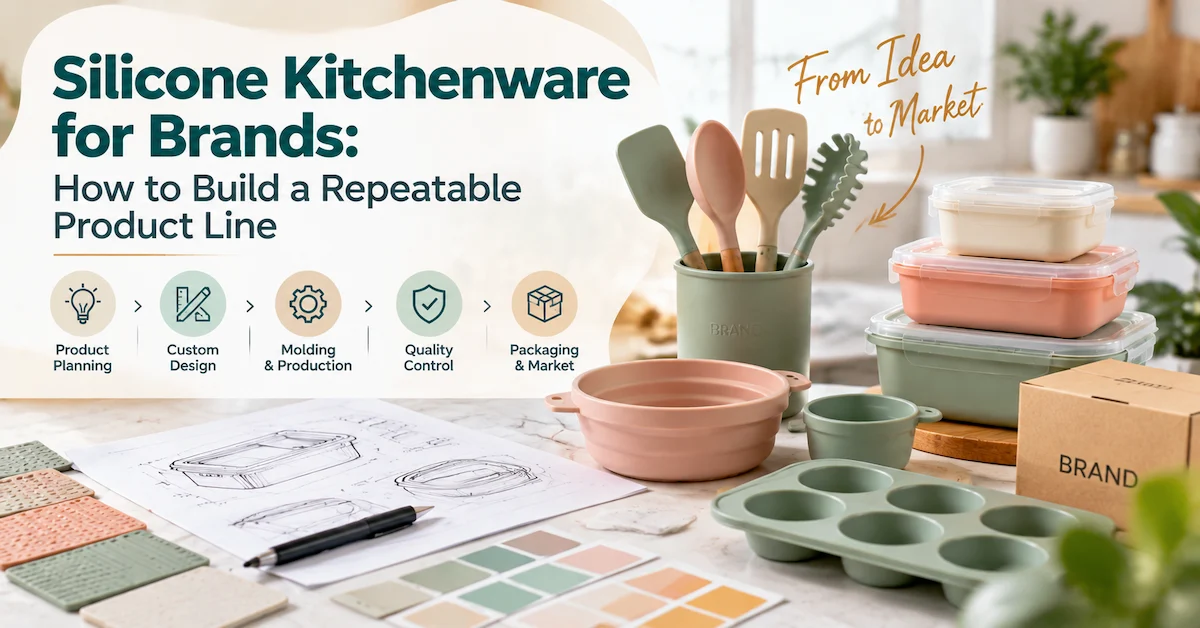
Which brands are a good fit for custom silicone kitchenware?
The most suitable buyer is not defined only by order size. A good fit is a company that can describe the product's job, the user, the sales channel, and the evidence needed for launch. The more clearly a brand defines those points, the easier it is for a manufacturer to assess feasibility and prepare a meaningful sample.
| Buyer type | Typical decision | Evidence to request |
|---|---|---|
| Private-label kitchenware brand | Whether an existing item can be differentiated with color, logo, set composition, and retail packaging. | Approved color reference, branding method, packaging artwork, product specification, and sample standard. |
| Importer or distributor | Whether the selected family can be supplied consistently across variants and replenishment orders. | Quantity by SKU and color, carton and label requirements, inspection plan, and repeat-order change control. |
| Retail or e-commerce brand | Whether the product function, visual identity, package, and evidence support the intended channel. | Usage instructions, product dimensions, photos, packaging, labeling, and destination-market compliance needs. |
| Product development team | Whether the geometry, material, and molding process can achieve the intended function and appearance. | 3D files or drawings, critical dimensions, material goals, functional tests, and revision history. |
How should a brand organize a silicone kitchenware product line?
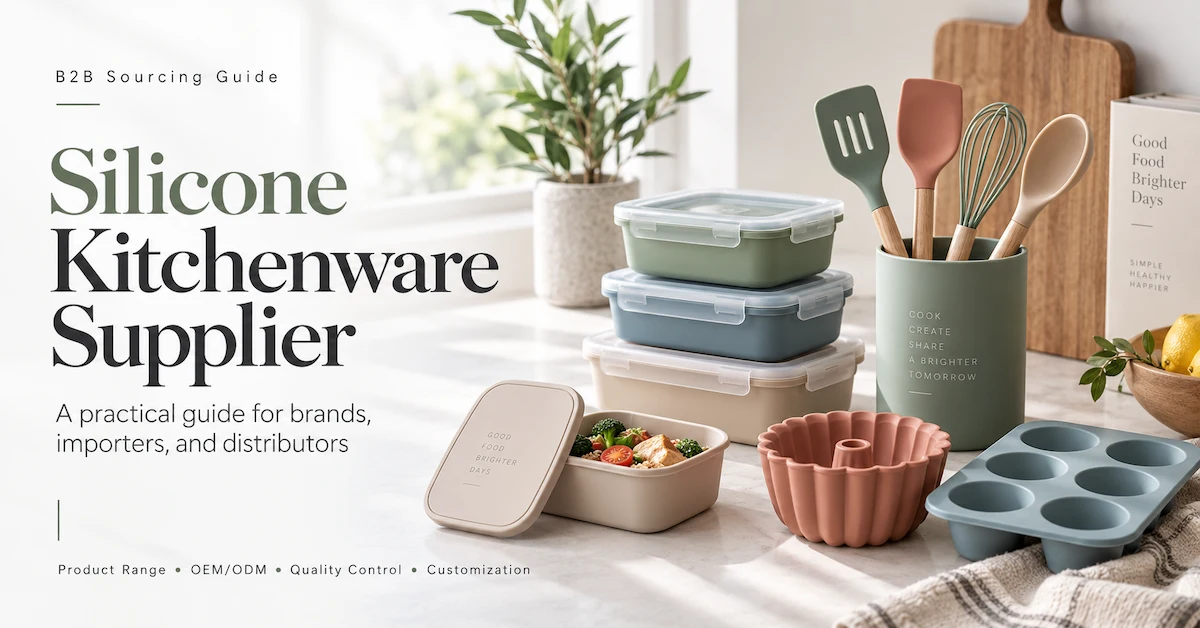
Start with the customer's task rather than the factory's catalog. A coherent range can be organized around meal preparation, food storage, baking, serving, portable use, or a particular retail audience. Each family should have a clear role, a consistent visual system, and a repeatable specification. This reduces the chance that a brand launches several attractive products that use different materials, inconsistent colors, or incompatible packaging formats.
| Product family | Common brand role | Design and sourcing questions |
|---|---|---|
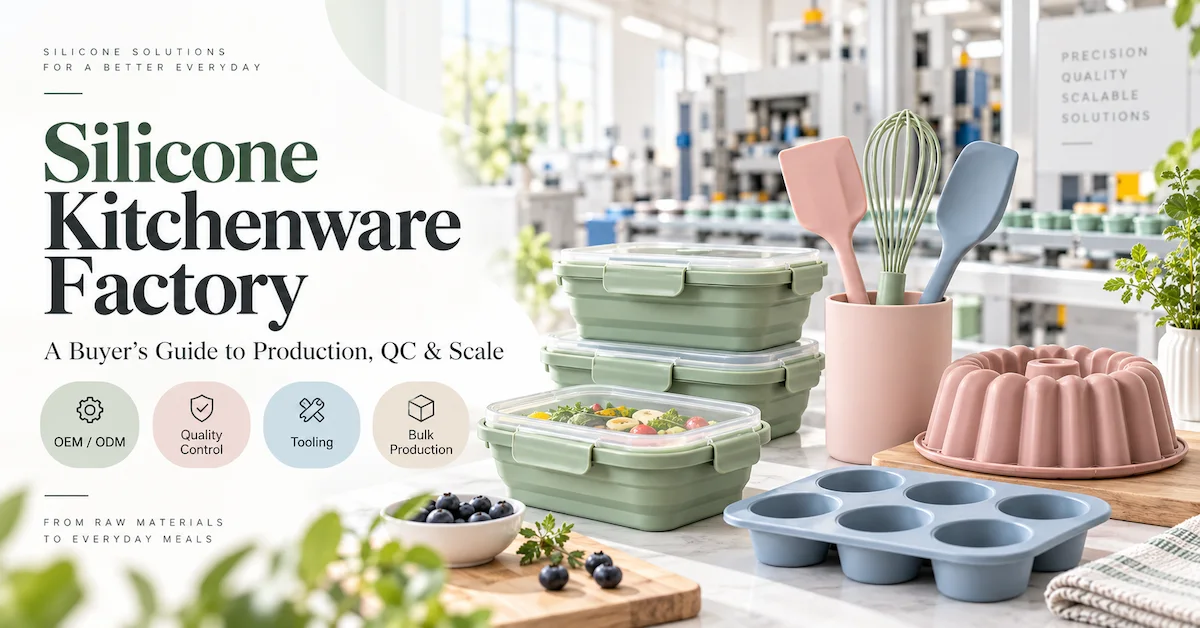
| Food containers and lunch boxes | Meal preparation, storage, school, office, travel, and portion organization. | Capacity, lid fit, folding or stacking behavior, closure components, cleaning, labeling, and packaging. |
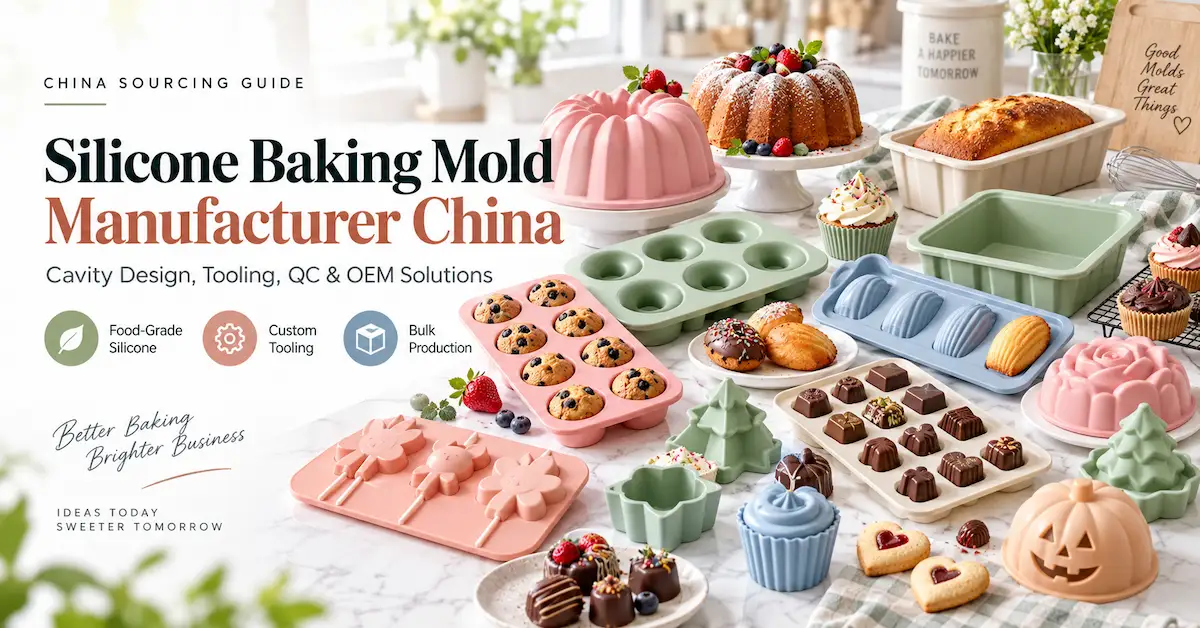
| Baking and dessert molds | Repeatable shapes for home bakers, professional users, seasonal collections, and gift sets. | Cavity shape, wall consistency, release behavior, surface finish, nesting, and retail protection. |
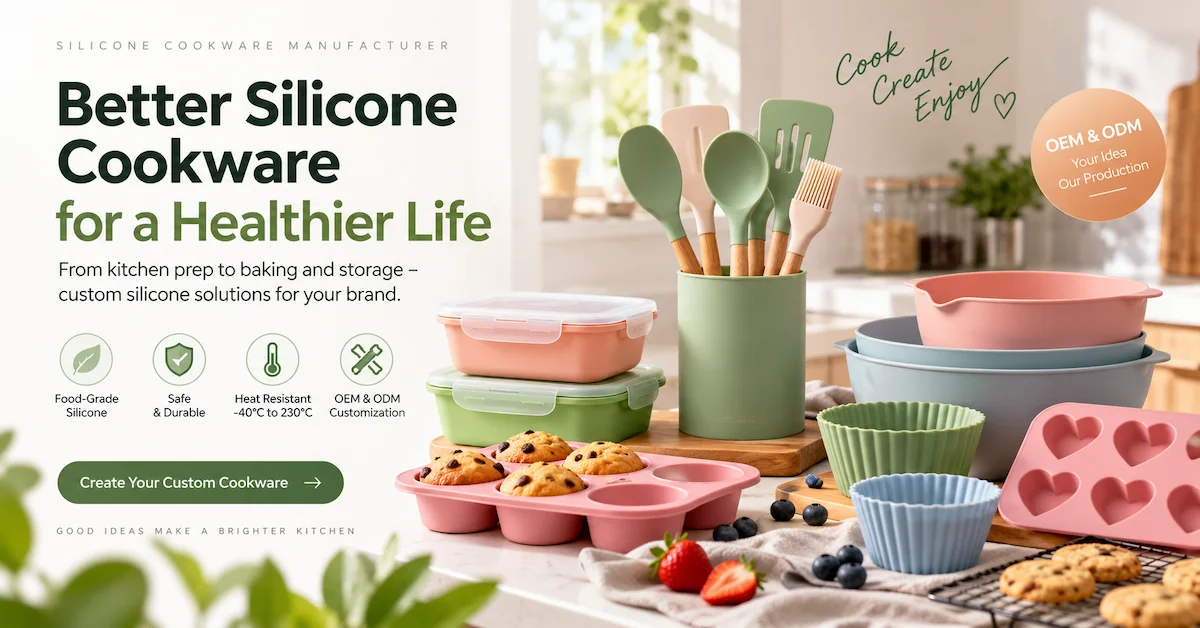
| Cooking and preparation tools | Daily cooking, baking, mixing, serving, and non-stick cookware support. | Handle construction, grip, edge geometry, food-contact surface, color, logo location, and set configuration. |
| Mats, covers, and flexible accessories | Work-surface protection, organization, heat-related use, and compact storage. | Flatness, thickness, texture, trimming, flexibility, surface marks, and package dimensions. |
Leadonex's public product navigation identifies Kitchenware & Molds as a category and lists silicone cake molds, ice molds, chocolate molds, food containers, and lollipop molds under the product area. The website also shows foldable lunch box directions and other kitchen-related products. These public categories can help a brand map a collection, but they do not establish that every product has the same material grade, temperature range, packaging, certification scope, or production process.
What material information should brands define?
The phrase food-grade silicone is a starting requirement, not a complete technical specification. A brand should define which parts contact food, which market the product will enter, what use conditions are expected, and what documentation is needed. A container body, lid, valve, insert, handle, coating, printed mark, and adhesive may not be covered by one generic statement. The final requirement should follow the complete product construction.
Leadonex's OEM/ODM page presents food-grade silicone rubber, FDA, LFGB, and DGCCRF references, and distinguishes HTV solid silicone from LSR liquid silicone rubber. Its customization page also states that engineers recommend materials according to requirements such as tensile strength, tear strength, applicable standards, and the selected product. The website lists FDA, LFGB, and RoHS-related material claims and says REACH, PAHs, and phthalates are tested by SGS on the public customization page. These are website statements; the brand should request the current document, product scope, sample identity, and destination-market applicability before making a claim on packaging or a product page.
Evidence boundary
The public website does not establish one universal material specification for every kitchenware SKU. It also does not publish a universal MOQ, price, mass-production lead time, certificate number, certificate expiry, or product-wide test scope. Ask for those items for the exact product, color, component set, quantity, and market.
| Specification field | What the brand should state | Why it matters |
|---|---|---|
| Food-contact parts | Identify the body, lid, seal, valve, insert, handle, coating, and printed areas that may contact food. | Prevents a general material claim from being applied to an unreviewed component. |
| Material route | State whether the project is open to solid silicone, LSR, or another proposed material route. | Material form affects tooling, molding, appearance, testing, and commercial assumptions. |
| Physical requirements | Define flexibility, tear or tensile goals, wall behavior, fit, sealing, and dimensional needs where relevant. | Gives engineering a measurable target instead of relying on a vague soft or durable description. |
| Market evidence | Name the destination market and the current reports, declarations, or tests required for launch. | A report must match the final product and the market claim; a general logo or statement is not enough. |
Which molding process is suitable for a brand product line?
There is no single best molding process for all silicone kitchenware. The correct route depends on geometry, wall thickness, detail, component integration, appearance, material, quantity, tooling plan, and evidence requirements. Leadonex publicly lists liquid silicone injection, solid silicone compression, silicone extrusion, two-color or multi-color molding, and precision co-injection drip molding among its capabilities. The engineering team should recommend the route for the actual drawing or sample.
Solid silicone compression molding
Compression molding places a prepared solid silicone charge into a heated tool, closes the mold, and cures the material under controlled conditions. This route may be relevant to thicker flexible kitchenware, mats, containers, lids, baking molds, and other shapes that can be designed around charge placement, cavity filling, parting lines, flash, trimming, and demolding. It is not automatically a low-cost or low-precision route; the commercial result depends on the tool, material preparation, cavity design, finishing, and inspection.
Liquid silicone injection
LSR molding uses a liquid silicone rubber route with controlled dosing, mixing, injection, venting, and curing. It may be considered for thin or detailed sections, integrated features, repeatable small components, seals, or multi-component designs when the material and tool are suitable. The process name alone does not prove a finished-part tolerance, food-contact result, or lower unit cost. The buyer should ask how the selected formulation, color, runner or venting design, cavity balance, curing, and inspection will be controlled.
Multi-color and secondary operations
A brand collection may need color blocking, a two-tone visual identity, a molded logo, printing, assembly, or precision cutting. Leadonex's public customization page lists two-color and multi-color options, printing, assembly, precision cutting, and custom packaging. The final quotation should state which operations are included, what the approved color reference is, and how each visible boundary or logo will be inspected.
| Decision point | Questions for the manufacturer | Brand approval record |
|---|---|---|
| Geometry | Where are the thin sections, thick sections, undercuts, vents, inserts, and demolding risks? | Approved drawing, 3D file, critical dimensions, and design revision. |
| Tooling | How many cavities are proposed, where is the parting line, and how will the mold be maintained? | Tool drawing, cavity plan, maintenance approach, and ownership terms to confirm. |
| Appearance | How will color, gloss, texture, flash, flow marks, logo boundaries, and surface defects be controlled? | Golden sample, approved color standard, defect photos, and acceptance limits. |
| Function | Which use conditions and functional checks are required for the selected product? | Written test method, pass/fail rule, sample identity, and report responsibility. |
Leadonex's homepage and customization material publish CNC precision machining, mold life testing, multi-cavity mold design, and mold maintenance. The homepage also makes a page-level claim that mold precision can reach up to +/-0.01 mm. A brand should not convert that statement into a universal finished-product tolerance. Confirm the exact mold feature, the critical part dimension, the measuring method, and the acceptance standard for the SKU.
What original evidence should a brand request before launch?
For silicone kitchenware for brands, original evidence means proof tied to the actual product rather than a general factory statement. The chain should run from approved design through material, sample, inspection, packaging, and shipment release, with enough detail to compare the next run.
Leadonex publicly describes raw-material testing, dimensional accuracy measurement, physical-property testing, environmental aging testing, and full-process inspection. It also describes one-stop work from design and prototyping to molded silicone production, printing, packaging, and delivery. These public capabilities are useful starting points for a buyer's quality plan. The buyer should ask which tests apply to the selected item, how often they are performed, what the report identifies, and what happens when a result does not meet the agreed requirement.
| Evidence layer | Example buyer record | Release question |
|---|---|---|
| Design | Drawing, 3D file, dimensions, texture, logo artwork, and revision number. | Is the sample and production order tied to the same revision? |
| Material | Material route, component list, color reference, and applicable food-contact documents. | Do the documents identify the product or material scope that the brand will claim? |
| Sample | Golden sample with appearance, function, dimensions, components, and packaging references. | Has the sample been approved in writing before mass production? |
| Production | Raw-material, dimensional, physical-property, appearance, and quantity inspection records. | Which checkpoints are completed before shipment release? |
| Shipment | Packaging approval, labels, carton information, product count, and shipment photos if agreed. | Does the shipped configuration match the approved retail and transport plan? |
A certificate logo without a product scope is not enough for a brand claim. The correct commercial question is: which document applies to which final configuration, which market, and which production revision? If a buyer needs FDA, LFGB, REACH, PAHs, phthalates, or another market requirement, the buyer should ask for the current report or declaration and confirm whether it covers the body, lid, printed surface, color, and accessories.
How do OEM and ODM services help a kitchenware brand?
OEM and ODM are not interchangeable labels. OEM is usually clearer when the brand owns or supplies the product specification and wants the factory to manufacture it. ODM is more relevant when the brand needs design, structure, feasibility, prototyping, and product-development support. Many projects sit between the two: an existing catalog product may need a new color, logo, packaging, accessory, or small structural adjustment.
Leadonex's public OEM/ODM page describes customization of design, function, material, size, structure, shape, texture, color, logo, pattern, packaging, and labeling. The customization page describes a six-stage public workflow: Requirement Analysis, Design & Development, Sample Making, Mass Production, Quality Inspection, and Delivery Service. A brand can use those stages as the skeleton for its project schedule, but the actual number of revisions, sampling conditions, tooling terms, and delivery date must be agreed for the project.
| Public workflow stage | Brand input | Output to confirm |
|---|---|---|
| Requirement Analysis | User, application, market, target product family, quantity, and fixed versus flexible requirements. | Written project brief and feasibility questions. |
| Design & Development | Drawing, reference sample, dimensions, texture, logo, color, and packaging direction. | Design proposal, material recommendation, tooling concept, and open issues. |
| Sample Making | Feedback on function, appearance, dimensions, components, and use conditions. | Approved sample and written change list. |
| Mass Production | Released specification, quantity by variant, artwork, packaging, and commercial approval. | Production against the approved revision and agreed inspection plan. |
| Quality Inspection | Acceptance limits, critical dimensions, functional tests, appearance standards, and report needs. | Inspection result, nonconformance handling, and release decision. |
| Delivery Service | Approved package, labels, carton information, destination, and logistics instructions. | Shipped product matching the approved product and package revision. |
This workflow makes responsibility visible. If the brand changes the logo after sample approval, adds an accessory after tooling, or changes the destination market after testing, record the change as a new requirement. A written revision system protects both sides from producing a technically correct but commercially wrong version.
For a deeper explanation of the public service route, buyers can review Leadonex's OEM and ODM solutions. For a project that needs a new shape, material route, logo, packaging, or set combination, the custom silicone products page is the more direct commercial path.
How should brands control colors, logos, and packaging?
Visual consistency is part of product quality for a brand. A collection can lose credibility when a supposedly matching set has different shades, inconsistent gloss, a logo that shifts between products, or packaging that does not protect the product during handling. Those issues should be discussed during sampling, not after the first shipment.
Leadonex states that product colors can be customized according to the Pantone color card and that two-color and marble silicone products can be made. The website also lists screen or pad printing, assembly, precision cutting, custom packaging design, labels, and packaging inspection. These are public service statements. The buyer should confirm the color reference, permitted variation, logo method, print durability requirement, package material, package dimensions, and final carton configuration for each SKU.
Create a visual approval pack
A practical approval pack can include a golden sample, color reference, logo artwork and position, surface texture, cosmetic defect standard, packaging dieline, label copy, and barcode information. Give it a revision number and date for future reorders.
Make packaging part of the RFQ
Packaging affects assembly, protection, retail presentation, carton size, storage, and shipping. State whether the product needs an OPP bag, insert, sleeve, color box, gift box, set box, label, barcode, or another format. Do not assume a standard package is included; confirm package, artwork, quantity, and inspection responsibility.
What factory and capacity information can a brand verify?
Scale can be relevant to a brand, but a headline figure should never replace project-specific verification. The public Leadonex customization page states a factory area of 15,300 square meters, 135 employees, daily production capacity of up to 38,000 sets, annual output value of nearly 100 million, and more than 10,500 customized silicone product projects. These figures should be treated as official website claims with scope to confirm. They do not prove that one SKU can be produced at that rate, that every process has the same capacity, or that a specific order will receive a particular schedule.
Leadonex also publishes a 7-15 day rapid-sampling statement. Treat it as project-dependent: drawing readiness, new tooling, revisions, material, testing, and packaging can change the timing. Confirm it for the actual project rather than using it as a universal delivery promise.
How to read the public scale claims
Use the published figures as questions, not as a guaranteed allocation: ask which workshop, process, SKU, shift, quality gates, sample assumptions, and dates apply to your order. Confirm the relevant team, available capacity, sample plan, and project schedule in writing.
What should be included in a silicone kitchenware RFQ?
A complete RFQ is the commercial foundation for silicone kitchenware for brands. Send the same information to every candidate so quotations describe the same product. Separate fixed requirements from open questions, and attach the controlled drawing, sample, or 3D file with critical dimensions.
| RFQ section | Information to include | Why the supplier needs it |
|---|---|---|
| Product definition | Product family, intended user, application, reference link, drawing, sample, or 3D file. | Clarifies what is being quoted and whether the request is standard, OEM, or ODM. |
| Construction | Dimensions, capacity, wall areas, lid, seal, insert, handle, accessories, and assembly. | Supports feasibility, material selection, tooling, and accurate costing. |
| Branding | Color references, logo artwork, position, size, printing or molded branding, and texture. | Determines tooling, secondary processing, inspection, and sample approval. |
| Material and market | Food-contact parts, target countries, required standards, test reports, declarations, and label claims. | Prevents an unsuitable or incomplete compliance assumption. |
| Commercial plan | Quantity by SKU and color, sample quantity, target launch, repeat-order expectation, and destination. | Allows the factory to evaluate tooling, capacity, package, and schedule assumptions. |
| Packaging and QC | Retail package, labels, carton, inspection points, defect limits, tests, and report format. | Makes the quotation and approval process comparable across suppliers. |
Do not request a quotation with only the phrase “custom silicone kitchenware.” That phrase leaves too many variables open: the material, product size, process, logo, packaging, quantity, document requirements, and destination market. A better inquiry asks the supplier to identify assumptions and open items. This will also make the first sales reply more useful because the team can discuss feasibility rather than guess what the buyer means.
For direct project communication, use Leadonex's Contact page and include the product brief. The public page identifies the company as WUYI JUCHENG INDUSTRY AND TRADE CO.,LTD and provides the public contact route. Commercial items such as MOQ, price, tooling ownership, payment terms, exact production schedule, and logistics terms should be requested in the inquiry rather than inferred from this guide.
How can a brand protect repeat orders?
A first shipment is not the finish line for branded kitchenware. The real test is whether the product can be reordered without drift in shape, color, surface, logo, package, or function. A brand should keep an approved sample, released drawing, component list, color reference, logo artwork, packaging files, inspection criteria, and all relevant product documents in one controlled record.
Before a repeat order, compare the new purchase order with the last approved revision. Confirm whether the material, color, tool, accessory, label, package, destination market, and quantity have changed. If they have changed, issue a new revision and request a new sample or approval where necessary. “Same as last time” is not a reliable specification when a product has multiple variants or when a brand works with different internal teams.
The manufacturer should also be told which requirements are critical. A slight color difference may be unacceptable on a coordinated set, while a cosmetic mark in a hidden area may be acceptable if the brand has agreed a standard. A lid fit, suction feature, fold line, or logo position may be more important than an uncritical dimension. Clear priorities help inspection focus on the customer experience.
A repeat-order control list
- Keep one approved golden sample for each materially different SKU or configuration.
- Use revision numbers for drawings, artwork, packaging, and inspection standards.
- Record color references and the accepted visual range for every colorway.
- Identify all food-contact and non-food-contact components.
- Confirm whether tooling, material, accessory, label, or package changes require re-approval.
- Require the production order and inspection plan to reference the released revision.
- Keep the evidence and test documents linked to the final product configuration.
What are the most common sourcing risks?
Brands usually encounter avoidable problems when they treat a molded silicone product as a simple commodity. The risks are not only material risks. They also include unclear design ownership, inconsistent approvals, missing component definitions, packaging changes, unsupported compliance language, and an assumption that a supplier's general capacity statement applies to the buyer's exact order.
| Risk | Why it happens | Preventive action |
|---|---|---|
| Different products are quoted as if they were equal | The RFQ lacks dimensions, components, process, packaging, or quantity by variant. | Send one controlled product brief and ask suppliers to list assumptions. |
| A food-grade claim is broader than the evidence | A general factory statement is applied to every component, color, or SKU. | Match documents to the final construction, market, and revision. |
| Sample looks right but production drifts | The golden sample, drawing, color, logo, and inspection standard were not released together. | Create a revision-controlled approval pack before mass production. |
| Packaging is treated as an afterthought | Retail and shipping requirements are not included in the original quotation. | Define package type, artwork, labels, count, protection, and inspection at RFQ stage. |
| The buyer assumes a universal MOQ or lead time | Commercial conditions vary with product, color, tooling, packaging, quantity, and production planning. | Ask for project-specific commercial terms in writing. |
The solution is controlled information: what the product is, what evidence applies, what the customer will notice, what must not change, and how the next order will be checked.
Frequently asked questions about silicone kitchenware for brands
Is silicone kitchenware for brands only suitable for large companies?
No. Silicone kitchenware for brands can suit different company sizes; the appropriate route depends on product definition, development scope, quantity, packaging, and evidence requirements. A smaller brand may begin with an existing product and customize color, logo, or package, while a larger brand may require a multi-SKU program with new tooling and a formal approval system. MOQ and commercial terms are not publicly stated as one universal figure, so confirm them for the project.
Can a brand customize silicone kitchenware colors and logos?
Leadonex publicly describes color customization using Pantone references, two-color and marble effects, embossed logos, screen or pad printing, and other branding options depending on the project. The selected logo method, position, artwork, color tolerance, surface, and inspection standard should be confirmed for the actual SKU.
Does every silicone product use the same material and temperature range?
A brand should not assume that. Leadonex presents different material forms and product-specific customization, while the public website does not establish one universal material or performance specification for every kitchenware SKU. Ask for the material and use conditions for each final configuration.
Should a brand choose OEM or ODM?
Choose OEM when the brand has a defined product specification and mainly needs manufacturing, sampling, branding, packaging, and quality control. Consider ODM when the brand needs help with design, structure, material selection, feasibility, prototyping, and product development. A hybrid project can use an existing product platform with selected design or packaging changes.
What documents should be requested for food-contact silicone kitchenware?
Request documents that match the final product, components, color, market, and production revision. Depending on the destination and product, the discussion may include FDA, LFGB, DGCCRF, REACH, PAHs, phthalates, or other applicable requirements. Leadonex's public pages list some of these standards or tests, but the current report, scope, certificate details, and applicability must be confirmed before a brand makes a compliance claim.
What is the best molding process for a silicone food container?
There is no universal answer. Solid silicone compression, LSR molding, or another route may be considered according to the wall, lid, seal, geometry, function, quantity, and evidence requirements. Provide a drawing or sample and ask the manufacturer to explain the proposed process, tooling risks, inspection points, and commercial assumptions.
Can a brand buy a standard product and add private labeling?
Often this is a practical starting point, but the available customization depends on the product. Confirm whether the selected item supports a new color, logo, accessory, set combination, label, retail package, or structural adjustment. If the shape or structure changes materially, new tooling or a separate development review may be required.
What should be checked on the first sample?
Check the approved dimensions, fit, stability, flexibility, lid or seal function, surface, flash, parting lines, color, logo, accessories, packaging, labels, and intended use conditions. Record the result against a written specification and keep the approved sample as the production reference.
Does the website publish MOQ, price, and mass-production lead time?
The public website does not publish one universal MOQ, price, tooling fee, or mass-production lead time for all silicone kitchenware. These commercial terms should be requested for the selected product, quantity, color, packaging, tooling status, destination market, and production plan.
How can a brand start an RFQ with Leadonex?
Review the public Kitchenware & Molds products, decide whether the project is standard, OEM, or ODM, then send the product reference or drawing together with quantity by variant, material and market requirements, colors, logo, packaging, evidence needs, and target schedule through the Leadonex contact page.
Conclusion
Silicone kitchenware for brands should be managed as a controlled product system. The strongest sourcing decision connects the product family to a real customer task, defines the complete material and component scope, selects a molding route that fits the geometry, approves tooling and samples, records original inspection evidence, controls colors and packaging, and keeps every repeat order tied to the same released revision.
Leadonex's public website identifies WUYI JUCHENG INDUSTRY AND TRADE CO.,LTD as the company behind the Leadonex brand and presents food-grade silicone product OEM/ODM manufacturing, Kitchenware & Molds products, custom molding, material guidance, tooling, quality inspection, packaging, and a six-stage development workflow. Those public capabilities give a brand a practical starting point, while the exact product, documents, MOQ, price, tooling terms, schedule, and destination-market requirements must be confirmed in a project-specific quotation.
The next step is a complete brief rather than a generic request for the lowest price. Define what the customer will use, what the brand must control, what evidence the market requires, and what must remain unchanged on the next order. Then send the same RFQ to the selected manufacturing partner and review the recommendation, sample, evidence, package, and commercial terms as one decision.