
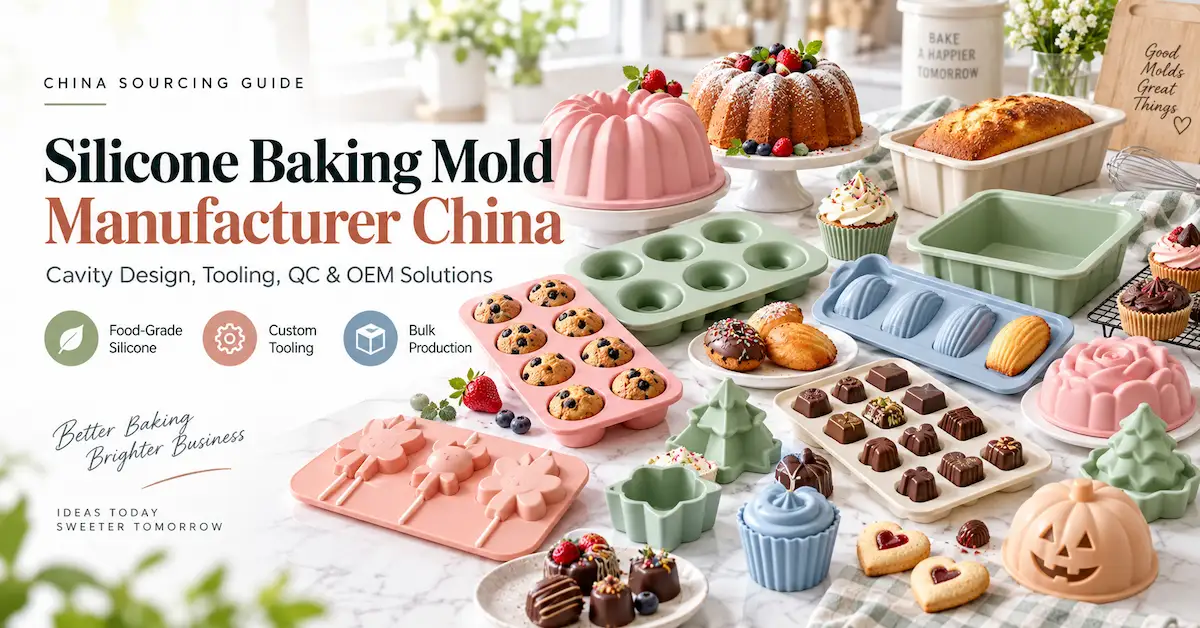
How to Evaluate a Silicone Baking Mold Manufacturer in China
Direct answer: A qualified silicone baking mold manufacturer in China should demonstrate control over cavity engineering, silicone material selection, tooling, sampling, production QC, packaging, and repeat-order traceability. Buyers should evaluate these capabilities against the exact SKU rather than relying only on catalog size, factory claims, or the lowest quotation.
Silicone baking molds appear simple, but their commercial performance depends on many connected variables. Cavity geometry affects release and food shape. Wall thickness affects stability and material cost. Silicone hardness influences both handling and demolding. Mold design affects production consistency, while packaging can determine whether the product arrives flat, distorted, clean, and retail-ready.
For professional buyers, the goal is therefore not simply to locate a factory that can mold silicone. The goal is to establish a controlled product specification that can be reproduced through sampling, bulk production, shipment, and future reorders.
Leadonex presents Kitchenware & Molds as one of its core silicone product categories. Buyers developing proprietary shapes, new cavity systems, private-label collections, or market-specific designs can also review its custom silicone manufacturing capabilities before preparing an RFQ.
What Should a Qualified Baking Mold Manufacturer Control?
Direct answer: The manufacturer should control six connected areas: product specification, cavity and mold engineering, silicone material, sample approval, production quality, and repeat-order records. A weakness in any one of these areas can create problems after an apparently successful sample.
| Control Area | What a Buyer Should Verify | Why It Matters |
|---|---|---|
| Product specification | Dimensions, cavity volume, structure, hardness, color, use conditions | Prevents ambiguous production requirements |
| Tooling | Mold design, cavity count, ownership, maintenance, revisions | Determines repeatability and scale |
| Material | Silicone type, pigment, batch control, relevant documentation | Affects safety, feel, color, and performance |
| Sample approval | Measurements, appearance, function, packaging | Creates the reference for bulk production |
| Production QC | First-piece, in-process and final inspection | Detects problems before shipment |
| Repeat-order control | Drawings, mold ID, golden sample, color formula, artwork | Prevents product drift over time |
A supplier that can make an attractive sample but cannot explain these controls may still be suitable for a simple catalog purchase. It is less suitable for an OEM program where product differentiation and repeatability matter.
Who Is This Guide For?
This guide is designed primarily for professional buyers comparing China-based silicone baking mold suppliers for OEM, private-label, tooling, or bulk production programs.
Kitchenware and Bakeware Brands
Brands usually need a clear product identity, controlled colors, unique shapes, packaging consistency, and reliable replenishment.
The main sourcing risk is not the first sample. It is whether the approved design remains consistent after several production runs.
Importers and Distributors
Importers frequently manage several shapes, price levels, colors, and packaging formats.
They need:
-
Stable SKU specifications
-
Clear documentation
-
Consolidated purchasing
-
Predictable production
-
Consistent repeat orders
Private-Label and E-Commerce Sellers
These buyers often compete through product differentiation and presentation.
They need to reduce problems such as:
-
Odor complaints
-
Bent or distorted molds
-
Incorrect dimensions
-
Color inconsistency
-
Poor demolding
-
Packaging damage
-
Different quality between reorders
Baking, Chocolate, and Dessert Brands
For these buyers, the mold may be part of the product experience itself.
Cavity accuracy, decorative detail, portion consistency, release behavior, and custom shapes can become important brand assets.
Start With a Product Brief, Not a Reference Photo
A reference photo helps explain an idea, but it is not a production specification.
Before asking a silicone baking mold manufacturer in China for a quotation, define what the mold must actually achieve.
Define the Product Type
Typical applications include:
-
Cake molds
-
Muffin and cupcake molds
-
Loaf molds
-
Chocolate molds
-
Candy molds
-
Mousse molds
-
Frozen dessert molds
-
Portion molds
-
Seasonal designs
-
Custom branded shapes
Different applications create different cavity, flexibility, detail, release, and packaging requirements.
Define the Target User
Clarify whether the product is intended for:
-
Home baking
-
Professional baking
-
Retail kitchenware
-
E-commerce
-
Gift sets
-
Promotional campaigns
-
Food brands
-
Seasonal collections
A premium pastry mold and a mass-market promotional mold should not automatically use the same engineering priorities.
Define the Destination Market
Destination affects:
-
Product documentation
-
Food-contact requirements
-
Packaging language
-
Product claims
-
Testing requirements
-
Labeling
A supplier should know where the product will be sold before final material and documentation decisions are made.
A Practical RFQ Starting Table
| Product-Brief Item | Buyer Input |
|---|---|
| Product type | Cake, muffin, chocolate, loaf, mousse, custom shape |
| Overall size | Length × width × height |
| Cavity count | Number of cavities |
| Cavity dimensions | Diameter, width, depth, or custom geometry |
| Target volume | Approximate portion or cavity capacity |
| Silicone requirement | Food-contact requirement, hardness if known |
| Color | Pantone or physical reference |
| Branding | Embossed, debossed, printed, packaging-only |
| Packaging | Bulk, sleeve, color box, set, e-commerce |
| Target market | Country or region |
| Quantity | Initial order and annual estimate |
Buyer takeaway: The more complete the RFQ, the easier it becomes to compare manufacturers on the same technical and commercial basis.
Cavity Engineering Determines Product Performance
A custom silicone baking mold is not simply a drawing converted into silicone.
The cavity influences:
-
Appearance
-
Portion size
-
Release
-
Structural strength
-
Cleaning
-
Tooling difficulty
-
Production consistency
Cavity Geometry and Detail
Detailed shapes can create stronger product differentiation, but every additional detail should have a functional reason.
Very narrow grooves, deep undercuts, thin decorative features, or abrupt geometry changes may create difficulties during molding or demolding.
Before tooling, ask:
-
Will the final baked shape retain the intended detail?
-
Can the product release without tearing or excessive inversion?
-
Can users clean the cavity easily?
-
Can the cavity be produced consistently across all positions in the tool?
Wall Thickness
Wall thickness affects both product feel and production cost.
A wall that is too thin may:
-
Collapse during filling
-
Feel weak
-
Deform easily
-
Lose shape
A wall that is unnecessarily thick may:
-
Increase silicone consumption
-
Increase product weight
-
Increase cost
-
Reduce flexibility
The correct thickness should be determined together with cavity size, hardness, and rim structure.
Rim and Handling Design
Large silicone molds may flex considerably when filled.
A suitable rim can improve:
-
Carrying
-
Filling
-
Stability
-
Shelf presentation
For some products, a reinforced border or support structure may be more valuable than simply increasing the thickness of the entire mold.
Cavity Spacing
Multi-cavity products need enough space between cavities to maintain structural stability.
Too little spacing may create weak connecting sections.
Too much spacing increases:
-
Product size
-
Material usage
-
Packaging volume
Cavity Volume
For portion-controlled molds, cavity volume should be treated as a measurable product characteristic.
A small change in:
-
Depth
-
Radius
-
Taper
-
Wall angle
can change the portion even when the cavity looks visually similar.
Buyer takeaway: Treat cavity geometry as an engineering specification, not only a styling decision. Confirm volume, dimensions, release path, wall thickness, spacing, rim stability, and critical tolerances before tooling approval.
Existing Mold, Modified Mold, or Fully Custom Tooling?
Not every private-label project needs a new mold.
The correct route depends on how much differentiation the buyer needs.
| Buyer Situation | Recommended Route | Main Advantage | Main Risk |
|---|---|---|---|
| Testing a new market | Existing mold + private label | Lowest development risk | Limited differentiation |
| Need different color/branding | Existing mold | Faster launch | Competitors may use similar shapes |
| Need minor structural changes | Modified design | Moderate differentiation | Existing tool may not support changes |
| Need proprietary shape | New custom mold | Strong differentiation | Higher tooling investment |
| Proven high-volume product | Production-optimized tooling | Better scaling potential | Higher upfront commitment |
Existing Mold
This can be suitable when the buyer mainly needs:
-
Custom color
-
Logo
-
Packaging
-
Product combinations
It is often a practical route for first market entry.
Modified Design
A modified design may involve:
-
Different cavity count
-
Revised rim
-
Different dimensions
-
Logo area
-
Surface texture
-
Small geometry changes
The supplier should explain whether the current tool can be modified or whether a new mold is technically safer.
Fully Custom Mold
A new tool is normally more appropriate for:
-
Exclusive shapes
-
Proprietary geometry
-
New structural concepts
-
Unique cavity systems
-
Strong brand differentiation
Leadonex's silicone kitchenware OEM guide provides additional context on how basic private labeling differs from deeper product development.
Material Selection Must Be Defined for the Exact Product
Direct answer: “Food-grade silicone” is not a complete purchasing specification. Buyers should confirm the proposed silicone type, hardness, pigment system, intended food-contact use, target market, and applicable documentation for the actual SKU.
Leadonex's OEM/ODM manufacturing information lists food-grade silicone, solid silicone, and liquid silicone rubber among its broader material and process options.
The exact choice still needs to be matched to the mold design.
Hardness and Flexibility
A softer mold may:
-
Release detailed shapes more easily
-
Flex more during use
But it may also:
-
Feel less stable when filled
-
Be harder to carry
A harder mold may provide better support but require more force during demolding.
Hardness should therefore be considered together with:
-
Product dimensions
-
Cavity depth
-
Rim design
-
Wall thickness
-
Expected handling
Color Control
Private-label bakeware often depends on coordinated brand colors.
The factory should preserve:
-
Approved Pantone
-
Physical color standard
-
Pigment formula
-
Batch reference
This becomes particularly important when buyers later add new shapes using the same branded color.
Odor Control
Odor can become a significant customer complaint even when the product looks acceptable.
Buyers should discuss:
-
Material
-
Curing
-
Post-curing where applicable
-
Cleaning
-
Storage
-
Packaging
Rather than relying on a general “odor-free” marketing statement, agree on the acceptance expectation for the actual product.
Food-Contact Documentation
Factory certificates and product-level food-contact evidence are not the same thing.
Ask:
-
Which document covers the material?
-
Which document covers the finished product?
-
Which market does it apply to?
-
Does it cover the selected formulation and pigment?
-
Do printing or other components change the compliance scope?
-
Is additional testing required?
Buyer takeaway: Verify documents against the exact material, finished SKU, and destination market rather than assuming that a company-level certificate automatically applies to every product.
Compression Molding vs LSR for Silicone Baking Molds
The manufacturing process should follow the product—not marketing language.
Leadonex lists both compression molding and LSR molding within its broader custom silicone manufacturing capabilities.
Compression Molding
Compression molding can be appropriate for many solid-silicone baking molds.
Important controls include:
-
Material preparation
-
Mold condition
-
Cure settings
-
Material loading
-
Flash
-
Trimming
-
First-piece inspection
LSR Molding
Liquid Silicone Rubber molding can be appropriate for products designed for an injection-based process.
Its suitability depends on:
-
Geometry
-
Material
-
Automation requirement
-
Volume
-
Tool design
-
Investment
How Buyers Should Compare the Two
Do not ask only:
Which process is better?
Ask:
Which process is more appropriate for this exact geometry, quantity, quality target, and commercial plan?
A capable manufacturer should be able to explain the engineering and cost logic behind the recommendation.
Tooling Cost: Understand What the Quote Includes
Tooling can be one of the largest one-time expenses in a custom silicone baking mold project.
The quotation should therefore be transparent.
What Influences Tooling Cost?
Key factors include:
-
Tool size
-
Number of cavities
-
Geometry
-
Decorative detail
-
Surface finish
-
Undercuts
-
Machining complexity
-
Venting
-
Production cavity count
-
Expected output
-
Revision requirements
Tool Ownership
Before paying for a mold, clarify:
-
Who legally owns it?
-
Where will it be stored?
-
Can it be used for another customer?
-
Who maintains it?
-
What is included in routine maintenance?
-
How are revisions documented?
-
What happens if the commercial relationship ends?
Mold Revision Control
Each engineering change should have a revision record.
If the buyer changes:
-
Cavity depth
-
Rim
-
Logo
-
Surface texture
-
Dimensions
the updated drawing, mold record, sample, and inspection standard should reference the same revision.
Buyer takeaway: Before paying for tooling, confirm mold ownership, included revisions, cavity count, maintenance responsibility, production output assumptions, and change-control rules in writing.
Sample Approval Should Validate Commercial Performance
A visually attractive sample is not automatically ready for mass production.
Sample approval should answer four questions:
-
Is the product dimensionally correct?
-
Does it function as intended?
-
Does it meet the agreed appearance standard?
-
Can it be packaged and reproduced consistently?
Dimensional Review
Possible critical dimensions include:
-
Overall length
-
Overall width
-
Product height
-
Cavity diameter or width
-
Cavity depth
-
Rim thickness
-
Spacing
-
Logo position
Not every dimension needs an extremely tight tolerance.
The important step is identifying which dimensions affect function, portion size, packaging, or presentation.
Appearance Review
Check:
-
Flash
-
Bubbles
-
Stains
-
Surface marks
-
Deformation
-
Short fill
-
Incomplete details
-
Poor trimming
-
Color variation
Functional Validation
Where relevant, test:
-
Filling
-
Carrying
-
Demolding
-
Shape recovery
-
Cavity detail
-
Cleaning access
-
Stacking
-
Packaging fit
Golden Sample
After approval, retain a final physical sample together with:
-
Drawing
-
Material specification
-
Color standard
-
Logo artwork
-
Packaging artwork
-
Inspection requirements
-
Revision number
This becomes the reference for mass production and future orders.
Use a Pilot Run Before a Large Launch
A development sample is often produced under close supervision.
A pilot production run helps answer a different question:
Can the same product be produced consistently under normal manufacturing conditions?
A pilot run can reveal:
-
Cavity-to-cavity differences
-
Trimming workload
-
Color variation
-
Actual defect patterns
-
Packaging problems
-
Production bottlenecks
-
Inspection workload
For proprietary or high-value products, this intermediate step can reduce launch risk.
Quality Control Should Follow the Product’s Failure Modes
Direct answer: Effective silicone baking mold QC should include incoming-material control, first-piece approval, in-process inspection, product-specific functional checks, and final inspection. A generic “strict QC” claim is not enough.
| Potential Issue | Commercial Impact | Appropriate Control |
|---|---|---|
| Excess flash | Poor appearance and trimming marks | Mold/process control and appearance standard |
| Short fill | Missing cavity detail | First-piece and in-process inspection |
| Bubbles | Visual defect | Material/process control |
| Warpage | Unstable filling or packaging problems | Structural and dimensional review |
| Color difference | Poor brand consistency | Color formula and master sample |
| Wrong cavity volume | Inconsistent portions | Critical dimension/volume verification |
| Rough trimming | Poor perceived quality | Trimming standard |
| Odor | Returns and poor reviews | Material/process/storage control |
| Weak rim | Difficult handling | DFM and functional validation |
| Packaging deformation | Poor arrival condition | Product-fit packaging validation |
Incoming Material Control
Confirm:
-
Material identification
-
Batch information
-
Pigment
-
Relevant documents
First-Piece Approval
Before full production begins, approve the initial pieces against:
-
Dimensions
-
Appearance
-
Color
-
Structure
In-Process Inspection
Production should monitor the actual defects most likely to occur during the run.
Final Inspection
The final inspection should include agreed:
-
Product characteristics
-
Branding
-
Quantity
-
Packaging
-
Labels
-
Carton configuration
Buyer takeaway: Ask the manufacturer what is inspected, when it is inspected, and what acceptance standard is used. “Strict QC” without measurable criteria provides little procurement value.
Compare Total Project Cost, Not Just Unit Price
A low unit quotation may become expensive if the project later requires:
-
Mold changes
-
Repeated samples
-
Rework
-
Replacement products
-
New packaging
-
Additional inspection
-
Launch delays
One-Time Costs
These can include:
-
Engineering
-
Tooling
-
Samples
-
Testing
-
Packaging development
-
Artwork setup
Recurring Costs
These can include:
-
Silicone
-
Pigment
-
Molding
-
Trimming
-
Printing
-
Inspection
-
Packaging
-
Cartons
Hidden Commercial Costs
Buyers should also consider:
-
Delayed launches
-
Customer returns
-
Inventory write-offs
-
Inconsistent repeat orders
-
Packaging failures
-
Compliance gaps
| Cost Driver | Why It Matters | Buyer Action |
|---|---|---|
| Product weight | Changes silicone consumption | Optimize structure, not only thickness |
| Cavity detail | Affects tooling complexity | Keep detail that creates customer value |
| Tool cavity count | Changes tooling and output | Match tooling to forecast |
| Color | Adds matching and control work | Approve color before production |
| Branding | Different methods change cost | Decide during design |
| Packaging | Can materially change landed cost | Develop with the product |
| Testing | Adds time and expense | Define target market early |
| Low order quantity | Spreads setup cost over fewer units | Use staged launch planning |
MOQ Should Be Viewed as a System, Not One Number
A factory may have one MOQ for molding and a different MOQ for:
-
Printed boxes
-
Labels
-
Inserts
-
Custom colors
-
Accessories
Therefore, buyers should ask for the MOQ structure rather than only:
What is your MOQ?
A staged launch can reduce risk:
-
Design and sample approval
-
Pilot production
-
Initial commercial order
-
Market feedback
-
Repeat order
-
Capacity optimization if demand is proven
Packaging Is Part of Product Quality
Silicone is flexible, which can reduce shipping volume—but flexibility also creates packaging risks.
A mold that is compressed for too long may arrive in poor visual condition.
Packaging development should consider:
-
Product shape
-
Cavity protection
-
Nesting
-
Folding
-
Surface protection
-
Retail presentation
-
Carton pressure
-
E-commerce handling
For premium molds, packaging should be sampled with the actual product rather than designed only from dimensions.
How to Qualify a Silicone Baking Mold Manufacturer in China
A silicone baking mold manufacturer in China should be evaluated using evidence rather than general claims.
Engineering Capability
Can the team identify risks in:
-
Cavity geometry
-
Wall thickness
-
Demolding
-
Rim structure
-
Mold construction
before tooling begins?
Tooling Capability
Can the supplier explain:
-
Mold design
-
Cavity count
-
Maintenance
-
Revisions
-
Ownership
Material Control
Can it identify:
-
Material
-
Batch
-
Pigment
-
Approved color
-
Relevant documentation
Production QC
Can it show how first-piece, in-process, and final inspection are connected to the product specification?
Repeat-Order Control
Can the supplier preserve:
-
Drawing
-
Golden sample
-
Color formula
-
Mold ID
-
Packaging artwork
-
Revision history
Capacity
Ask for SKU-level output, not only total factory capacity.
The Leadonex silicone kitchenware factory audit guide provides a broader framework for evaluating production control, tooling, QC, capacity, and traceability.
Use a Weighted Supplier Scorecard
A scorecard prevents unit price from dominating the decision.
| Evaluation Area | Suggested Weight |
|---|---|
| Product engineering and DFM | 15% |
| Material and compliance control | 15% |
| Tooling capability | 15% |
| Production QC | 15% |
| Sample and pilot discipline | 10% |
| Repeat-order traceability | 10% |
| Capacity and delivery planning | 10% |
| Packaging and private label | 5% |
| Commercial clarity | 5% |
A proprietary premium mold may justify higher weighting for tooling, DFM, and IP.
A seasonal promotion may place more weight on schedule.
The purpose is not to create one universal supplier score. It is to make the purchasing logic explicit.
Plan Capacity Around the Actual SKU
Overall factory capacity is useful background, but it does not equal output for one product.
Leadonex publicly presents factory-level manufacturing capability and production resources on its About Us and customization pages.
For an actual baking-mold program, buyers should request product-specific output based on:
-
Tool count
-
Cavity count
-
Cycle time
-
Cure time
-
Trimming
-
Inspection
-
Color changes
-
Printing
-
Packaging
A six-shape, four-color program requires very different planning from a one-SKU order.
Protect Repeat Orders From Product Drift
Repeat orders should not rely on employee memory.
Maintain a controlled product file containing:
-
Final drawing
-
Material
-
Mold identification
-
Color formula
-
Golden sample
-
Logo artwork
-
Packaging artwork
-
Inspection standard
-
Revision history
Any engineering change should be approved before production.
This prevents gradual changes that may individually seem small but eventually create a product materially different from the original launch version.
How Leadonex Supports Custom Baking Mold Projects
Leadonex's published manufacturing information describes capabilities covering product development, material selection, tooling, silicone molding, post-processing, branding, quality inspection, custom packaging, and bulk production.
Its custom silicone manufacturing service includes compression molding and LSR-related manufacturing capabilities, while its OEM/ODM service describes requirement analysis, design and development, sample making, production, quality inspection, and delivery.
For baking-mold sourcing, those factory-level capabilities still need to be translated into a product-specific plan covering:
-
Cavity engineering
-
Material
-
Mold
-
Sample approval
-
QC
-
Documentation
-
Packaging
-
Capacity
-
Lead time
Buyers can also review Leadonex's existing silicone cupcake mold bulk guide and silicone chocolate mold wholesale guide for more category-specific sourcing considerations.
What Should a Professional RFQ Include?
A good RFQ should make it possible for several suppliers to quote the same product.
Product Information
Include:
-
Drawing or reference sample
-
Overall dimensions
-
Cavity dimensions
-
Cavity count
-
Target volume
-
Surface finish
-
Required structural features
Material Information
Include:
-
Target market
-
Intended use
-
Food-contact requirement
-
Hardness if known
-
Color
-
Testing requirement
Branding and Packaging
Include:
-
Logo
-
Artwork
-
Packaging format
-
Label
-
Barcode
-
Retail or e-commerce channel
Commercial Information
Include:
-
Initial order quantity
-
Annual forecast
-
Number of colors
-
Number of SKUs
-
Launch schedule
-
Shipping destination
If a technical variable is unknown, mark it as an engineering question rather than guessing.
Questions to Ask Before Paying for Tooling
Before committing to a custom mold, ask:
-
Which silicone material is proposed?
-
Why is the proposed molding process suitable?
-
What DFM changes are recommended?
-
Which dimensions are critical?
-
How many production cavities will the tool have?
-
What is included in the tooling price?
-
Who owns the mold?
-
How many sample revisions are included?
-
How are mold changes documented?
-
How is the approved color stored?
-
Which quality checks are performed?
-
Which documents apply to the product?
-
What is realistic output for this SKU?
-
What is the production bottleneck?
-
How will packaging prevent deformation?
Clear answers before tooling usually cost less than correcting ambiguity after tooling.
FAQ
What Is a Silicone Baking Mold Manufacturer in China?
A silicone baking mold manufacturer in China produces or manages the molding, tooling, quality control, and bulk production of silicone bakeware. For OEM projects, buyers should verify which engineering, mold-making, material, packaging, and testing activities are controlled directly by the supplier.
Why Source Silicone Baking Molds From China?
China has an established ecosystem for silicone molding, tooling, packaging, and export production. The commercial benefit depends on choosing a supplier whose engineering capability, documentation, QC, capacity, communication, and repeat-order controls match the actual product.
Do Private-Label Baking Molds Always Need New Tooling?
No. Existing molds may support custom colors, branding, and packaging. New tooling becomes more relevant when buyers need proprietary dimensions, cavity geometry, structural changes, or exclusive designs.
How Is Custom Silicone Mold Cost Calculated?
Tooling cost can depend on mold size, cavity count, detail, geometry, finish, machining complexity, expected production output, and revision requirements. Buyers should confirm exactly what the tooling quotation includes.
What Is the Best Silicone Hardness for Baking Molds?
There is no single best hardness. The appropriate level depends on product size, wall thickness, cavity depth, rim design, flexibility, and handling requirements.
Compression Molding or LSR: Which Is Better?
Neither is universally better. The correct process depends on geometry, material, volume, tooling investment, automation requirements, and the intended product.
How Should a Baking Mold Sample Be Approved?
Review dimensions, cavity volume, color, surface, flash, deformation, demolding, shape recovery, branding, and package fit. Retain the approved product as a golden sample together with the final specification.
What Food-Contact Documents Should Buyers Request?
The required evidence depends on the silicone formulation, pigments, finished product, destination market, and other components. Verify the scope of each document instead of relying on a generic certificate list.
How Can Buyers Reduce Tooling Risk?
Complete a DFM review before machining, define mold ownership, agree on sample revisions, approve critical dimensions, document design changes, and consider pilot production before a large commercial order.
How Can Buyers Control Repeat-Order Quality?
Maintain a controlled product file containing the drawing, mold ID, material specification, color formula, golden sample, logo artwork, packaging artwork, QC criteria, and revision history.
What Should Buyers Compare Besides Unit Price?
Compare tooling, samples, testing, packaging, defect risk, production capacity, repeat-order consistency, communication, and landed cost. A slightly lower unit price may not reduce total project cost.
How Can I Start a Custom Baking Mold Project?
Prepare your drawing, reference sample, dimensions, cavity requirements, target market, colors, packaging, expected quantity, and launch schedule. You can then contact Leadonex for a project and tooling evaluation.
Conclusion
Choosing a silicone baking mold manufacturer in China requires more than comparing unit prices. Buyers should evaluate cavity engineering, material control, tooling ownership, sample validation, product-specific QC, packaging, realistic capacity, and repeat-order traceability before committing to bulk production.
For a new silicone baking mold, private-label collection, or custom cavity project, contact Leadonex for an OEM/ODM manufacturing and tooling evaluation or review its custom silicone manufacturing capabilities before requesting a final quotation.