
How Should Buyers Evaluate a Silicone Cookware Manufacturer?
Choosing a silicone cookware manufacturer is not simply a matter of finding the lowest unit price.
For kitchenware brands, importers, distributors, and private-label buyers, a reliable manufacturing partner should be able to control the full product development process, including material selection, tooling, molding, sampling, quality inspection, branding, packaging, and repeat production.
The real sourcing question is therefore:
Can this manufacturer turn your product requirements into a stable, repeatable manufacturing specification?
That distinction becomes especially important for silicone cookware because different products can require very different structures, hardness levels, molding methods, inspection points, and food-contact documentation.
Buyers can begin by reviewing Leadonex's current silicone kitchenware and mold products and then use its custom silicone manufacturing service when a project requires new tooling, structural changes, private labeling, or OEM/ODM development.
What Does a Silicone Cookware Manufacturer Actually Produce?
In B2B sourcing, “silicone cookware” is often used as a broad commercial term.
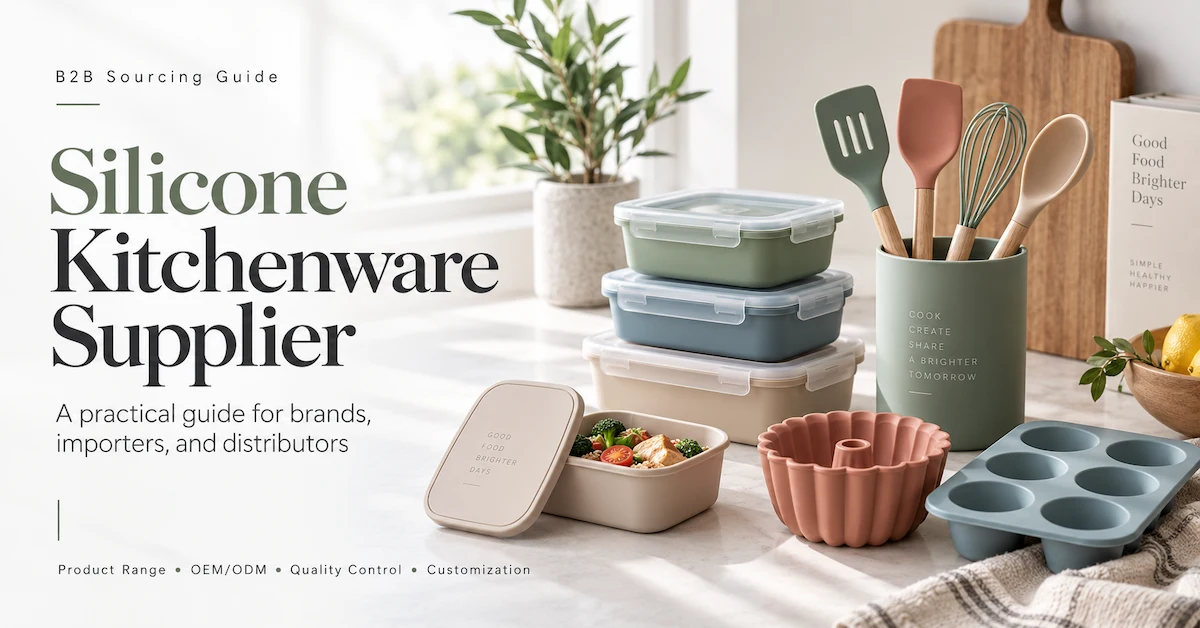
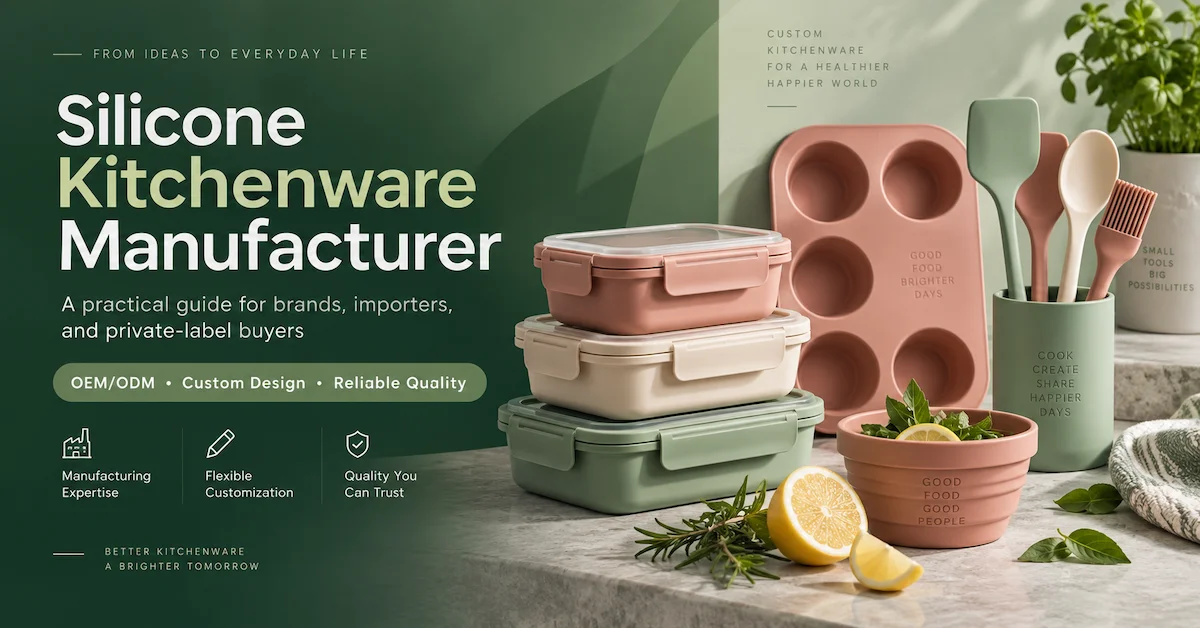
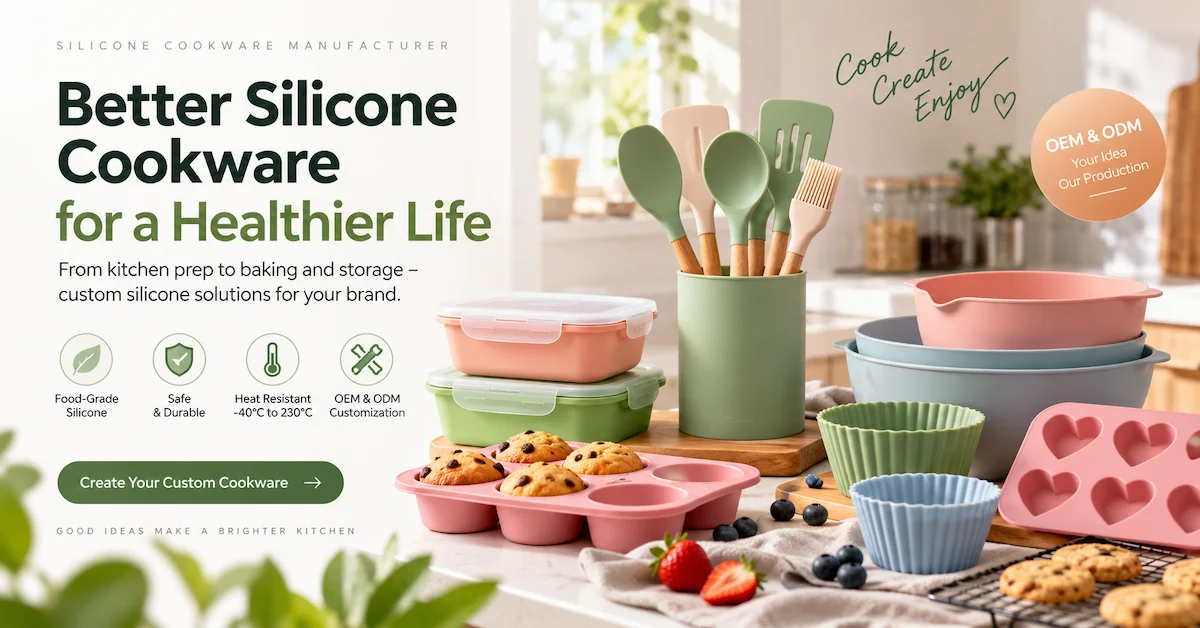
It may include products used for baking, cooking, food preparation, serving, storage, and portable meal solutions.
Common product directions include:
-
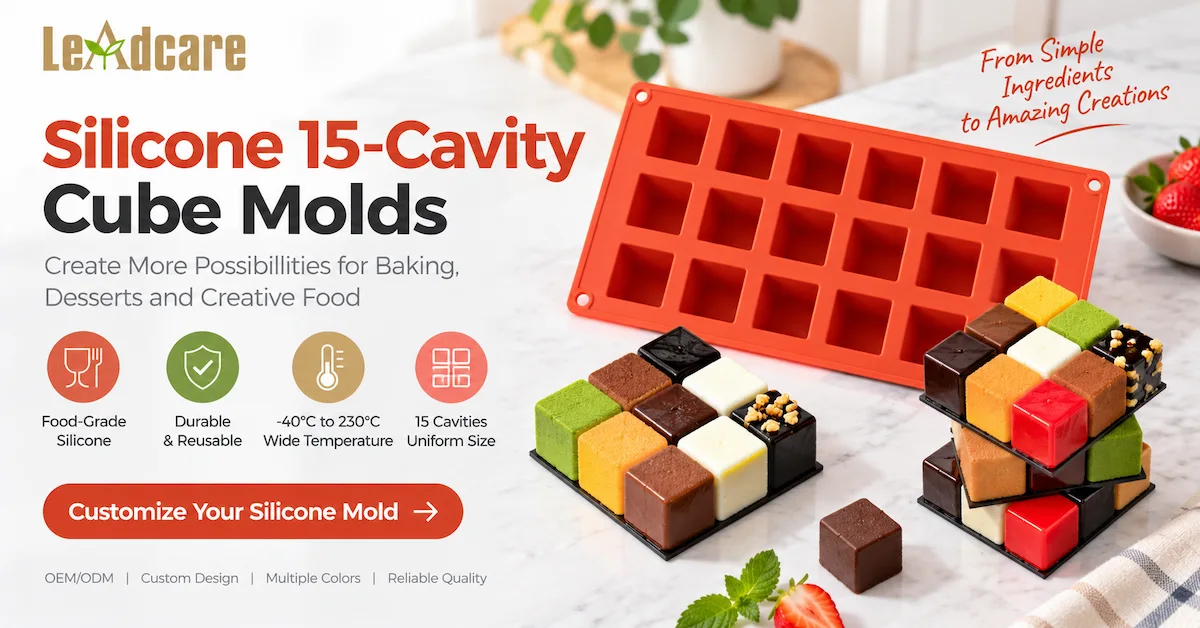
Silicone baking molds
-
Silicone cake molds
-
Chocolate molds
-
Ice molds
-
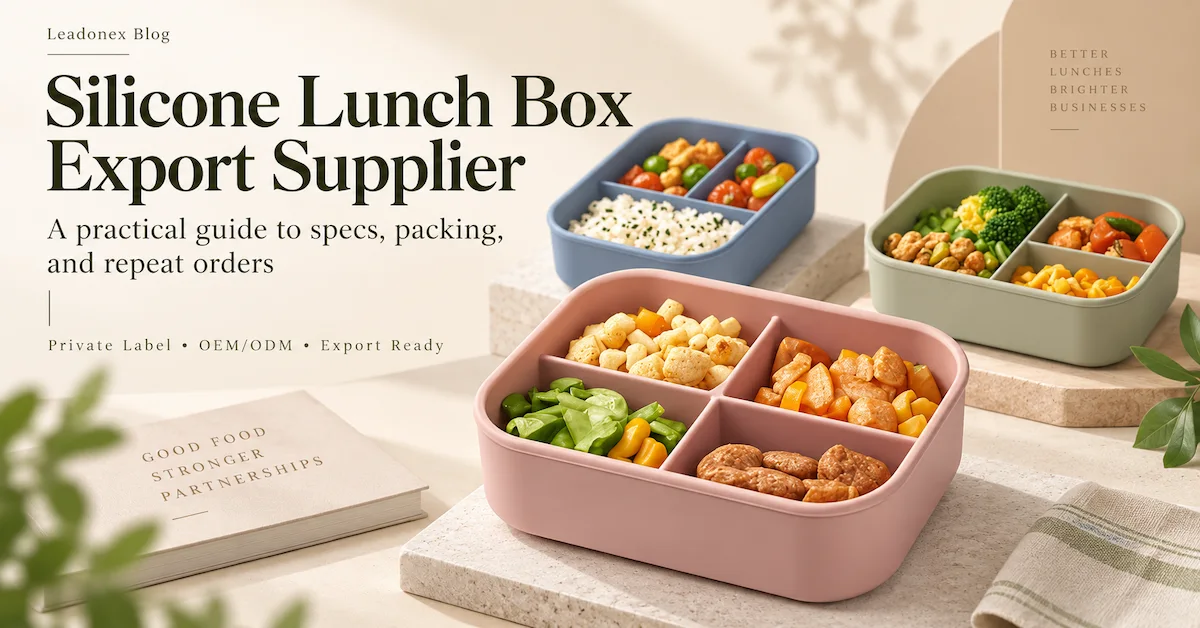
Silicone food containers
-
Foldable lunch boxes
-
Cooking utensils
-
Food storage products
-
Custom molded kitchen accessories
The exact manufacturing requirements vary significantly by product.
A baking mold may require careful cavity design and demolding performance, while a foldable food container may depend more heavily on wall thickness, folding geometry, lid fit, and recovery after repeated use.
Why Product Definition Matters Before RFQ
A factory cannot provide a meaningful quotation if the product specification is unclear.
Before requesting pricing, buyers should define:
-
Product type
-
Dimensions
-
Capacity
-
Material
-
Hardness
-
Color
-
Structure
-
Components
-
Logo
-
Packaging
-
Target market
-
Required testing
-
Expected order volume
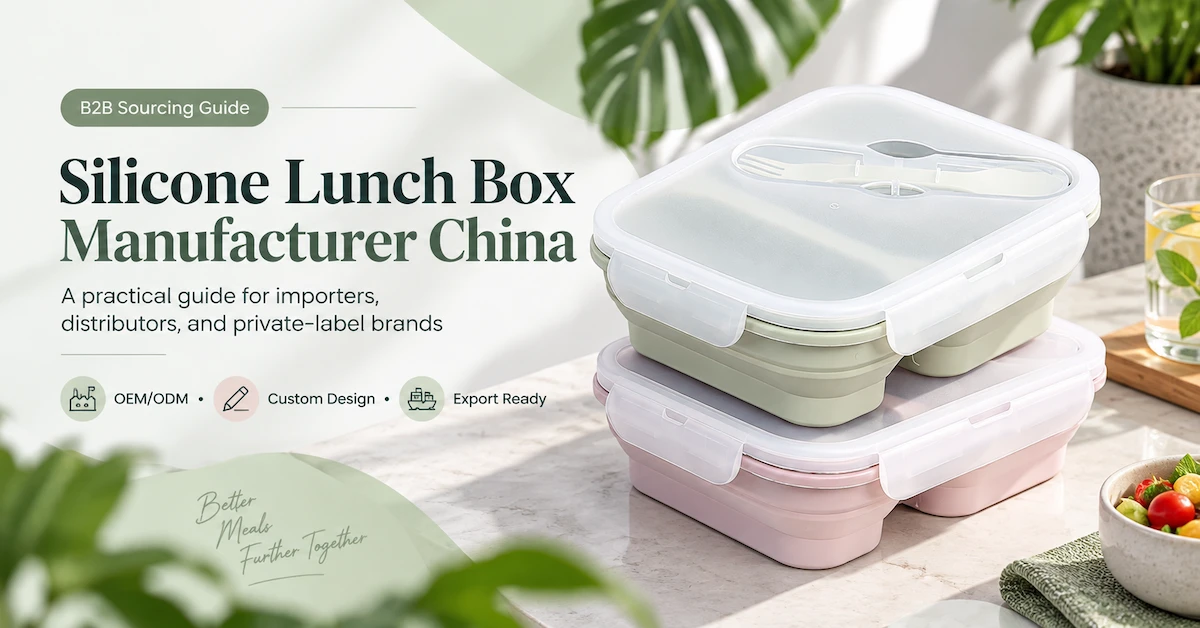
For example, Leadonex currently displays a single-compartment foldable silicone lunch box. A professional RFQ for this type of product should specify more than just the product name.
It should also identify the container dimensions, folding structure, lid configuration, cutlery setup, color, packaging, and quality expectations.
Which Buyers Typically Source Silicone Cookware?
Silicone cookware manufacturing is mainly relevant to buyers who need stable commercial supply rather than one-off consumer purchases.
Kitchenware Brands
Kitchenware brands typically focus on:
-
Product differentiation
-
Exclusive colors
-
Custom structures
-
Logo application
-
Packaging
-
Long-term replenishment
Importers and Distributors
Their priorities often include:
-
Stable supply
-
Competitive landed cost
-
Product documentation
-
Multi-SKU sourcing
-
Batch consistency
-
Repeat-order reliability
Private-Label Buyers
Private-label projects commonly require:
-
Pantone color matching
-
Logo customization
-
Retail packaging
-
Product combinations
-
Labeling
-
Barcode or SKU management
E-Commerce Brands
Amazon, Shopify, and DTC brands may care more about:
-
Differentiated design
-
Packaging presentation
-
Lower initial commercial risk
-
Product consistency
-
Review-related quality issues
-
Fast repeat orders
Product Development Teams
Product managers and designers usually focus on:
-
Structure
-
Material behavior
-
Moldability
-
Prototype approval
-
Tooling
-
Function
-
Manufacturability
The more customized the project becomes, the more important engineering support, sample control, tooling management, and written specifications become.
Material Selection Should Be Defined Before Comparing Prices
One of the most important questions buyers should ask a silicone cookware manufacturer is:
What silicone material is proposed for this exact application?
The answer should be more specific than simply saying “food-grade silicone.”
Leadonex's OEM and silicone material information lists ordinary silicone rubber, food-grade silicone rubber, medical silicone rubber, HTV solid silicone, and LSR liquid silicone rubber among its available material directions.
What Affects Silicone Material Selection?
Material selection may depend on:
-
Intended food-contact use
-
Temperature conditions
-
Product flexibility
-
Hardness
-
Tear resistance
-
Geometry
-
Structural design
-
Surface requirements
-
Molding process
-
Target market
-
Testing requirements
A silicone baking mold, collapsible container, and reinforced kitchen tool may therefore require different material or process decisions.
Food-Grade Silicone Is Not a Complete Specification
The phrase “food-grade silicone” is useful, but it does not answer every procurement question.
Buyers should confirm:
-
The proposed material
-
Applicable food-contact requirement
-
Test report relevance
-
Target market
-
Product configuration
-
Pigments or additives
-
Finished-product testing needs
Leadonex publicly references FDA-, LFGB-, and DGCCRF-related food-grade material options.
However, professional buyers should still verify whether the relevant documentation applies to the exact material and finished product they intend to purchase.
Buyer takeaway: Never assume that a factory-level statement automatically proves compliance for every individual SKU.
HTV vs LSR: Which Silicone Process Is Better?
There is no universal answer.
The appropriate manufacturing process depends on product design, material requirements, production volume, geometry, tooling, and desired consistency.
Leadonex lists both silicone compression molding and liquid silicone rubber molding among its manufacturing capabilities.
HTV and Compression Molding
HTV solid silicone is commonly associated with compression molding applications.
It may be suitable for products where buyers need:
-
Flexible molded structures
-
Defined hardness
-
Larger silicone parts
-
Custom cavity shapes
-
Controlled wall thickness
-
Traditional molded kitchenware
The exact suitability depends on the product design.
LSR Molding
Liquid Silicone Rubber molding may be suitable for products that require a different injection-based manufacturing route.
Potential decision factors include:
-
Product geometry
-
Production efficiency
-
Precision requirements
-
Material behavior
-
Tooling design
-
Volume
What Buyers Should Ask the Manufacturer
Instead of asking:
Is LSR better than compression molding?
Ask:
Which process do you recommend for this product, and what engineering or commercial factors support that recommendation?
A capable silicone cookware manufacturer should be able to explain the process choice in practical terms.
Tooling Determines the Depth of Customization
There is a major difference between private labeling an existing product and developing a new silicone cookware design.
Changing a logo or color may require little or no tooling change.
Changing the dimensions, cavity structure, wall thickness, folding mechanism, or product shape may require mold modification or completely new tooling.
Leadonex's customization service covers dimensions, structure, material, hardness, color, logo, patterns, packaging, and mold development.
Three Common OEM Development Routes
| Development Route | Typical Changes | New Tooling | Best For |
|---|---|---|---|
| Existing Product Private Label | Color, logo, packaging | Usually not | Market testing and standard collections |
| Existing Product Modification | Size, cavities, details, structure | Sometimes | Brands seeking product differentiation |
| Fully Custom Development | New shape, structure, function | Usually | Proprietary products and long-term programs |
Why Mold Capability Matters
The mold controls much of the product geometry.
A manufacturer with tooling capability can potentially support:
-
Structure optimization
-
Cavity changes
-
New product development
-
Mold maintenance
-
Mold modification
-
Multi-cavity production planning
Leadonex publicly states that its CNC mold machining capability can reach precision of up to ±0.01 mm.
That should be understood as a mold machining capability, not as a guarantee that every finished silicone product has a ±0.01 mm tolerance.
Finished-product tolerance must be evaluated according to the material, structure, molding process, and individual product specification.
How Should Buyers Approve Silicone Cookware Samples?
Sample approval should be treated as a production-control step, not simply a visual review.
A buyer should not approve a sample only because it “looks correct.”
The sample should be checked against a written specification.
Key Sample Approval Points
Dimensions
Check critical product dimensions and fit.
Material
Confirm the approved material specification.
Hardness
Ensure flexibility and stiffness match the intended function.
Color
Compare against the agreed Pantone or master color reference.
Surface
Check:
-
Flash
-
Bubbles
-
Stains
-
Deformation
-
Uneven texture
-
Trimming quality
Function
Depending on the product, check:
-
Folding
-
Rebound
-
Lid fit
-
Sealing
-
Demolding
-
Suction
-
Grip
-
Component fit
Branding
Verify logo size, location, clarity, and process.
Packaging
Confirm the retail or shipping configuration before mass production.
Use a Golden Sample
Once approved, a physical golden sample can become an important reference for production and repeat orders.
It should be used together with:
-
Product drawings
-
Written specifications
-
Material requirements
-
Pantone references
-
Packaging artwork
-
Inspection criteria
This creates a much stronger basis for quality control than verbal approval.
What Should Quality Control Cover?
Statements such as “strict QC” or “high quality” are not enough for professional procurement.
Buyers should ask what is actually inspected.
Leadonex's manufacturing information references raw-material testing, dimensional measurement, physical-property testing, process inspection, and final product control.
Typical Silicone Cookware QC Areas
| QC Area | Typical Inspection Points |
|---|---|
| Raw Material | Material specification, color preparation, applicable documents |
| Dimensions | Length, width, height, cavity size, part fit |
| Appearance | Flash, bubbles, stains, deformation, surface quality |
| Function | Folding, rebound, lid fit, sealing, demolding |
| Color | Consistency with approved reference |
| Branding | Logo position, size, clarity |
| Assembly | Components and accessories |
| Packaging | Artwork, label, SKU, quantity, retail presentation |
Not every inspection point applies to every product.
A silicone cake mold and a collapsible lunch box should not use exactly the same inspection plan.
The QC plan should follow the product's real failure risks.
How Should Compliance Documents Be Verified?
This is one of the most important areas for food-contact silicone sourcing.
A company may hold factory or management certifications while an individual product requires separate testing or documentation.
Leadonex's custom manufacturing information publicly references certifications and audit programs including:
-
ISO9001
-
ISO14001
-
BSCI
-
SEDEX
-
BRC
These types of company- or factory-level credentials should not automatically be treated as product-level food-contact evidence.
Ask Six Compliance Questions
Before ordering, ask:
-
Which document applies to the silicone material?
-
Which document applies to the finished product?
-
Which market does the document cover?
-
Is the report relevant to the current formulation?
-
Does printing, pigment, or assembly affect compliance?
-
Does the destination market require additional testing?
This helps prevent a common sourcing mistake: accepting a large certificate list without checking whether the documents actually apply to the purchased SKU.
How Important Is Factory Capacity?
Factory scale can help buyers assess whether a supplier is suitable for larger or recurring programs.
Leadonex publicly states:
-
Approximately 15,300 m² factory area
-
135 employees
-
120 production and testing equipment units
-
Overall daily production capacity reaching up to approximately 38,000 sets
These figures provide a useful indication of general factory capacity.
However, they should not be interpreted as the guaranteed output of one silicone cookware SKU.
Actual SKU Capacity Depends On
-
Mold quantity
-
Number of mold cavities
-
Product weight
-
Molding cycle
-
Product complexity
-
Printing
-
Trimming
-
Assembly
-
Packaging
-
Inspection
-
Production scheduling
For large orders, buyers should ask for a production plan based on the actual product and order mix.
You can review more company information on the Leadonex About Us page.
Why Repeat-Order Consistency Matters
The first order is not the only test of a silicone cookware manufacturer.
Many supply-chain issues appear during repeat orders.
A manufacturer should be able to preserve:
-
Approved material
-
Drawings
-
Mold identification
-
Pantone color
-
Golden sample
-
Logo artwork
-
Packaging artwork
-
Components
-
Inspection standard
-
Revision history
Without this information, future orders may gradually drift away from the original approved product.
Repeat Orders Should Not Restart From Zero
For long-term buyers, a controlled specification system helps reduce:
-
Color variation
-
Structure changes
-
Packaging mistakes
-
Material substitutions
-
Component mismatches
-
Approval delays
That is why repeatability can be more valuable than a small difference in the initial unit price.
What Determines Silicone Cookware Cost?
There is no meaningful universal price for custom silicone cookware.
Price depends on the product specification.
Material
Material grade, formulation, hardness, pigments, and performance requirements can affect cost.
Product Weight
Higher material consumption usually increases cost.
Mold Complexity
Tooling cost may depend on:
-
Product dimensions
-
Cavity count
-
Geometry
-
Surface details
-
Mold structure
-
Machining requirements
Color Requirements
Precise Pantone matching may require additional preparation and control.
Secondary Processing
Additional steps may include:
-
Printing
-
Laser marking
-
Trimming
-
Assembly
-
Surface treatment
-
Packaging
Testing
Product-specific testing can create additional project cost.
Packaging
Packaging choices may range from simple bulk packing to:
-
Printed retail boxes
-
Gift boxes
-
Inserts
-
Labels
-
Barcodes
-
Multi-product sets
Order Quantity
Volume affects production efficiency and the way tooling, setup, packaging, and purchasing costs are allocated.
Buyer takeaway: Compare the complete project cost rather than unit price alone.
How Can Buyers Reduce Silicone Cookware Sourcing Risk?
A practical supplier evaluation process should focus on evidence.
Check Product Experience
Does the manufacturer already work with products similar to yours?
Confirm Material Knowledge
Can the supplier explain why a specific silicone material is recommended?
Evaluate Process Capability
Does the factory have the required molding technology?
Review Tooling Support
Can it develop, modify, and maintain molds?
Check Engineering Capability
Can the team support product structure and manufacturability?
Review Sampling Discipline
Can samples become formal production references?
Confirm QC Logic
Does the inspection plan match actual product risks?
Verify Compliance Relevance
Are documents relevant to the exact material, product, and market?
Review OEM Depth
Can the supplier support more than logo printing?
Test Repeat-Order Management
Can the factory reproduce the same product in future orders?
These questions are more useful than simply asking whether the factory is “professional.”
How Does Leadonex Support Silicone Cookware OEM and ODM?
Leadonex positions its silicone manufacturing service around product development, materials, molding, tooling, quality control, branding, packaging, and mass production.
Its published OEM/ODM workflow includes six main stages:
-
Requirement Analysis
-
Design & Development
-
Sample Making
-
Mass Production
-
Quality Inspection
-
Delivery Service
The company also provides a more detailed custom manufacturing workflow that includes material selection, prototype development, tooling, molding, curing, post-processing, logo application, packaging, and final quality inspection.
Typical Project Types
Leadonex can potentially support projects such as:
-
Existing-product private label
-
Color customization
-
Logo application
-
Packaging development
-
Existing-product modification
-
New mold development
-
Custom silicone products
-
Multi-SKU kitchenware programs
Buyers can review Leadonex OEM and ODM capabilities or explore its custom silicone product development service.
What Should You Include in a Silicone Cookware RFQ?
A detailed RFQ makes quotations more accurate and supplier comparisons more useful.
Include as much of the following information as possible:
-
Product name
-
Reference image
-
Physical sample
-
2D drawing
-
3D file
-
Dimensions
-
Capacity
-
Intended use
-
Material requirements
-
Hardness
-
Temperature conditions
-
Target market
-
Pantone color
-
Logo method
-
Packaging
-
Testing requirements
-
Initial quantity
-
Estimated annual quantity
-
Required delivery schedule
What If Some Specifications Are Unknown?
Do not guess.
Mark unknown items as engineering questions and ask the manufacturer to review them.
This is especially important for:
-
Hardness
-
Mold design
-
Product tolerance
-
Molding process
-
Material grade
-
Testing requirements
A good RFQ does not need every answer on day one, but it should clearly separate confirmed requirements from open technical decisions.
FAQ
What Products Can a Silicone Cookware Manufacturer Produce?
Depending on its manufacturing and tooling capabilities, a supplier may produce silicone baking molds, food containers, kitchen accessories, storage products, and custom molded kitchenware.
The exact product range should always be verified with the manufacturer.
Is Silicone Cookware the Same as Silicone Kitchenware?
The terms often overlap.
“Silicone kitchenware” is usually broader, while “silicone cookware” may focus more specifically on food preparation, baking, cooking, and related products.
For sourcing purposes, define the actual SKU instead of relying only on the category name.
What Material Should Be Used for Food-Contact Silicone Cookware?
The decision depends on intended use, target market, temperature conditions, product structure, hardness, and testing requirements.
Buyers should confirm the specific proposed material and relevant documentation before mass production.
Is LSR Better Than HTV Silicone?
Not automatically.
The correct choice depends on the product design, process, material requirements, volume, tooling, and manufacturing objectives.
Do I Need a New Mold for Private-Label Silicone Cookware?
Not necessarily.
Color, logo, and packaging changes may use an existing design.
Changes to structure, dimensions, cavities, or function may require mold modification or completely new tooling.
What Should Be Checked During Sample Approval?
Check dimensions, material, color, hardness, surface appearance, function, branding, components, and packaging.
The approved version should be retained as a golden sample where appropriate.
What Are Common Silicone Cookware Quality Problems?
Possible issues include:
-
Flash
-
Bubbles
-
Stains
-
Deformation
-
Dimensional variation
-
Color difference
-
Poor rebound
-
Component fit problems
-
Logo defects
-
Packaging errors
The relevant inspection points depend on the product.
Does a Factory Certificate Prove Product Compliance?
No.
Factory certification and product-level food-contact documentation serve different purposes.
Buyers should confirm evidence that applies to the exact material, finished product, and destination market.
What Affects Silicone Cookware MOQ?
MOQ can be influenced by:
-
Product design
-
Existing or new tooling
-
Material
-
Color
-
Packaging
-
Printing
-
Production setup
-
Commercial quantity
The exact MOQ should be confirmed for each project.
How Can I Request a Custom Silicone Cookware Quote?
Prepare your product drawings, reference samples, dimensions, intended application, target market, color, logo, packaging, testing requirements, and expected quantity.
Then submit the project through the Leadonex contact page or discuss a new design through its custom silicone manufacturing service.
Conclusion
Choosing a silicone cookware manufacturer should be based on the complete manufacturing system rather than unit price alone. Material selection, tooling, molding capability, sample approval, QC, compliance documentation, OEM flexibility, and repeat-order consistency all affect long-term sourcing risk.
If you are developing a new silicone cookware product, upgrading an existing design, or planning a private-label collection, you can contact Leadonex for an OEM/ODM project review and quotation or submit your concept through the custom silicone product development service.