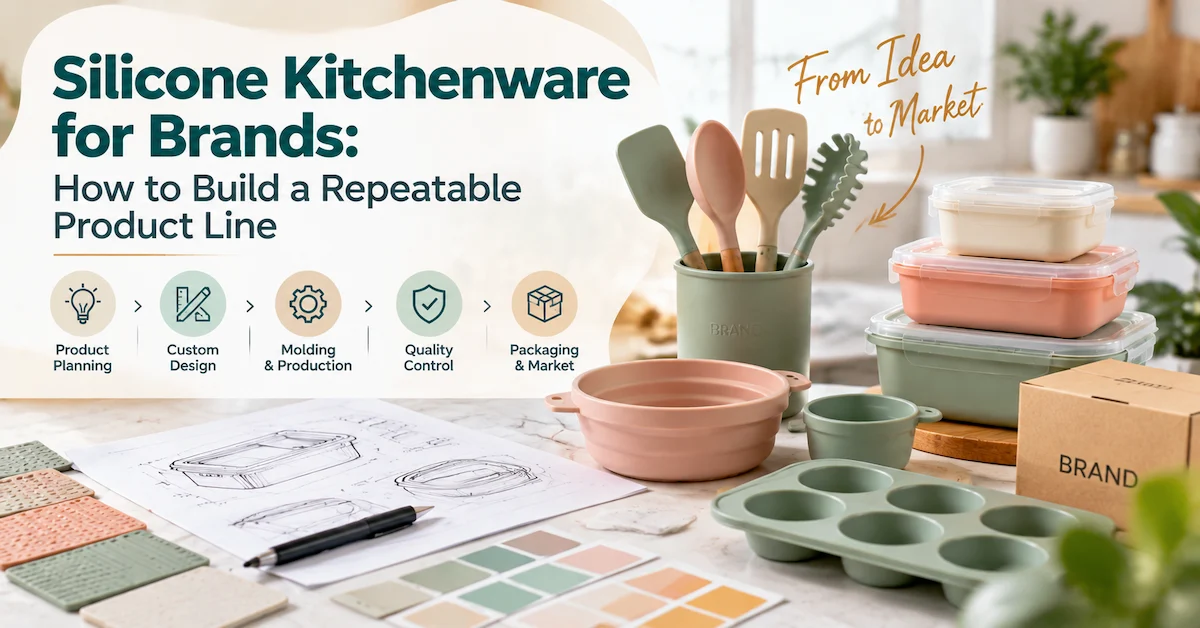

How to choose a silicone kitchenware manufacturer: the short answer
The right silicone kitchenware manufacturer can convert your product brief into a controlled, repeatable production specification. The evaluation should connect intended use to product structure, food-contact parts, material route, molding, tooling, sampling, inspection, packaging, and reorders. A catalog and low price alone do not prove control of the whole project.
For a brand, importer, distributor, retailer, or product team, answer the search question “how to choose silicone kitchenware manufacturer” in stages: define the product and market, verify relevant capabilities, request a comparable quotation, approve a written sample standard, and confirm repeat-order controls.
Leadonex's Kitchenware & Molds product range provides a starting point for food containers, foldable lunch boxes, baking molds, and related silicone products. Its custom silicone product service describes product development, molding, material selection, branding, packaging, and inspection. Those pages help a buyer define the questions to ask; they do not replace product-specific confirmation.
Who needs a manufacturer-selection framework?
This question is especially important when the buyer is moving from a retail sample, a concept drawing, or an existing product to a repeatable commercial range. Different buyers have different risks, so the same manufacturer may be suitable for one project and unsuitable for another. Selection should begin with the buyer's decision, not with a general claim such as “one-stop service.”
| Buyer | Main decision | Most important proof |
|---|---|---|
| Private-label brand | Can the product become a differentiated brand SKU rather than a generic catalog item? | Color, logo, structure, packaging, sample approval, and change control. |
| Importer or distributor | Can the same configuration be supplied and documented across replenishment orders? | Specification control, inspection plan, carton information, and commercial response. |
| Retail or e-commerce buyer | Does the product, package, and documentation fit the sales channel and destination market? | Usability, appearance, label content, package protection, and applicable evidence. |
| Product-development team | Can the factory turn a drawing or concept into a manufacturable, tested part? | Engineering review, material recommendation, mold proposal, prototype, and revision records. |
A buyer who already has a production drawing may need a strong OEM partner and a clear manufacturing quotation. A buyer who has only a market idea may need ODM support, product definition, sampling, and feasibility analysis. Asking a supplier to quote both situations in the same way creates confusion because the development responsibility, tooling scope, and evidence requirements are different.
Step 1: define the product before comparing manufacturers
A manufacturer cannot be evaluated fairly until the product is defined. “Silicone kitchenware” may mean a baking mold, food container, lunch box, utensil, mat, cover, or set. Each category has different geometry, components, food-contact surfaces, packaging, and inspection priorities. This is the first practical answer to how to choose silicone kitchenware manufacturer: define the SKU before scoring the factory.
Create a brief identifying the customer task, channel, target market, dimensions, capacity, components, food-contact areas, color, logo, packaging, and documents. Attach a drawing, 3D file, physical reference, or clear photographs. If the design is open, state which features are fixed and which are proposals. This separates feasibility from final quotation.
| Brief field | What to write | Why it changes selection |
|---|---|---|
| Product role | Storage, baking, preparation, serving, meal prep, travel, or gift set. | The use determines function checks and the relevant product family. |
| Construction | Body, lid, seal, handle, insert, closure, accessory, and assembly requirements. | A single material claim may not cover every component. |
| Market | Destination countries, channel, customer type, and intended label claims. | Material and documentation requirements must match the market and final product. |
| Commercial plan | Quantity by SKU and color, launch timing, sample need, and repeat-order expectation. | The factory needs the project scope to assess tooling, production planning, and packaging. |
Leadonex's product navigation identifies Kitchenware & Molds and includes silicone food containers and several mold directions. That is useful for a buyer starting from a product family. It does not mean that every product has identical material, process, temperature, certification, packaging, or lead-time information. Those details remain specific to the selected SKU and project.
Step 2: check whether the manufacturer's capabilities match the product
The word “manufacturer” should be tested against the work your project needs. A suitable partner should explain where design ends, tooling begins, which molding route is proposed, what post-processing is required, and how production will be inspected. This is more useful than a general claim that the supplier can make silicone products.
Leadonex's public customization page describes silicone rubber compression molding, liquid silicone rubber molding, precision co-injection drip molding, silicone fabric coating and curing, 3D modeling, structural optimization, material recommendations, feasibility analysis, CNC machining, mold life testing, multi-cavity mold design, and mold maintenance. Ask whether the proposed combination fits the actual geometry and quantity.
Questions about engineering and tooling
- Will the manufacturer review the drawing or sample before quoting tooling?
- Which sections create risks for filling, curing, demolding, flash, or deformation?
- Is a multi-cavity mold appropriate for the expected quantity and quality requirements?
- How will the tool be identified, maintained, and checked after the sample is approved?
- Which dimensions are critical, and what measuring method will be used?
- What changes to the design, logo, color, or package would require a new approval?
A manufacturing capability list is evidence of available services, not proof that every service is included in every order. Ask for the proposed process, the assumptions behind the quote, the sample plan, and the inspection record for your exact SKU. This is especially important when a catalog product will be modified rather than purchased exactly as shown. If you are learning how to choose silicone kitchenware manufacturer, ask for this product-specific explanation before requesting a final price.
Step 3: verify material and food-contact evidence
Food-grade silicone is not a complete product specification. A professional buyer should identify every part that contacts food, the destination market, the intended use conditions, the desired material form, and the documents needed to support the final claim. A container body, lid, valve, insert, printed mark, adhesive, and packaging may not share the same evidence scope.
Leadonex's OEM/ODM page presents ordinary, food-grade, and medical silicone rubber categories, and distinguishes HTV solid silicone from LSR liquid silicone rubber. It references FDA, LFGB, and DGCCRF in the food-grade material discussion. The customization page also lists FDA, LFGB, and RoHS-related material wording and says REACH, PAHs, and phthalates are tested by SGS. These are public website statements. Before a brand makes a market or packaging claim, request the current document and confirm its product, color, component, production, and destination-market scope.
| Evidence question | Buyer request | What must remain project-specific |
|---|---|---|
| Material identity | Material form, grade, supplier or formulation reference, color system, and food-contact parts. | The exact formulation and component set for the approved SKU. |
| Market requirement | Destination market, applicable standard, label claim, and test or declaration need. | Whether the document applies to the final product and intended claim. |
| Use conditions | Expected contact, temperature, cleaning, storage, and repeated-use conditions. | The final use instructions and performance limits for the product. |
| Document control | Report identity, issue date, test sample, laboratory, and applicable scope. | Current validity and traceability to the final production revision. |
The public website does not establish one universal material specification, certificate number, expiry date, test scope, MOQ, price, mold fee, or mass-production lead time for every kitchenware SKU. A credible manufacturer should discuss these items for the exact product instead of treating a general statement as a complete compliance package. This evidence boundary is central to how to choose silicone kitchenware manufacturer for a regulated market.
Step 4: evaluate sampling as an engineering stage
A sample should answer more than “does this look good?” It should test whether the product definition can be manufactured consistently and whether the product performs the task that the buyer plans to sell. Sampling should therefore be tied to a written revision, a material route, a color reference, a logo file, and a list of functional and cosmetic checks.
Leadonex's public OEM/ODM workflow lists Requirement Analysis, Design & Development, Sample Making, Mass Production, Quality Inspection, and Delivery Service. The customization page also describes a detailed process that includes design concept, material selection, prototype development, mold and tooling, molding, curing, demolding, initial QC, post-processing, cleaning, packaging, and final QC. For a buyer, the value of this process is not the number of steps. The value is whether every step produces a record or an approved decision that controls the next step.
A useful sample approval record
- Product name, SKU, revision, material reference, color reference, and sample date.
- Approved dimensions, capacity, fit, wall behavior, and critical interfaces.
- Surface finish, flash, parting line, bubbles, marks, logo position, and color limits.
- Functional checks relevant to the use, such as lid fit, folding, stability, release, or assembly.
- Packaging, labels, accessories, and the quantity or configuration shown to the buyer.
- Open issues, responsible person, corrective action, and approval decision.
The public OEM/ODM page states 7-15 days rapid sampling. Treat this as a published service statement, not as a promise for every product. Confirm the starting point, sample complexity, tooling condition, revisions, color requirements, and whether the timing refers to the sample itself or a complete approved development package.
Step 5: inspect the quality-control system, not only the sample
A sample can be excellent while repeat orders drift if production control is weak. Ask where quality is checked, which requirements are measurable, how nonconforming parts are handled, and how the approved sample becomes the production reference. For buyers comparing how to choose silicone kitchenware manufacturer, the inspection record is stronger evidence than a quality slogan.
Leadonex publicly lists raw-material testing, dimensional accuracy measurement, physical-property testing, and environmental aging testing as quality-control capabilities. Its OEM/ODM page describes a professional quality-management team controlling raw materials and finished products according to export inspection standards. These categories are relevant to supplier evaluation, but the exact test method, sampling plan, acceptance limit, report format, and responsibility should be agreed for the project.
| Control point | What to verify | Buyer record |
|---|---|---|
| Raw materials | Material identity, color, incoming inspection, and connection to the approved requirement. | Material record, batch identity, and applicable report. |
| Dimensions | Critical dimensions, tolerances, measuring tools, and inspection frequency. | Released drawing and inspection result. |
| Appearance | Color, surface, flash, parting line, bubbles, marks, logo, and defect limits. | Golden sample, visual standard, and defect photos or descriptions. |
| Function | Checks connected to the product's actual use, components, and instructions. | Test method, pass/fail rule, sample identity, and result. |
| Final shipment | Quantity, accessories, labels, package, carton, cleanliness, and release decision. | Final inspection record and shipment approval. |
A buyer should also ask how the factory handles a failed inspection. Does the team isolate the affected lot, identify the root cause, rework or scrap the product, and record the decision? This question often reveals more about operational maturity than a broad phrase such as “strict QC.”
Step 6: compare OEM, ODM, and private-label support
The best manufacturer depends partly on how much of the product decision the buyer owns. OEM is usually the clearer route when the buyer has a controlled drawing, material requirement, dimensions, brand files, and inspection standard. ODM is more suitable when the buyer needs help converting a market idea into a product through design, structure, material selection, prototyping, testing, and production.
Leadonex describes OEM/ODM services that cover design, prototyping, molded silicone contract manufacturing, printing, packaging, material, structure, function, shape, size, color, logo, pattern, labels, and other customization fields. Its public six-stage process is a useful framework for asking who owns each decision. Do not rely on the word “ODM” alone; confirm the actual deliverables, revisions, approvals, tooling assumptions, and commercial boundaries.
| Route | Buyer usually brings | Manufacturer should clarify |
|---|---|---|
| Standard sourcing | Product reference, quantity, market, package, and desired delivery window. | Available configuration, customization limits, documentation, and price assumptions. |
| OEM | Drawing or sample, material goal, color, logo, packaging, and quality standard. | Feasibility, tooling, process, sampling, production control, and quotation scope. |
| ODM | Customer need, target user, market, function, price objective, and brand direction. | Design proposal, technical feasibility, prototype, revision process, testing, tooling, and ownership terms to confirm. |
| Private label | Existing item or platform plus logo, colors, label, package, and SKU plan. | What can change without new tooling and which changes require a new sample. |
A buyer should ask for a written scope before paying for development. The public website does not publish universal tooling ownership, tooling fees, sample fees, payment terms, or MOQ. Those terms should be included in the project quotation and commercial agreement instead of being inferred from a general service page.
Step 7: check branding, packaging, and export readiness
A manufacturer may produce the silicone part but still be a poor brand fit if branding and packaging are late additions. Confirm how Pantone colors, two-color or marble effects, logos, printing, labels, assembly, retail packs, and shipping cartons are handled. A good product can lose margin or arrive damaged when the package ignores the product and channel.
Leadonex's public customization page lists Pantone-based color customization, two-color and marble silicone options, logo and printing options, and customized packaging from design and development through assembly and inspection. The website also identifies kitchenware products such as food containers and foldable lunch boxes, which may require different package dimensions and protection from a flat baking mold. Ask for an itemized package proposal rather than assuming that a standard pack is included.
Packaging questions for the RFQ
- What is the retail package type, size, material, artwork responsibility, and label language?
- How many pieces or sets are packed together, and how are components protected?
- What carton marks, barcode fields, warnings, instructions, and destination-market information are needed?
- Will the factory assemble the set, inspect the package, and provide packaging samples?
- What changes to the package trigger a new cost, sample, or production approval?
Export readiness also includes communication. The public Contact page identifies WUYI JUCHENG INDUSTRY AND TRADE CO.,LTD, gives an address in Wuyi, Jinhua, Zhejiang, China, and lists phone, email, WhatsApp, WeChat, and QQ contact routes. Use the contact channel to send a complete brief and ask the team to confirm the current commercial response, documents, and project contact. The public page does not establish a universal logistics term for every order.
Step 8: read factory scale claims with the correct scope
Factory size matters, but a large number is not automatically the right answer for every project. A buyer needs to know what the number measures and whether it applies to the selected product, material, color, package, and production period. Scale should be considered together with engineering responsiveness, inspection discipline, communication, and the ability to protect a small or medium brand's specification.
The Leadonex customization page states up to 38,000 sets of daily production capacity, 15,300 square meters of factory area, 135 employees, and more than 10,500 customized silicone projects. These official website statements include no public calculation method or SKU allocation. Use them for verification, not as a promise of capacity for your order.
| Published claim | What it may help you assess | What to confirm |
|---|---|---|
| Up to 38,000 sets per day | The site presents a production-capacity statement. | Definition of set, product scope, current allocation, and availability for your schedule. |
| 15,300 m² factory area | The site gives a facility-area figure. | Which production, tooling, warehouse, and office areas are included. |
| 135 employees | The site provides a workforce figure. | Current organization, engineering and QC coverage, and project communication ownership. |
| 10,500+ customized projects | The site presents an experience statement across silicone projects. | Relevant experience for your product family, market, process, and documentation needs. |
Do not turn these figures into a calculated monthly capacity, guaranteed order allocation, or conclusion that a particular SKU can be delivered by a particular date. Request a project schedule and ask how the factory will reserve tooling, material, production, inspection, and packing resources for your order.
Step 9: compare quotations on the same scope
A quotation comparison is meaningful only when each manufacturer prices the same product and service boundary. One supplier may quote an existing item with a logo, while another quotes a redesigned product with tooling, packaging, testing, and assembly. The lower number may simply exclude work the buyer still needs. This is why how to choose silicone kitchenware manufacturer is a scope-comparison question, not a unit-price question.
Send the same RFQ package to every candidate and ask each one to list assumptions. The RFQ should identify the product, material, components, dimensions, colors, logo, tooling, sample, inspection, packaging, quantity, destination, and schedule. Ask the supplier to separate one-time costs from unit costs and to state what is included in sampling, packaging, documents, and final inspection.
| Quotation field | Ask the manufacturer to state | Why it prevents confusion |
|---|---|---|
| Product scope | SKU, drawing revision, components, color, and quantity by variant. | Ensures every supplier is pricing the same configuration. |
| Tooling | New tool or existing tool, cavity plan, sample responsibility, maintenance, and ownership terms. | Separates development cost and protects future expectations. |
| Quality | Inspection points, tests, acceptance limits, reports, and corrective-action process. | Makes a general QC promise commercially meaningful. |
| Packaging | Retail pack, labels, assembly, carton, protection, and artwork responsibilities. | Prevents later package costs and launch delays. |
| Commercial terms | MOQ, price basis, sample and tooling charges, schedule, payment, and logistics assumptions. | The website does not publish universal values, so the project quotation must define them. |
The most useful response is not necessarily the fastest or cheapest response. Look for a manufacturer that identifies missing information, explains process risks, distinguishes confirmed facts from assumptions, and proposes a practical next step. That behavior reduces the chance of discovering important exclusions after the purchase order is issued.
Step 10: protect the approved product for repeat orders
A manufacturer-selection decision is incomplete until the buyer understands how the product will be repeated. Silicone products can drift in color, shape, surface, logo position, trimming, assembly, package, or documentation if the approval record is not controlled. The first order should create a reusable production reference rather than a one-time visual approval.
Keep an approved golden sample, released drawing, material and color references, logo artwork, component list, packaging files, inspection standard, reports, and change history together. Before each reorder, compare the purchase order with the last released revision. If the material, color, tool, accessory, label, package, market, or quantity changes, decide whether a new sample or evidence review is required.
Repeat-order questions for a selected manufacturer
- How is the approved product revision identified on the production order?
- How are material batches, colors, molds, and accessory components connected to the SKU?
- Which changes require buyer approval before production?
- How are mold maintenance and repair records retained?
- How are inspection results and nonconformities recorded?
- How are updated packaging files and market documents controlled?
The right answer is a process you can understand and audit. It should not depend on one salesperson remembering what was agreed months earlier. This is one reason the supplier's engineering, production, QC, and sales teams should be able to work from the same released information.
A practical manufacturer scorecard for buyers
A simple scorecard helps a team avoid overvaluing price, presentation, or a single successful sample. Use a 0-5 score for each category, write the evidence behind the score, and mark unknown items as pending rather than silently treating them as acceptable. The weights below are a buyer-side recommendation for commercial investigation; they are not a published Leadonex rating.
| Category | Suggested weight | Evidence to record |
|---|---|---|
| Product and engineering fit | 20% | Feasibility response, proposed molding route, tooling questions, and design support. |
| Material and compliance fit | 20% | Material identity, food-contact parts, applicable standards, and current reports. |
| Sampling and QC | 20% | Sample approval record, inspection plan, test method, acceptance rule, and corrective action. |
| Customization and packaging | 15% | Color, logo, assembly, labels, package samples, and artwork control. |
| Supply and repeat-order control | 15% | Capacity scope, schedule response, revision control, and production communication. |
| Commercial clarity | 10% | Itemized quotation, assumptions, MOQ, tooling, payment, logistics, and unresolved questions. |
Do not select a supplier solely because the total score looks high. Set minimum requirements for material evidence, sample approval, and commercial clarity. A candidate that fails a critical food-contact or quality requirement should not be rescued by a low price in another category. The scorecard makes how to choose silicone kitchenware manufacturer visible to everyone involved in the buying decision.
What should be in a silicone kitchenware RFQ?
A complete RFQ shows whether a silicone kitchenware manufacturer understands your project and makes responses comparable. Send a specific package rather than one photograph and “please quote.” It is the practical handoff between how to choose silicone kitchenware manufacturer and starting the selected project.
| RFQ section | Information to include | Expected response |
|---|---|---|
| Product | Category, application, drawing, sample, 3D file, dimensions, capacity, and components. | Feasibility comments, proposed route, and missing inputs. |
| Material and market | Food-contact parts, destination countries, use conditions, standards, claims, and documents. | Material recommendation and evidence scope for confirmation. |
| Branding | Pantone or physical color reference, logo artwork, position, size, printing, texture, and label. | Branding method, sample requirement, and cost assumptions. |
| Quantity and timing | Sample quantity, order quantity by variant, launch target, and reorder expectation. | MOQ, schedule, capacity assumptions, and production milestones. |
| Quality | Critical dimensions, appearance limits, function checks, test needs, and inspection standard. | Inspection plan, sample reference, reports, and corrective-action process. |
| Packaging | Retail pack, labels, accessories, carton, barcode, language, and shipping protection. | Package proposal, artwork requirements, assembly scope, and cost. |
Leadonex's public Contact page includes a form for name, company, email, and phone, and lists phone, email, WhatsApp, WeChat, and QQ contact routes. A buyer can use the Leadonex contact page as the project entry point, but should include the RFQ details in the message or attached specification so the response can address the actual product.
Red flags when choosing a silicone kitchenware manufacturer
A red flag is a gap between what the buyer needs to control and what the supplier is willing or able to explain. Some gaps need a better brief; others show that the manufacturer is not suitable for the project.
| Warning sign | Why it matters | Follow-up action |
|---|---|---|
| Quote arrives without product assumptions | The price may be for a different material, package, or configuration. | Ask for an itemized quote and list of exclusions. |
| General food-grade claim only | The claim may not cover every component, color, market, or production revision. | Request document scope and match it to the final SKU. |
| No written sample standard | The buyer and factory may remember different approvals. | Release a golden sample, drawing, color, logo, and inspection standard together. |
| Capacity number without scope | A factory-wide figure does not prove current capacity for your SKU and date. | Ask for product-specific planning and resource availability. |
| Commercial terms remain verbal | Tooling, MOQ, payment, schedule, and package assumptions can change later. | Request written confirmation before approval or payment. |
The goal is not to eliminate every uncertainty before the first conversation. The goal is to make uncertainty visible, assign the next verification step, and avoid turning an unconfirmed assumption into a purchase-order requirement.
Frequently asked questions
What is the first question to ask a silicone kitchenware manufacturer?
Ask whether the manufacturer can review your exact product brief and explain the proposed material, tooling, molding, sampling, inspection, and packaging route. This is more useful than asking only whether the factory produces silicone kitchenware.
Should I choose the lowest quotation?
No. Compare quotations only after confirming that they cover the same product, material, tooling, sample, quality, packaging, quantity, and commercial terms. A low price may exclude development or evidence that your launch still requires.
Does Leadonex support both OEM and ODM projects?
Leadonex publicly presents both OEM and ODM services. The OEM/ODM page describes customization across design, function, material, size, structure, shape, texture, color, logo, pattern, packaging, and labeling, alongside a six-stage development and delivery workflow. Confirm the exact scope, tooling, and commercial terms for your project.
Which silicone materials does the website list?
The OEM/ODM page lists ordinary silicone rubber, food-grade silicone rubber, and medical silicone rubber, and distinguishes HTV solid silicone from LSR liquid silicone rubber. It also refers to FDA, LFGB, and DGCCRF standards for food-grade material discussion. The final material and document scope must be confirmed for the exact SKU and destination market.
Does the website publish MOQ and standard lead time?
The public pages reviewed for this guide do not publish one universal MOQ, price, tooling fee, or mass-production lead time for every silicone kitchenware product. The customization page does state 7-15 days rapid sampling, but that statement must be confirmed for the product, tooling, revisions, colors, and approval conditions.
What should I send when requesting a quote?
Send the product reference or drawing, application, target market, quantity by SKU and color, components, material and food-contact requirements, logo and color files, packaging expectations, quality checks, required documents, and target schedule. The more complete the brief, the easier it is to compare the response with other manufacturers.
Are the factory's published capacity figures a guarantee for my order?
No. Leadonex's customization page publishes figures for daily production capacity, factory area, employees, and customized projects, but it does not define the allocation for every product or order. Treat the figures as official website claims and request a project-specific production plan.
How do I protect my brand's repeat orders?
Keep a revision-controlled approval pack containing the golden sample, drawing, material, color, logo, component list, package, inspection criteria, and relevant documents. Require each repeat order to reference the released revision and ask the manufacturer to confirm any change before production.
Conclusion
To answer how to choose silicone kitchenware manufacturer responsibly, evaluate the full decision chain, not only catalog or price. Define the product and market, test engineering and molding fit, verify material evidence, control sampling and QC, compare OEM or ODM scope, review branding and packaging, interpret capacity claims, and protect the approved revision for reorders.
Leadonex's public website identifies WUYI JUCHENG INDUSTRY AND TRADE CO.,LTD and presents silicone OEM/ODM manufacturing, kitchenware and molds, customization, material guidance, molding, tooling, QC, packaging, and delivery workflow. Capacity statements should be verified against the exact product and schedule; the final decision should use the project quotation, sample, evidence, and written terms.
Send a complete RFQ rather than a generic price request. Include the product, market, material, quantity, branding, packaging, quality, documents, and schedule so the manufacturer can identify what still needs confirmation.