
What should a silicone lunch box bulk supplier provide?
A silicone lunch box bulk supplier should provide a controlled commercial specification, not just a product photograph and a low quotation. For a buyer ordering for a retail chain, distributor, private-label brand, marketplace, or food-storage program, the useful deliverable is a repeatable product record. That record should identify the selected model, dimensions, capacity, body construction, lid or closure, accessories, material route, color, logo, package, destination market, inspection criteria, and quantity by variant.
This is the central answer for the search term silicone lunch box bulk supplier: choose the supplier that can convert a product idea into an approved SKU and then reproduce that SKU under the same agreed conditions. The supplier does not need to promise every commercial field on a public webpage. It does need to show which items are confirmed, which items are recommendations, and which items must be quoted or tested for the specific order.
| Supplier deliverable | Why a bulk buyer needs it | Release question |
|---|---|---|
| SKU definition | Prevents different shapes, sizes, lids, or accessories from being treated as one item. | Can a new operator identify the exact approved product? |
| Material and evidence scope | Connects the food-contact claim to the actual body, lid, seal, print, and accessory configuration. | Does the document match the final product and target market? |
| Approved sample | Creates a physical reference for appearance, fit, function, and workmanship. | What is the golden sample, and who approved it? |
| Packing and carton record | Protects the product and supports inventory planning, labels, and shipment preparation. | Are retail, inner, and outer-carton requirements clear? |
| Inspection and change control | Keeps the second order from silently changing the first order. | What must be re-approved before a material, mold, color, or package change? |
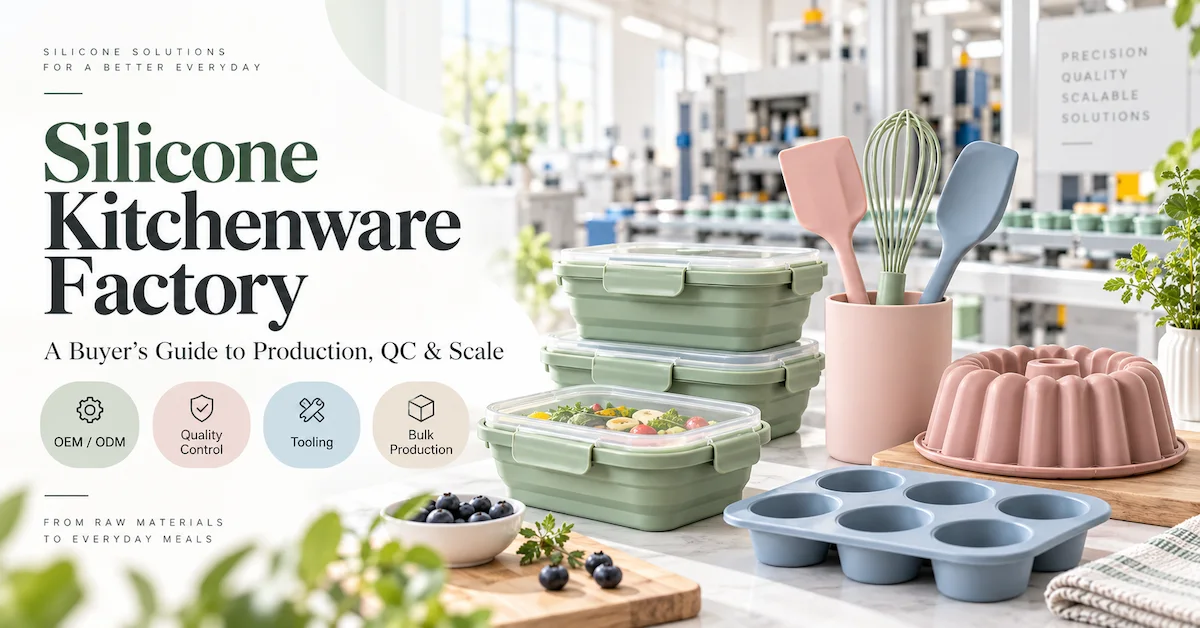
Leadonex's public silicone food container category and Kitchenware & Molds range show several foldable lunch box directions. They are useful starting points for product selection, but a bulk buyer should still request project-specific confirmation for the final construction, order quantity, packaging, and evidence package.
Bulk supplier, wholesale seller, or manufacturer: what is the difference?
The words supplier, wholesaler, factory, OEM, and manufacturer are often used interchangeably in search results. They describe different levels of responsibility. A wholesale seller may offer available stock and a simple order process. A trading company may coordinate several factories and combine products. A manufacturer may control molding, production, inspection, and packaging directly. An OEM/ODM manufacturer may also support product development, tooling, sampling, branding, and production release.
For a small test order, a wholesale seller may be sufficient. For a bulk program with private labeling, seasonal colors, multiple variants, or repeat orders, the buyer should ask who owns each step. The relevant question is not whether a company uses the word factory. The relevant question is whether the same organization can explain the product route from requirement analysis to sample making, mass production, quality inspection, and delivery.
| Partner type | Typical strength | Questions for a commercial buyer |
|---|---|---|
| Wholesale seller | Ready products and straightforward purchasing. | Can the seller support a custom logo, package, test request, and repeat specification? |
| Trading supplier | Product coordination and access to multiple factories. | Which factory makes the SKU, and who controls changes and nonconformities? |
| Direct manufacturer | Direct control of process, tooling, quality, and production records. | Can it identify the process route, quality checks, and capacity assumptions for this SKU? |
| OEM/ODM partner | Development, customization, tooling, production, and delivery coordination. | Which decisions are included, and which require a separate project quotation? |
Leadonex's public site presents WUYI JUCHENG INDUSTRY AND TRADE CO.,LTD as the company behind the Leadonex silicone product OEM manufacturing brand. Its public service pages describe customization, molding, packaging, inspection, and OEM/ODM workflow. That public positioning is relevant to a bulk buyer, but it does not automatically confirm that every listed service is included in every lunch box quotation.
How should a silicone lunch box bulk supplier plan the SKU before quoting?
Start by defining the commercial job of the product. A silicone lunch box bulk supplier needs to know whether an office meal-preparation product prioritizes stackability, cleaning, and a compact stored form. A school or family product may need compartments or cutlery. A retailer may need strong shelf presentation and a controlled carton pack. A distributor may prioritize a clear range architecture with several shapes that share colors and packaging logic.
The term bulk does not define a product. It defines an order context. Before comparing quotes, identify the SKU count, quantity by color and size, packaging level, destination market, label language, accessories, and required documents. A supplier cannot compare two bulk quotes fairly if one quote includes only a bare silicone body and the other includes a lid, utensil set, printed label, retail box, inspection, and export carton.
| Planning field | Buyer decision | Why it affects the order |
|---|---|---|
| Customer and channel | Retail, distribution, e-commerce, meal prep, school, office, or travel. | Defines product story, package, accessories, and content requirements. |
| Shape and footprint | Rectangular, square, round, or another approved geometry. | Affects storage, carton packing, shelf fit, and product family consistency. |
| Compartment plan | Single compartment, double compartment, or another configuration. | Changes tooling, use instructions, cleaning expectations, and SKU identity. |
| Closure and accessories | Lid, seal, clips, knife, fork, divider, or no accessory. | Determines the finished bill of materials and functional checks. |
| Color and branding | Color reference, logo artwork, print method, and location. | Affects sampling, appearance approval, production records, and package hierarchy. |
| Quantity by variant | Total units, colors, sizes, sets, and first-order versus reorder plan. | Enables a comparable quote and realistic production planning. |
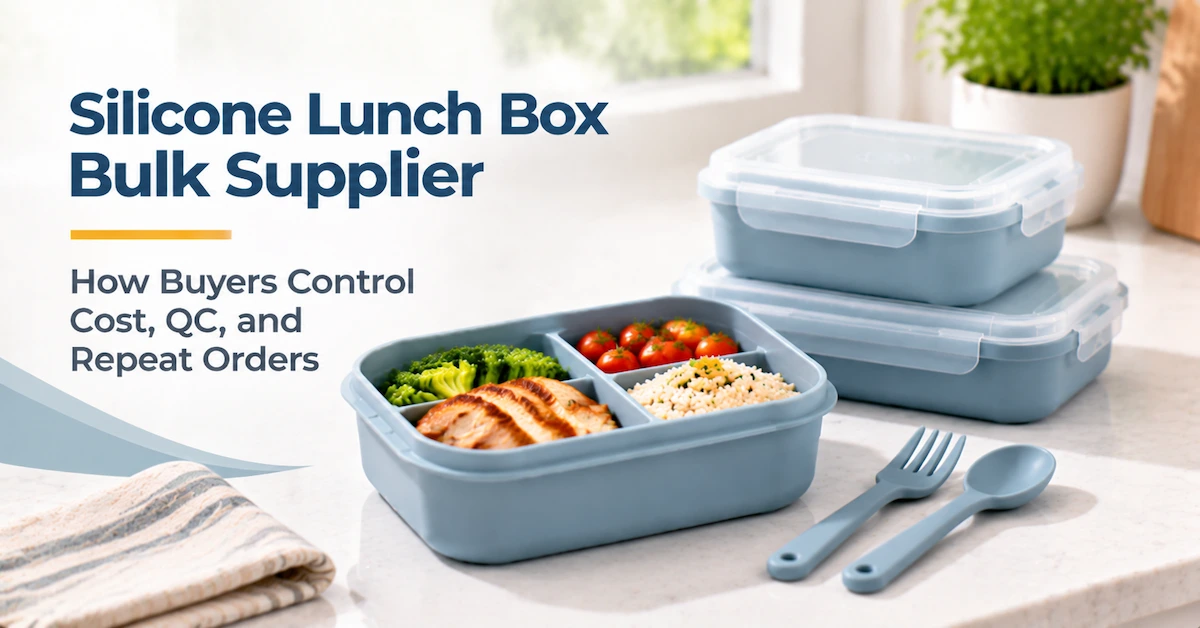
Leadonex's public product range includes lidless, square, rectangular, round, double-compartment, and single-compartment foldable lunch box directions, including a knife-and-fork configuration. For example, buyers can review the rectangular foldable lunch box and the double-compartment foldable lunch box as separate starting points. These are not interchangeable SKUs. Confirm the chosen product's exact components and commercial configuration before ordering.
A useful RFQ sentence might be: “We need a rectangular foldable silicone lunch box for a private-label retail program, with a specified lid, one approved color set, a defined retail package, a target destination market, and a first-order quantity split by variant.” That sentence is more valuable to a bulk supplier than “Please send your best price for silicone lunch boxes.”
Which lunch box structures are useful for a commercial range?
A product range can use structure to create clear buying choices. Rectangular formats may fit meal-preparation routines and storage shelves. Square formats may support a different footprint or visual family. Round formats can serve a distinct serving or storage position. Single-compartment and double-compartment versions should be merchandised as different use cases rather than only different pictures. A knife-and-fork configuration adds an accessory and therefore changes the bill of materials, inspection plan, and package.
The foldable feature also needs a commercial definition. Buyers should decide whether the product's main value is reduced storage volume, portability, stackability, or a specific retail story. Do not turn a general claim about flexibility into an unsupported cycle-life or leak-performance claim. Ask the supplier to identify what has been tested, under which conditions, and whether the result applies to the final product configuration.
| Structure direction | Potential commercial role | Bulk-order checks |
|---|---|---|
| Rectangular foldable box | Meal preparation, office lunch, storage, and coordinated kitchen collections. | Footprint, lid fit, fold profile, corners, label area, and carton orientation. |
| Square foldable box | A compact food-storage or lifestyle SKU with a different visual identity. | Stacking, lid engagement, corner finish, and package fit. |
| Round foldable box | A serving, snack, or storage format that can broaden a product family. | Round lid fit, circular wall consistency, package stability, and range differentiation. |
| Double-compartment box | Portion separation or meal organization for a retail or school-oriented line. | Divider integrity, cleaning access, lid coverage, and accessory pack. |
| Single-compartment box with cutlery | A convenience-oriented set with a stronger ready-to-carry proposition. | Cutlery fit, accessory count, package cavity, and missing-component control. |
For a first bulk program, avoid launching every structure unless the channel and inventory plan justify it. A smaller, clearly differentiated range is easier to sample, inspect, explain to customers, and replenish. The supplier should quote each SKU or variant transparently instead of hiding different configurations inside one generic line item.
What material and food-contact information should a buyer request?
A food-contact product needs a material conversation that is specific to the finished configuration. Ask which parts contact food, which silicone form is proposed, whether the product includes non-silicone parts, and which market or standard the evidence is intended to support. “Food-grade silicone” should be treated as a starting description, not as a substitute for product-specific documentation.
Leadonex's public OEM/ODM information distinguishes ordinary silicone rubber, food-grade silicone rubber, and medical silicone rubber, and refers to HTV solid silicone and LSR liquid silicone rubber. Its public customization page lists FDA, LFGB, and RoHS-related material wording and states that REACH, PAHs, and phthalates are tested by SGS. The same page also lists factory and management certifications. These are official website statements; they should not be expanded into a claim that every lunch box, color, accessory, or market has the same document scope.
| Evidence area | Buyer should define | Supplier response to request |
|---|---|---|
| Food-contact parts | Body, lid, seal, divider, utensil, print, and any insert that touches food. | A component list and evidence matched to the actual order configuration. |
| Target market | Destination country, sales channel, label language, and intended use. | Applicable standard, report type, declaration, and document scope. |
| Material identity | Silicone type, color system, hardness requirement if applicable, and non-silicone materials. | Material specification, color approval, and any available test or declaration. |
| Use claims | Storage, reheating, cleaning, folding, freezer, or other claims planned for the package. | Test conditions or written limitations supporting each claim. |
A buyer should also check whether the evidence is current, whether the sample identity matches the production version, and whether the report covers the colored or printed parts used in the order. If the supplier cannot provide a certificate number, report date, sample description, or scope, record that as an open item rather than converting a general website statement into a product guarantee.
How do molding and tooling choices affect a bulk order?
The production route is part of the product definition. Silicone compression molding and LSR molding are not interchangeable labels for a buyer's quotation. The selected route may affect the mold concept, part geometry, cycle, finishing, assembly, appearance, and the way the supplier manages future changes. The right decision depends on the design and not simply on which process sounds more advanced.
Leadonex's public customization page lists silicone rubber compression molding, LSR molding, and precision co-injection drip molding. Its public service material also describes structural optimization, feasibility analysis, CNC precision machining, mold life testing, multi-cavity mold design, and mold maintenance. For a lunch box project, ask the supplier to connect the proposed process to the actual body, lid, divider, seal, logo, and accessory requirements.
| Tooling discussion | Buyer question | Record before approval |
|---|---|---|
| Existing tool | Does the existing mold produce the required dimensions and finish? | Approved sample identity and any permitted changes. |
| Modified platform | Which changes require engineering or new inserts? | Updated drawing, sample plan, and quotation assumptions. |
| New mold | What is the design, validation, maintenance, and approval sequence? | Tooling scope, ownership terms, sample gates, and change-control rules. |
| Multi-cavity concept | Is it suitable for the required quantity and consistency expectations? | Cavity identification, inspection plan, and replacement or maintenance approach. |
Do not approve tooling from a rendering alone. Ask for a feasibility response, a sample route, and a clear description of what the sample is intended to prove. Product-specific tooling fees, sample fees, ownership, and lead times are not published as universal terms on the website and must be confirmed for the project.
What should the sample approval process prove?
A sample is not only a photograph for marketing. It is the first physical version of the product record. Before bulk production, compare the sample with the drawing, selected product page, approved color, logo artwork, lid or accessory list, package plan, and intended use. Record the exact changes requested and identify which changes are closed.
For a foldable lunch box, a buyer may examine the opening and folding behavior, wall uniformity, base stability, lid engagement, compartment definition, edge finish, odor, visible contamination, logo placement, and fit of any knife or fork. These are recommended buyer checks, not claims that a public product page has published test results. The supplier and buyer should agree on the actual inspection method and acceptance criteria for the final order.
| Sample gate | Inspect | Approval evidence |
|---|---|---|
| Form and dimensions | Shape, footprint, height, wall profile, corners, and critical interfaces. | Drawing or measurement record with revision number. |
| Function | Opening, closing, folding, stability, compartments, and accessory fit. | Written test method, result, and approved sample reference. |
| Appearance | Color, texture, flash, marks, seams, logo, and print position. | Signed or otherwise traceable visual approval. |
| Package and label | Retail package, accessory count, barcode or label area, and carton concept. | Approved artwork and packing instruction. |
If a sample is changed after approval, issue a new revision rather than continuing to call it the same sample. The buyer should retain a reference sample or an agreed digital and written record. This is especially important when several colors, compartments, lids, or accessory combinations are included in one bulk order.
How should bulk-order quality control be written?
Quality control is more useful when written as a series of checks connected to the approved SKU. A general statement such as “strict quality control” does not define what will be inspected or what happens when a result fails. A bulk buyer should ask for a control plan that separates incoming materials, in-process molding, assembly, appearance, dimensions, function, packaging, and final shipment release.
Leadonex's public customization information describes raw-material testing, dimensional measurement, physical-property testing, environmental aging testing, and full-process inspection. Its OEM/ODM page also describes a sequence that includes quality inspection and delivery service. These public statements establish relevant quality-control capabilities, but the actual acceptance level, sampling plan, test conditions, and report format need to be agreed for the selected lunch box.
| Control stage | Possible check | Record to request |
|---|---|---|
| Incoming material | Material identity, batch reference, color, and required documentation. | Material or batch record matched to the order. |
| Molding and trimming | Flash, marks, incomplete fill, surface condition, and cavity consistency. | In-process checklist and corrective-action record if needed. |
| Dimensions and fit | Critical dimensions, lid engagement, compartment fit, and accessory placement. | Measurement record using the approved drawing and revision. |
| Functional checks | Opening, closing, folding, stability, and any agreed leakage or use test. | Condition, sample size, result, and disposition of failures. |
| Final packing | Color mix, accessory count, label, retail package, inner pack, and carton marks. | Packing checklist and shipment release confirmation. |
If your product relies on a leak claim, define the test conditions instead of using the word leak-proof as a general promise. The same applies to freezer, microwave, dishwasher, temperature, odor, cycle-life, and stain-resistance claims. If the official page or project report does not publish a result, the claim should remain open until it is tested and documented.
What packaging information should a bulk buyer include?
Packaging is part of the order, not a final decoration. The product may need a retail box, sleeve, insert, label, barcode, warning panel, instruction sheet, inner carton, export carton, or protective packing. The correct combination depends on the channel and market. A distributor ordering bulk units for a warehouse may want a different packing structure from a brand shipping individual units through e-commerce.
Leadonex's public customization material includes packaging design and packaging support. For a commercial quotation, give the supplier the package level, dimensions or preferred footprint, artwork status, quantity per inner and outer carton if known, labeling requirements, and destination. If the final carton specification is not yet known, mark it as a quotation assumption so that the unit price is not misunderstood.
| Packaging layer | Buyer requirement | Commercial risk if omitted |
|---|---|---|
| Product protection | Protection against dust, deformation, abrasion, and missing accessories. | Appearance damage or incomplete sets at receiving. |
| Retail presentation | Brand, product name, use instructions, claims, barcode, and language. | Rework, relabeling, or delay before sale. |
| Inner pack | Units per pack, color separation, set composition, and handling label. | Picking errors and unclear stock counts. |
| Outer carton | Carton marks, SKU identity, quantity, gross or net information if required, and stacking plan. | Receiving and freight-handling problems. |
Do not claim that one packaging method is an export requirement for every destination. Packaging, labeling, and shipping documentation are market and shipment specific. Ask the supplier to separate product price, package price, printing, assembly, and any other charged item so the quote can be compared with alternatives.
How should buyers compare quotes from a silicone lunch box bulk supplier?
The lowest unit price is not necessarily the lowest landed cost. Compare quotations only after the same product definition is used. A price for a bare silicone body cannot be compared with a price for a complete retail-ready set. The quote should state the assumptions for quantity, color, logo, package, accessories, testing, inspection, tooling, and shipment.
MOQ is another field that must be confirmed instead of assumed. A supplier may use different quantity rules for an existing SKU, a new color, a printed logo, a new package, a new mold, or a multi-variant order. The website does not publish one universal MOQ for every lunch box. Request the MOQ by SKU and by variant, and ask whether mixed colors or mixed models are accepted under the same commercial conditions.
| Quote line | Must be stated | Buyer comparison rule |
|---|---|---|
| Product and variant | Model, size, compartment, lid, accessory, color, and revision. | Compare like with like, not a generic product name. |
| Quantity terms | MOQ, order quantity, split by color or SKU, and overage policy if relevant. | Compare the same quantity tier and variant mix. |
| Customization | Logo, Pantone or physical color, printing, package, label, and assembly. | Separate included and chargeable items. |
| Tooling and sample | Existing or new mold, sample route, revisions, and one-time charges. | Do not hide one-time engineering costs inside the unit price. |
| Schedule | Sample timing, production timing, inspection timing, and shipment assumptions. | Ask for a project schedule; do not infer it from a general website claim. |
Leadonex's public customization page states that daily production capacity can reach 38,000 sets and lists a factory area of 15,300 square meters and 135 employees. These are website-level statements, not a guaranteed capacity allocation for a particular lunch box SKU. Ask the supplier to confirm whether the selected product, quantity, color mix, packaging, and target shipment window can be supported together.
How can a buyer protect repeat-order consistency?
The first order proves that a product can be made once. The second order proves whether the purchasing system is controlled. A repeat order may fail because the supplier changes material, color, mold condition, trimming method, printing position, packaging, accessory source, or inspection practice without an agreed revision process.
Create a change-control record that names the approved product revision, drawing, sample, material information, color reference, artwork, package, inspection method, and open deviations. Ask the supplier to notify you before changing a critical input. If a change is necessary, require a sample or document review before bulk production resumes.
| Controlled item | Keep on record | Re-approval trigger |
|---|---|---|
| Product structure | Drawing, 3D file, sample, critical dimensions, and component list. | Any mold, geometry, lid, divider, or accessory change. |
| Material and color | Material description, batch or evidence scope, color approval, and print standard. | Material source, formulation, color system, or surface change. |
| Packaging | Artwork, label, inner pack, carton mark, and quantity configuration. | Artwork, carton, label language, or pack-count change. |
| Quality release | Inspection criteria, results, nonconformity decisions, and shipment release. | Any change to acceptance criteria or production route. |
This discipline matters for all bulk buyers, but it matters especially for private-label brands that need the product photograph, package, customer reviews, and replenishment inventory to remain consistent. A supplier that answers repeat-order questions clearly is usually more useful than one that only sends a first-order price.
What does Leadonex publicly offer for lunch box projects?
Leadonex's public pages identify WUYI JUCHENG INDUSTRY AND TRADE CO.,LTD and present the company as a silicone product OEM/ODM manufacturer. The product navigation places silicone food containers and foldable lunch box directions inside Kitchenware & Molds. The public customization page describes one-stop custom silicone product solutions for brand owners, product development managers, designers, and product managers.
The publicly described process includes requirement analysis, design and development, sample making, mass production, quality inspection, and delivery service. The customization page lists compression molding, LSR molding, precision co-injection drip molding, printing, assembly, packaging, raw-material testing, dimensional measurement, physical-property testing, environmental aging testing, and full-process inspection. The OEM/ODM page also describes size, color, style, logo, and related customization options.
For a bulk lunch box RFQ, these capabilities are relevant starting points. They do not replace a product-specific feasibility review. Send the exact structure, quantity by variant, material and market requirements, branding, package, evidence needs, and target schedule. The supplier can then clarify which parts use an existing platform, which parts require modification, and which parts require a new development route.
The public website does not provide one universal MOQ, price list, tooling fee, production lead time, leak-test result, or certificate scope for every lunch box. Those fields should be included in the quotation request rather than inferred from general company information.
What should a buyer include in a silicone lunch box bulk RFQ?
A good RFQ allows the supplier to answer the commercial question without guessing. Include a reference product page or image, preferred structure, dimensions or target capacity, lid and accessory requirements, color, logo, package, destination market, expected quantity by variant, and the evidence required for the intended sale. State what is fixed and what is open for recommendation.
| RFQ section | Information to send | Answer you should receive |
|---|---|---|
| Product | Link, drawing, reference sample, structure, size, capacity, lid, divider, and accessory. | Recommended model or feasibility response with open questions. |
| Material and market | Food-contact parts, destination market, standards, and intended claims. | Material route, document scope, and evidence availability. |
| Branding | Logo artwork, color reference, print or embossing, and placement. | Branding method, sample route, and applicable charges. |
| Packaging | Retail package, labels, language, carton, barcode, and pack counts. | Package proposal, artwork needs, and quote assumptions. |
| Commercial | Quantity by SKU and color, first order, reorder intent, and target timing. | MOQ, unit price, one-time costs, sample timing, production assumptions, and shipment terms. |
The more complete the brief, the easier it is to compare Leadonex with another supplier. A serious bulk supplier should be able to respond with a clear list of confirmed details, recommendations, exceptions, and items that require a technical or commercial decision.
FAQ about choosing a silicone lunch box bulk supplier
What is the most important difference between a bulk supplier and a retail seller?
A bulk supplier should be able to define and reproduce a commercial SKU. That includes more than having inventory. Ask whether the partner can support variant planning, material evidence, samples, branding, packaging, inspection, and repeat-order control. A retail seller may be suitable when you only need ready-to-ship stock and do not need a controlled product program.
Does Leadonex publish a universal MOQ for silicone lunch boxes?
The public website does not publish one universal MOQ for every lunch box configuration. MOQ should be requested by model, color, logo, packaging, and any new-tooling requirement. A mixed-SKU or mixed-color order may use different conditions from an existing single-SKU order.
Can a buyer order an existing foldable lunch box with a private label?
The public product range provides existing foldable lunch box directions, and the customization pages describe size, color, style, logo, printing, labels, and packaging support. Whether a selected product can receive a particular logo or package without new tooling must be confirmed for the project.
Which product structures can a buyer discuss?
The public Kitchenware & Molds and silicone food container pages show lidless, square, rectangular, round, double-compartment, single-compartment, and knife-and-fork foldable lunch box directions. Treat each direction as a separate SKU starting point and confirm its exact body, lid, accessory, packaging, and document scope.
What food-contact documents should a buyer ask for?
Ask for documents matched to the final product, food-contact components, color, printing, destination market, and intended claims. Leadonex's public customization page lists FDA, LFGB, and RoHS-related material wording and SGS testing references for REACH, PAHs, and phthalates. The public statements do not replace checking the current report or declaration for the actual order.
Does a foldable lunch box automatically have a published leak-proof or cycle-life result?
No. A foldable design and a leak-proof or cycle-life claim are different things. If the claim matters to the product positioning, request a test method, conditions, sample identity, result, and acceptance criteria. Do not convert a general product description into a numerical performance promise.
What factory information does Leadonex publish?
The public customization page states up to 38,000 sets of daily production capacity, a 15,300 square meter factory area, and 135 employees. The website also describes molding, material testing, dimensional measurement, physical-property testing, environmental aging testing, packaging, and full-process inspection. These are public website statements, not a guarantee of capacity, schedule, or test coverage for one specific lunch box order.
What should buyers ask a silicone lunch box bulk supplier to include in an RFQ?
Send the chosen product or reference, dimensions or target capacity, lid and accessory plan, quantity by model and color, material and market requirements, logo and color files, packaging needs, required documents, destination, and target timing. Ask the supplier to separate confirmed facts, recommendations, one-time costs, recurring costs, and open decisions.
Conclusion
The best silicone lunch box bulk supplier is the one that makes the commercial order understandable before it makes the production promise. Define the exact lunch box structure, separate variants, connect material evidence to the final food-contact configuration, choose the molding and tooling route, approve a traceable sample, write the inspection and packaging records, confirm MOQ and schedule by SKU, and create a change-control process for reorders.
Leadonex's public product and customization pages provide a starting point for foldable silicone lunch box selection, OEM/ODM development, molding, packaging, and quality discussions. The next step is a project-specific review of the product, quantity, branding, destination market, evidence, and schedule. Submit those details before requesting a final quotation so the response can be evaluated on the complete order rather than on unit price alone.