
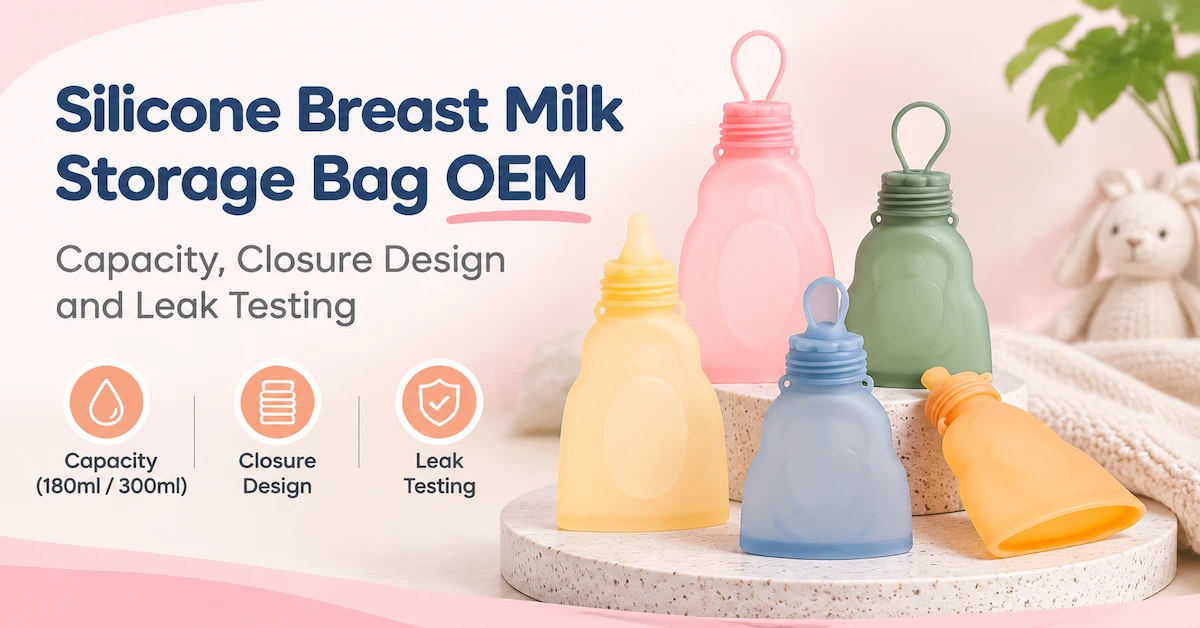
A silicone breast milk storage bag OEM program should be quoted as a controlled storage system, not a generic silicone pouch. Define usable capacity, headspace, geometry, closure, connector, leak-test conditions, cleaning, evidence, market documents, and retail packaging.
What should a silicone breast milk storage bag OEM quote cover?
The quote should cover pumping or transfer, storage, handling, cleaning, and retail sale. Hand filling, adapter filling, flat storage, upright storage, and bottle transfer create different seal, opening, wall-stress, and evidence requirements.
Define a written configuration: capacity at the fill line, empty and filled dimensions, wall and base behavior, closure, interface, material, color, markings, care method, storage condition, package, and acceptance tests. A photograph alone is not a comparable OEM specification.
| Project layer | Buyer must define | Supplier response should show |
|---|---|---|
| Capacity | Nominal volume, usable fill volume, headspace, graduation marks, and expansion allowance. | Measurement method, fill line, dimensions, and sample result. |
| Bag structure | Flat, stand-up, gusseted, foldable, pour corner, base, opening, and wall behavior. | Drawing or 3D review, critical dimensions, and manufacturing risks. |
| Closure and connection | Zip, slider, cap, threaded adapter, pump interface, gasket, or multi-part system. | Closure sequence, mating dimensions, seal design, and compatibility assumptions. |
| Leak performance | Filled volume, orientation, temperature, handling, drop or squeeze conditions, and failure limit. | Test method, sample count, conditioning, acceptance criteria, and result record. |
| Reuse | Washing, drying, sterilization, odor, residue, inspection, and replacement instructions. | Care instructions and evidence matched to the final material and components. |
| Retail program | Brand, capacity label, artwork, language, barcode, unit pack, carton, and target market. | Artwork proof, packed sample, label review, and variant-level quote. |
Leadonex's customization page lists material, function, size, structure, shape, texture, color, logo, pattern, packaging, and labels. This supports discussion but does not establish validation for every closure, connector, or milk-storage condition. Ask for a feasibility review before claims.
Which buyers and use cases need this level of control?
This guide is for maternity and baby-care brands, breast-pump accessory brands, importers, distributors, retail teams, private labels, and hospital or milk-bank suppliers. State whether the bag is for home pumping, travel, freezer storage, clinic handling, or pump-to-bottle transfer. Clinical programs may require tighter traceability and validation than retail products.
How should capacity and bag geometry be specified?
Capacity is not only the number printed on the package. Distinguish nominal capacity, recommended fill, maximum physical volume, and the space required for expansion and closure. A pouch can hold a stated volume yet fail the workflow if headspace is too small or the full bag is difficult to close.
Freeze the capacity definition
Specify measuring liquid, temperature, fill line, meniscus rule, graduation tolerance, and whether the scale is informational or controlled. If the package says 200 ml or 8 oz, define whether it means nominal reference, usable maximum, or recommended fill. Artwork, mold, and inspection must use the same definition.
Review the empty and filled envelope
Record empty footprint, filled height, base and opening width, wall zones, gusset or stand-up geometry, pour corner, and labeling area. A flat pouch may save freezer space but need filling support; a stand-up pouch may improve dispensing while using more depth. A wider opening can improve cleaning but increase seal span and force.
Consider stress around the closure
The top seal is sensitive because users open, fill, press, or slide it repeatedly. A rigid cap or connector also creates a rigid-to-flexible transition that needs review. Sharp corners, thin transitions, flash, and uneven walls can become leakage or tearing risks. Request a section drawing and identify the critical seal, gasket, weld, or molded interface.
| Capacity or geometry field | What to record | Sample acceptance question |
|---|---|---|
| Nominal volume | Declared volume, units, fill line, and measurement liquid. | Does the actual sample reach the stated fill line at the defined volume? |
| Headspace | Space retained below the closure and expansion allowance for storage. | Can the bag close without pushing liquid into the seal? |
| Opening | Clear opening width, filling method, funnel or pump access, and cleaning access. | Can a user fill and clean the bag without hidden residue zones? |
| Base and walls | Stand-up footprint, flat storage footprint, thickness zones, gusset, and fold lines. | Does the bag remain stable when filled and pack as intended when empty? |
| Scale and label area | Graduation location, writing area, print position, and visibility after filling. | Can the user read the scale and identify the contents after storage? |
Approve empty and filled samples. The empty sample proves dimensions and pack fit; the filled sample reveals wall stretch, base stability, closure access, scale visibility, and connection stress.
Which closure and connector design should be evaluated?
Closure design is a system choice. A press-to-close seal, slider, screw cap, threaded neck, pump adapter, or combined closure has a different user sequence and a different failure mode. The right design depends on whether the bag is filled by hand, connected to a pump, poured into a bottle, stored flat, or repeatedly opened for feeding.
Compare the main closure routes
A zip-style seal can be simple for hand filling, but it depends on the user fully engaging the seal across its width. A rigid slider can give tactile confirmation but adds a component and may affect packaging. A screw cap or threaded connector can provide a defined closing action, but thread tolerance, gasket compression, cross-threading, and residue around the neck must be reviewed. A pump adapter may reduce transfer steps, but the interface has to match the intended pump or an approved adapter standard.
Do not call a closure leak-proof because it feels tight. Define the closure sequence, engagement indicator, opening force, reclose behavior, and the conditions under which the sealed sample is tested. If the bag is intended for multiple uses, test the closure after the stated cleaning and reuse cycle or state clearly that the result is only for a new sample.
| Closure route | Useful when | Questions before approval |
|---|---|---|
| Press or zip seal | Hand filling and a compact top profile are priorities. | How is full engagement confirmed? What is the seal width and cleaning access? |
| Slider-assisted seal | The brand wants a more guided closure action. | Is the slider captive, removable, cleanable, and protected during packing? |
| Threaded cap or neck | Pouring, bottle transfer, or a rigid interface is important. | What thread, gasket, torque, and mating component are specified? |
| Pump connector | The product is designed to reduce transfer from a breast pump. | Which pump or adapter standard is covered, and how is compatibility verified? |
| Multi-part system | Filling, storage, and dispensing require different interfaces. | Are all materials, joints, seals, and replacement parts included in evidence? |
A breast milk storage bag supplier should provide a compatibility matrix when the project includes connectors. The matrix should identify the pump or bottle reference, mating part, thread or flange dimensions, seal location, allowable angular misalignment, and the test performed. “Universal” is not a technical specification unless the supported interfaces are listed.
How should leak resistance be tested?
A useful leak test reproduces filling, closure, storage, carrying, and cleaning. An empty bag held upside down is not enough. Test the actual closure, connector, color, print, and package-relevant configuration, recording fluid, volume, temperature, orientation, conditioning, handling, duration, sample count, and failure definition.
Build a failure-mode test matrix
| Test condition | What it can reveal | Acceptance record |
|---|---|---|
| Static orientation | Incomplete closure, pinholes, poor neck seal, or gravity leakage. | Filled volume, orientation, duration, temperature, and visible leakage result. |
| Filled handling | Leakage when the user lifts, squeezes, stacks, or transfers the pouch. | Handling sequence, force direction, closure condition, and failure point. |
| Cold or frozen conditioning | Seal contraction, material stiffness, wall stress, or damage during thawing. | Conditioning profile, package state, opening method, and post-condition leak result. |
| Connection test | Cross-threading, gasket mismatch, adapter movement, or pump-interface leakage. | Mating parts, assembly method, torque or force rule, and result. |
| Drop or impact, if required | Damage to a filled bag, cap, slider, seam, or rigid-to-flexible transition. | Drop height and orientation, conditioning, sample count, and leak/visual criteria. |
| After cleaning or reuse | Closure wear, odor, residue, distortion, and loss of seal after the declared care cycle. | Cleaning method, cycle count, inspection, and retest result. |
Distinguish “no visible leakage during this test” from a broad “leak-proof” claim. Any claim needs defined method and scope. If no product report exists, request a development test plan before approving packaging language. Do not copy competitor tolerances, drop heights, reuse counts, or temperature claims into a Leadonex specification.
Inspect the seal, not only the liquid
After testing, inspect the seal land, closure track, thread, gasket, connector transition, flash, bubbles, cuts, whitening, distortion, and marks. A dry sample can still show a defect that becomes a failure after opening or cold conditioning. Retain the sample and record its revision.
What cleaning and reuse requirements should be written?
“Reusable” needs a care definition. State washing method, detergent, drying position, sterilization method, frequency, and inspection points. A wide opening may ease cleaning; a narrow neck, deep corner, connector, or slider may retain residue.
Separate the silicone body from any cap, gasket, print, adhesive, label, or adapter. Care instructions must match every component. If boiling, steam, dishwasher, or another sterilization method is expected, confirm support for the assembled configuration; do not generalize a material statement to the finished product.
| Reuse question | Buyer should specify | Risk if left open |
|---|---|---|
| Washing | Hand wash, dishwasher position, detergent, water condition, and opening state. | Residue or odor remains in seals, threads, corners, or connectors. |
| Drying | Inverted, open, hanging, rack, or air-drying method. | Moisture remains trapped inside a closed pouch or adapter. |
| Sterilization | Whether boiling, steam, UV, or another route is required. | Heat or radiation changes the component or invalidates the care claim. |
| Inspection | Seal damage, discoloration, odor, tears, distortion, and closure wear. | A visibly degraded bag stays in service because replacement rules were not defined. |
| Replacement | When the user should discard or replace the bag or closure. | Reuse continues after the product no longer meets the intended condition. |
A reusable storage program should include user instructions, but the buyer should not publish a reuse cycle count unless the final product has been tested under the stated cleaning and storage conditions. Leadonex's public website does not publish a breast-milk-bag reuse count or care protocol.
What material and compliance documents should be requested?
Evidence must match the final material, color, closure, connector, print, package claim, and destination market. A raw-silicone report may not cover pigment, print, adapter, gasket, or the assembled pouch. Identify every part that contacts milk, hands, cleaning agents, or the storage environment.
Leadonex's public pages list ordinary silicone rubber, food-grade silicone rubber, medical silicone rubber, HTV solid silicone, and LSR liquid silicone rubber. The customization page references FDA, LFGB, DGCCRF, RoHS-related wording, REACH, PAHs, and phthalates testing. These are official website references and material or compliance starting points, not a universal statement that every breast milk bag configuration is certified for every market.
| Evidence layer | Question to answer | Scope to match | Do not assume |
|---|---|---|---|
| Material identity | Which silicone grade and physical form are proposed? | Bag body, color, batch, contact use, and market. | Food-grade wording covers all non-silicone components. |
| Finished product | Does the document cover the assembled pouch? | Dimensions, closure, connector, gasket, print, and final SKU. | A similar bag is evidence for a new design. |
| Market requirement | Which regulation or retailer requirement is being addressed? | Destination, test method, report date, responsible party, and claim. | FDA, LFGB, or another label is a universal approval. |
| Care and claims | Can the package state reusable, freezer, dishwasher, or sterilization claims? | Final configuration, use condition, instructions, and supporting result. | A general silicone temperature range proves the assembled product claim. |
Ask the supplier to mark each document available, to be arranged, not applicable, or requiring confirmation. Record document number, configuration, color, components, method, validity, and approval owner so procurement and retail-copy review use the same evidence.
How should OEM packaging and SKU planning be handled?
Develop packaging with the pouch, closure, connector, instructions, and storage orientation in view. A stand-up bag, flat pouch, or adapter set may need different protection and inserts. Graduation, write-on areas, cleaning instructions, and claims also affect artwork review.
Freeze the retail SKU
- Product name, capacity, units, fill guidance, storage orientation, market, and revision.
- Bag color, logo, graduation artwork, writing area, closure, connector, and compatibility statement.
- Cleaning, drying, storage, sterilization, warning, age, and claim language.
- Unit pack, leaflet, barcode, language, carton data, quantity by variant, and reorder rule.
Leadonex lists packaging and labels within its public customization service. No standard breast milk bag package or carton is published; approve a packed sample and final artwork proof before production.
What should be included in the first sample approval?
The first sample should represent the final structure, material route, color, closure, connector, artwork, and package. A placeholder closure or adapter cannot serve as the final leak or compatibility reference.
| Sample gate | Practical check | Record to retain |
|---|---|---|
| Capacity | Measure declared volume at the defined fill line and inspect graduation visibility. | Liquid, temperature, fill method, reading, tolerance, and sample ID. |
| Structure | Check empty footprint, filled height, base, opening, wall zones, and storage form. | Drawing revision, measurements, photographs, and deviations. |
| Closure | Open, fill, close, reopen, and inspect seal engagement and user feedback. | Closure sequence, force or torque method, and acceptance decision. |
| Compatibility | Mate the declared pump, adapter, bottle, cap, or connector and inspect the interface. | Part numbers, mating dimensions, orientation, and test result. |
| Leak test | Run the agreed filled, conditioned, oriented, handled, and post-cleaning tests. | Method, sample count, result, failure definition, and retained sample. |
| Package | Pack the exact product, instructions, components, label, and barcode. | Signed artwork, packed sample, carton record, and approver. |
Keep one signed golden sample with the buyer and one agreed production reference with the supplier. Any change to silicone grade, pigment, closure, gasket, connector, mold, artwork, package, or cleaning instruction should trigger a written impact review. The response may be a document update, dimensional inspection, new decorated sample, leak retest, or full reapproval depending on the change.
How should a buyer compare supplier quotations?
Compare the cost of an approved storage system, not an unconfigured pouch. One quote may include a bag only; another may include cap, connector, printing, box, inspection, and testing. Separate one-time and recurring costs.
| Quote line | Supplier should state | Why it affects the decision |
|---|---|---|
| Product | Capacity definition, dimensions, material, color, weight if used, and accepted variation. | Different fill lines or wall structures can create different products. |
| Closure system | Seal, cap, slider, gasket, adapter, connector, and included components. | A low price may omit the part that controls leakage or compatibility. |
| Tooling and modification | Existing mold, modification, new mold, cavity plan, maintenance, and ownership terms. | New capacity or closure geometry may require development work. |
| Testing and documents | Leak method, material reports, finished-product tests, laboratory, responsibility, and cost. | Evidence scope may otherwise appear after the quote is accepted. |
| Quantity | MOQ and price by capacity, color, artwork, closure, set, and package. | A large total order can still fragment into small variants. |
| Packaging | Unit pack, leaflet, barcode, inner pack, carton, protection, and shipment assumptions. | Packaging changes the finished SKU and landed cost. |
| Schedule | Drawing, tooling, sample, correction, test, production, inspection, packing, and shipment milestones. | One total lead-time number hides approval dependencies. |
The public Leadonex OEM/ODM workflow lists Requirement Analysis, Design & Development, Sample Making, Mass Production, Quality Inspection, and Delivery Service. The customization page also lists design, material selection, mold development, printing, packaging, and inspection. These published capabilities support an RFQ conversation, but the public website does not state a universal breast milk bag MOQ, price, tooling fee, leak result, or production schedule.
What does Leadonex publicly offer for this project?
Leadonex identifies WUYI JUCHENG INDUSTRY AND TRADE CO.,LTD as a custom silicone OEM/ODM manufacturer. Its public customization page lists compression molding, LSR molding, precision co-injection drip molding, material selection, structural and size customization, printing, packaging, and inspection. The published workflow runs from requirement analysis and design through sampling, mass production, inspection, and delivery.
The website also states company-level figures including more than 10,500 customized silicone projects, up to 38,000 sets of daily capacity, a 15,300 square meter factory, 135 employees, 25+ years of expertise, and 120 testing instruments and production equipment. These claims support initial supplier screening but do not prove a breast milk bag SKU's capacity, closure validation, leak performance, or compliance scope.
For a project review, send a reference design or drawing, target capacity and units, storage orientation, filling route, closure preference, pump or bottle interface, material and market requirements, color, artwork, cleaning method, leak-test expectation, package, quantity by variant, and target launch. Review the published OEM/ODM process and the customization capabilities against those actual requirements.
RFQ checklist for a silicone breast milk storage bag OEM project
Use these fields in the first supplier message. The purpose is to make the response technically and commercially comparable, not to force a supplier to accept an unverified design.
- Company, sales channel, destination market, intended user, and whether the use is home, travel, clinic, or milk-bank related.
- Reference product, sketch, 2D drawing, 3D file, patent constraint, or physical sample.
- Nominal capacity, recommended fill volume, units, graduation scale, headspace, and expansion allowance.
- Empty and filled dimensions, opening, wall zones, base, gusset, pour corner, storage orientation, and labeling area.
- Closure route: zip, slider, cap, thread, adapter, gasket, connector, or multi-part system.
- Pump, bottle, or adapter compatibility requirement with part numbers and mating dimensions.
- Material grade, color, pigments, printed or molded decoration, and every component that contacts milk.
- Cleaning, drying, sterilization, reuse, odor, residue, inspection, and replacement expectations.
- Leak test conditions: fill volume, fluid, temperature, orientation, conditioning, handling, drop requirement, sample count, and failure limit.
- Target-market evidence: material reports, finished-product testing, closure or component scope, claim wording, and document validity.
- Retail pack, instructions, barcode, labels, language, inner quantity, carton quantity, and transport protection.
- Quantity by capacity, color, artwork, closure, and package; MOQ assumptions; sample timing; launch date; and reorder plan.
- Request the supplier to mark every item as confirmed, estimated, assumed, or requiring engineering review.
A complete RFQ helps identify an existing platform, modified structure, or new-tooling route. It lets the buyer compare a silicone breast milk bag manufacturer by engineering response and evidence, not a generic leak-proof claim.
FAQ: silicone breast milk storage bag OEM procurement
What is included in a silicone breast milk storage bag OEM service?
It can include structure, material, capacity, closure, connectors, tooling, branding, packaging, samples, inspection, and delivery coordination. Scope depends on design and market.
What capacity should a reusable breast milk storage pouch have?
Follow the target storage and feeding workflow. Define nominal volume, recommended fill, headspace, expansion allowance, units, and graduation method instead of copying a generic size.
How can a breast milk storage bag be tested for leaks?
Test the final filled configuration under defined orientation, temperature, conditioning, handling, connection, and cleaning conditions. Record sample count and failure definition.
Is a screw cap better than a zip closure?
Neither is universal. A zip may simplify hand filling; a cap or threaded adapter may support pouring or pump transfer. Compare user sequence, cleaning, compatibility, and leak results.
Can a custom bag connect directly to a breast pump?
It may be possible, but define pump or adapter reference, mating dimensions, seal location, and a connection test. Do not use “universal” without a supported-interface list.
What documents should a buyer request?
Request material identity, finished-product evidence, component scope, market requirements, methods, report dates, claim wording, and validity matched to the final configuration.
Does Leadonex publish a breast milk bag MOQ?
The public site does not publish a universal MOQ for this product. Confirm MOQ by capacity, color, closure, connector, artwork, packaging, and tooling route.
Does Leadonex publish a breast milk bag leak-test result?
No bag-specific leak result is publicly stated. Request a test plan and final report for the exact bag, closure, connector, volume, and conditioning.
Does Leadonex publish a universal production lead time?
No universal lead time is publicly stated. Request milestones for drawing, tooling, sampling, correction, testing, production, inspection, packing, and shipment.
What should I send when asking for an OEM quote?
Send the reference or drawing, capacity, geometry, closure, interface, material, market, care, leak test, packaging, quantity by variant, and launch information in the RFQ checklist.
Conclusion
A reliable silicone breast milk storage bag OEM program needs a defined capacity, controlled geometry, compatible closure and connector, and leak testing that reproduces storage and handling. Cleaning, reuse, evidence, market documents, packaging, and change control must match the final assembled configuration.
Leadonex's information supports discussion of material selection, structure, mold development, printing, packaging, sampling, and inspection. Send RFQ fields and request confirmation of applicable capacity, closure, connector, test, document, and packaging options.