
What question should a silicone molding manufacturer answer?
The real procurement question is usually not “Can you mold silicone?” It is “Can you turn this design into a repeatable part with controlled dimensions, consistent appearance, suitable material evidence, and a production record that our quality team can approve?” That is a commercial investigation and RFQ intent because the answer affects tooling spend, launch risk, and future replenishment.
A silicone molding manufacturer may support kitchenware, baby products, pet products, outdoor goods, industrial accessories, protective cases, or other molded silicone applications. The product category alone does not prove process capability. A thin flexible sheet, a thick compression-molded bowl, a liquid silicone seal, and a multi-color consumer product can require different engineering decisions.
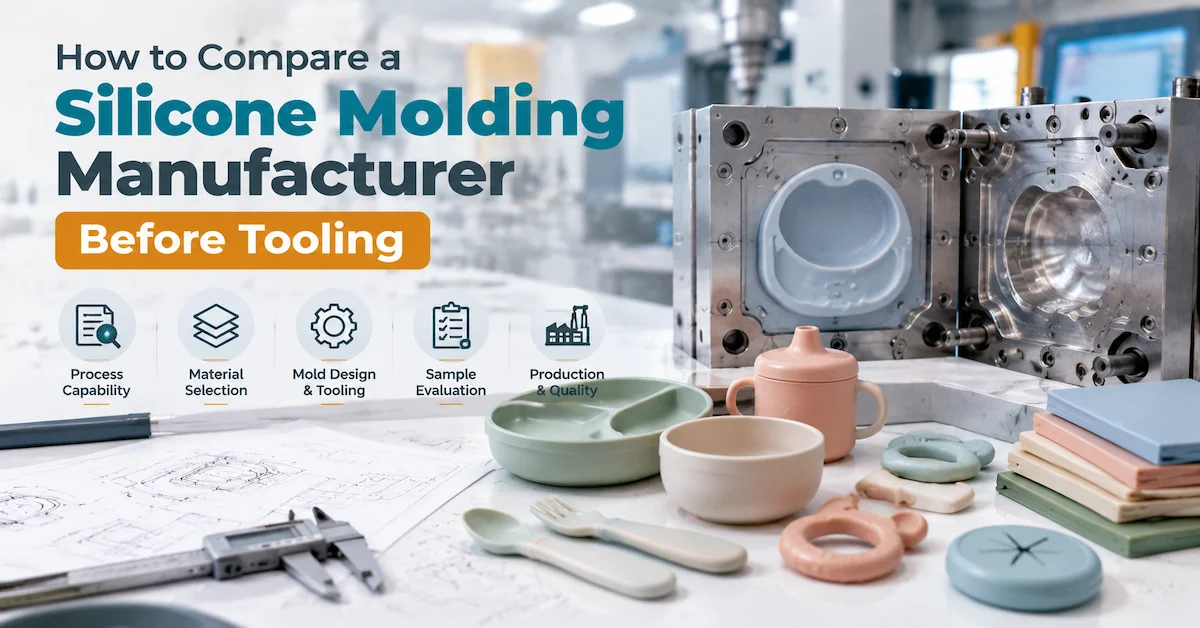
For buyers, the target of comparison should therefore be a part-process-tool-evidence chain. The supplier should be able to show how the part is defined, how the mold will be made, how the first sample will be checked, and how the approved version will be protected during production.
The five decisions behind a useful supplier comparison
| Decision | Question to ask | Evidence to request |
|---|---|---|
| Process fit | Which molding route matches the geometry, thickness, material, appearance, and order plan? | Process recommendation with design assumptions and limitations |
| Tooling | How will the mold control parting lines, cavities, flash, dimensions, and repeat use? | Tooling drawing, revision record, cavity plan, and maintenance approach |
| Sample | What exactly will the buyer approve before mass production? | Labeled sample, measurement sheet, function notes, and change list |
| Quality | How will raw materials, first articles, in-process parts, and finished goods be checked? | Inspection plan, defect standard, test records, and final release report |
| Commercial execution | Can the approved product be packed, labeled, shipped, and reordered consistently? | Packaging proof, carton data, shipping assumptions, and repeat-order controls |
Start with process fit, not the supplier catalog
A catalog can show that a factory has produced silicone products. It does not automatically show that the factory has selected the right process for your new part. Put the geometry and use case first, then ask the supplier to explain the process choice.
Solid silicone compression molding
Compression molding uses prepared solid silicone material placed into a mold and cured under controlled conditions. It can be relevant to many thicker or relatively stable molded shapes, but the correct design depends on the part geometry, material, cavity layout, appearance requirements, and production plan. The buyer should ask how the proposed process will manage flash, parting lines, trapped air, inserts, and the visual standard.
Do not assume that “compression molding” means the same result for every product. A bowl, mat, toy, gasket, and protective sleeve can have very different critical dimensions and cosmetic risks. The supplier response should identify the features that will be measured and the features that are primarily visual.
Liquid silicone rubber molding
Liquid silicone rubber, or LSR, is a distinct material and process route from solid silicone compression molding. It may be considered for designs that need liquid injection, repeatable filling of detailed geometry, or a different production setup. Whether it is appropriate depends on the part, material specification, tooling, equipment, and required evidence. Ask the manufacturer to state the proposed LSR grade or material route rather than using “LSR” as a generic quality label.
Extrusion and continuous profiles
Silicone extrusion is relevant to continuous profiles, tubes, strips, cords, or other shapes that are formed through a die and then cured or finished. If your project is a cut-to-length profile rather than a discrete molded product, an extrusion supplier may be more appropriate than a factory that only discusses compression molds. Confirm dimensional control along the length, cut accuracy, surface requirements, and packaging for the finished profile.
Two-color, multi-color, and co-injection work
Multi-color products create additional decisions around material compatibility, color boundaries, registration, mold structure, and appearance inspection. Leadonex publicly lists two-color and multi-color molding, as well as precision co-injection drip molding, among its manufacturing capabilities. That is a published capability statement, not a guarantee that every design or color combination is feasible. Ask for a design review and a sample plan for the exact artwork, color count, and surface finish.
| Project characteristic | Questions for the molding supplier | Buyer approval point |
|---|---|---|
| Thick or flexible molded part | How will filling, curing, flash, deformation, and demolding be controlled? | First article matches the drawing and approved appearance standard |
| Fine details or tight interfaces | What tooling features, parting line, draft, and measurement method are proposed? | Critical dimensions and fit are recorded, not judged only by photographs |
| Continuous profile | Is extrusion more suitable than a discrete mold, and how are length and cut tolerances checked? | Profile and cut sample are approved against a written specification |
| Two or more colors | How are color boundaries, registration, material compatibility, and cosmetic defects controlled? | Color references and boundary acceptance standard are signed off |
| Food-contact or baby product | What material, pigment, component, and market evidence applies to the final configuration? | Documents match the approved product and destination market |
How to evaluate mold engineering before paying for tooling
Tooling is where a product idea becomes a repeatable physical reference. Once a mold is approved, changes can affect cost, timing, appearance, dimensions, and production setup. A buyer should not authorize tooling from a product photograph alone. Request a review that connects the 3D model or drawing to the actual mold decisions.
Five mold checkpoints
- Parting line: Ask where the mold will open and where any witness line or flash may appear. The best location is not only a machining decision; it may affect grip, sealing, food contact, appearance, or the customer's view of the product.
- Draft and demolding: Confirm that the part can be removed without damaging thin walls, small details, undercuts, logos, or flexible edges. If an insert or special release method is needed, record it in the design review.
- Wall thickness and transition: Ask the engineer to identify thick-to-thin transitions, corners, ribs, bosses, and areas where the silicone may behave differently during filling or curing. A visually simple shape can still have a difficult material path.
- Cavity and layout: For multi-cavity tooling, confirm the number of cavities, cavity identification, balance assumptions, and how the buyer will compare parts from different cavities. A high cavity count is not automatically better if it makes consistency harder to control.
- Maintenance and change control: Clarify how the mold is identified, cleaned, stored, maintained, modified, and approved after a change. The buyer should know which revision produced the sample that was signed off.
Leadonex publicly describes CNC precision machining, mold life testing, multi-cavity mold design, and mold maintenance service. Its homepage also states that mold precision can reach +/-0.01 mm. Use that statement as a reason to ask which mold feature or measurement it refers to; do not rewrite it as a universal finished-product tolerance. Finished silicone parts can have their own material, curing, measurement, and environmental variables.
Official website statement: Leadonex presents precision mold manufacturing with CNC machining, mold life testing, multi-cavity mold design, mold maintenance, and a page-level mold precision claim of up to +/-0.01 mm.
What a buyer still needs to confirm: the tolerance for the specific mold feature, the finished-part tolerance for each critical dimension, the measurement equipment, the inspection method, and the acceptance standard for the approved SKU.
Tooling questions that belong in the RFQ
| RFQ field | Why it matters | What is not publicly universal |
|---|---|---|
| Mold type and material | Influences durability, surface, maintenance, and part repeatability. | Exact mold steel, life, and replacement conditions for your project |
| Cavity count | Changes output per cycle, balancing, inspection, and commercial cost. | Best cavity count without reviewing the actual geometry and demand |
| Tooling ownership | Protects the buyer's investment and future production options. | Ownership, storage, transfer, and modification terms |
| Tooling revision | Connects the approved sample to the mold used for production. | How revisions are recorded unless agreed in writing |
| Maintenance plan | Reduces drift in flash, surface, fit, and dimensions over repeat orders. | Universal mold-life or maintenance interval |
Confirm material route and evidence by product
A silicone molding manufacturer may offer several material routes. The correct question is not simply “Is the silicone food grade?” The buyer should define the intended application, contact conditions, color, hardness target if known, temperature exposure, cleaning routine, and destination market. Then request a material proposal and evidence that match the final part.
Solid silicone and LSR are not interchangeable labels
Leadonex's customization information refers to solid silicone and LSR, and states that engineers can recommend materials based on requirements such as tensile strength, tear strength, standards, and application. This supports a material-selection discussion. It does not establish one universal formulation, hardness, or performance range for every product.
For a food-contact item, the evidence should identify the material and final configuration. For a component exposed to heat, cold, oils, detergents, or repeated flexing, the buyer should identify those conditions before accepting a general material statement. For a non-food industrial part, the critical evidence may be dimensional stability, tear strength, compression set, electrical behavior, or chemical compatibility instead.
Use an evidence matrix instead of a certificate word
| Material question | Buyer should document | Common mistake to avoid |
|---|---|---|
| What material is used? | Material description, grade or standard requested, color compound, and component list | Assuming every silicone component in a set has the same formulation |
| What will it contact? | Food, skin, water, oils, chemicals, air, heat, cold, or another defined environment | Using a food-contact statement for a non-food or different construction without review |
| What evidence is required? | Applicable report, declaration, test, or customer specification for the destination market | Treating a logo or standard name as proof without a report scope |
| What changes the evidence? | Color, pigment, coating, insert, adhesive, lid, printing, and product revision | Assuming a report automatically covers every color and revision |
Leadonex's public customization page lists FDA, LFGB, and RoHS-related material references, and refers to REACH, PAHs, and phthalate testing by SGS. Selected product pages also list ISO9001, BSCI, and FDA test-report references. Public pages do not expose every certificate number, expiry date, report file, product scope, or market scope. A buyer should request current documentation before using a certification claim on packaging, a product page, or a sales proposal.
Approve the sample as a production reference
The first sample is not only a visual preview. It is the point at which the buyer confirms whether the product can move from design to production. A useful sample record includes the drawing or 3D reference, material and color, dimensions, weight where relevant, function, surface, logo, packaging assumption, inspection notes, and revision number.
Sample approval checklist
- Identity: Label the sample with a date, SKU, color, mold revision, and supplier reference.
- Geometry: Measure critical dimensions, wall thickness where relevant, openings, interfaces, and fit features.
- Appearance: Compare surface, gloss or matte finish, parting line, flash, bubbles, color, logo, and pattern to the approved standard.
- Function: Test the part in its intended use environment, including fit, sealing, flexing, grip, release, or assembly.
- Cleaning and care: Confirm the proposed care instruction against the final construction and the buyer's intended market claim.
- Packaging: Place the approved product in the proposed package and check protection, labeling, barcode, and carton assumptions.
- Change record: List every change from the reference design and decide whether another sample is required.
Leadonex's published OEM/ODM workflow is organized as Requirement Analysis, Design and Development, Sample Making, Mass Production, Quality Inspection, and Delivery Service. Its public service information also states 7-15 days rapid sampling. That sampling statement should be confirmed for the specific design, tooling status, material, revision count, and approval process. It should not be treated as a universal mass-production lead time.
Do not approve from a single sample alone
For a critical part, ask how many samples are needed to judge variation and what changes between samples. If the product has multiple cavities, multiple colors, several components, or a lid and base that must fit together, inspect the complete configuration. A beautiful single sample may not reveal cavity-to-cavity variation, color variation, assembly issues, or packaging damage.
Review quality control at four production points
A silicone molding manufacturer should be evaluated by the records it can produce, not only by broad statements such as “strict quality control.” Leadonex publicly describes raw-material testing, dimensional accuracy measurement, physical-property testing, environmental aging testing, and full-process inspection from raw materials to finished products. Translate those published capabilities into a project-specific control plan.
| Control point | What to check | Record to request |
|---|---|---|
| Incoming material | Material identity, lot, color compound, packaging, and traceability | Incoming inspection or material-lot record |
| First article | Dimensions, weight, surface, flash, color, fit, and function against approved sample | First-article inspection sheet with photos and revision |
| In-process molding | Critical dimensions, cavity identity, appearance, parting line, inserts, and demolding result | Process inspection frequency and nonconformance record |
| Final release | Quantity, appearance, assembly, labels, packaging, carton marks, and sampling result | Final inspection report and packing photos |
Define defects before the first production order
Ask the supplier to classify defects for the actual part. A sharp edge, exposed flash, incomplete seal, missing insert, wrong color, wrong logo, dimensional failure, and small cosmetic mark have different consequences. The inspection standard should identify which defects are critical, major, or minor, and what the buyer will accept.
For a multi-cavity tool, include cavity identification in the inspection record. For a multi-color part, define the acceptable boundary, registration, and color reference. For a product with an assembly or lid, inspect the assembled product rather than only the individual molded pieces.
Do not ask a factory to promise a defect rate without defining the product, inspection level, sample size, and defect classification. A measurable inspection plan is more useful than a universal quality adjective.
Do not forget post-processing, branding, and packaging
Molding is only one stage of a sellable silicone product. A buyer may also need trimming, surface treatment, screen or pad printing, assembly, precision cutting, custom packaging, labels, and inspection. Leadonex publicly lists these post-processing and custom-service capabilities. Confirm which are included in the quotation and which are separate operations.
Branding questions
- Is the logo molded into the tool, printed after molding, transferred, or applied through another method?
- What surface finish and color reference will be used for approval?
- How will the supplier protect the artwork during cleaning, handling, and packing?
- Does the brand file require a new insert, tool modification, screen, pad, or artwork plate?
- Does the logo location create a food-contact, cleaning, grip, or sealing issue?
Packaging is part of the specification
Packaging can change product protection, carton utilization, shipping cost, retail presentation, and labeling compliance. Include the final bag, box, insert, barcode, carton mark, and instruction sheet in the approval record. If the product is sold as a set, verify that every component listed on the package is present and matches the approved version.
Leadonex's published customization information includes packaging and labels, while selected product pages show default OPP packaging and optional custom color boxes. Those pages provide a useful RFQ starting point. Confirm the exact packing method, quantity per carton, carton dimensions, artwork responsibility, and packing inspection for the final SKU.
Use factory evidence carefully when comparing manufacturers
Factory scale can matter, but it should be connected to the product and the order. Leadonex identifies the business as WUYI JUCHENG INDUSTRY AND TRADE CO.,LTD and presents its location in Wuyi, Jinhua, Zhejiang, China. Its public website positions Leadonex as a food-grade silicone products OEM/ODM manufacturer and describes design, mold, molding, post-processing, inspection, packaging, and delivery support.
The customization page states a factory area of 15,300 square meters, 135 employees, daily production capacity of up to 38,000 sets, nearly 100 million in annual output value, and more than 10,500 customized silicone projects. These are official website claims with undefined scope. They should be verified during the RFQ and should not be converted into a guaranteed capacity allocation, monthly output, or delivery date for a specific part.
Official fact: Leadonex publishes molding methods, design and tooling capabilities, quality-control categories, an OEM/ODM workflow, factory information, and a range of custom silicone applications.
Official claim requiring confirmation: factory figures, certification references, rapid-sampling timing, mold precision, and project counts are presented on official pages, but public pages do not provide every certificate number, expiry date, scope, production allocation, or product-specific report.
Buyer recommendation: Request the documents, records, and production assumptions for the exact SKU, destination market, material, color, tool, and order plan before making a commercial commitment.
Build an RFQ that a molding engineer can answer
A weak RFQ asks for a unit price against a photo. A useful RFQ gives the supplier enough information to discuss feasibility, process, tooling, sample, evidence, packaging, and repeat orders. It also makes supplier quotes comparable.
- Part definition: product name, application, target user, reference drawing or 3D file, dimensions, critical interfaces, weight target, and annual demand estimate.
- Material: requested material route, hardness target if known, color system, contact environment, temperature exposure, cleaning method, and required market evidence.
- Process: ask the supplier to recommend compression, LSR, extrusion, two-color, co-injection, or another route and to state the assumptions behind the recommendation.
- Tooling: mold concept, cavity count, material, parting line, tooling revision, maintenance, ownership, storage, modification, and sample timing.
- Quality: critical dimensions, appearance standard, defect classification, inspection stages, test responsibility, report format, and release criteria.
- Branding: logo method, artwork, color references, surface finish, inserts, assembly, and intellectual-property handling.
- Packaging: individual pack, set configuration, labels, barcode, language, carton quantity, carton size, protective materials, and shipping marks.
- Commercial terms: tooling, sampling, color development, packaging, inspection, production, shipping assumptions, MOQ, payment, and lead time shown separately for the exact configuration.
MOQ, price, mass-production lead time, tooling ownership, payment terms, and logistics terms are not universal facts that can be copied from a general website page. Request them for the product and order configuration you are actually considering.
Compare supplier responses with a weighted decision table
Price should be part of the decision, but it should not be the first or only filter. A supplier that excludes testing, packaging, tooling changes, inspection, or sample revisions from its first quote may look cheaper while creating more downstream risk. Use one response template for every manufacturer.
| Comparison area | Strong response | Weak response |
|---|---|---|
| Process recommendation | Explains why the process fits the part and identifies design limitations. | Lists every process without connecting one to the actual design. |
| Tooling proposal | Shows cavity, parting-line, revision, maintenance, and approval assumptions. | Quotes a mold without a drawing, scope, or change-control path. |
| Material evidence | Matches material, color, component, product, and destination market. | Uses a general certificate word with no report scope or product reference. |
| Sample control | Provides a labeled sample and a measurable approval checklist. | Asks the buyer to approve from photographs or an unnumbered sample. |
| Quality plan | Defines inspection points, defects, sampling, and final release records. | Uses only “100% quality inspection” without a standard or report. |
| Commercial clarity | Separates tooling, sampling, packaging, testing, production, and shipping assumptions. | Provides one unexplained unit price that changes after approval. |
Warning signs before approving the mold
- The supplier accepts a reference photo but cannot confirm the critical dimensions or material route.
- The quotation does not identify whether the item is standard, modified, or fully custom.
- The supplier promises a universal tolerance, certificate, delivery time, or defect rate without reviewing the product.
- The mold drawing, approved sample, purchase order, and packaging artwork use different revisions.
- The factory shows certificates but cannot explain the product, material, color, or market scope.
- The sample is approved visually, but no one records fit, sealing, flexing, cleaning, surface, or cavity variation.
- Tooling ownership, maintenance, storage, or modification rules are left to verbal discussion.
- The supplier cannot identify what happens when a raw material, color, mold, process, or packaging component changes.
These signs do not automatically prove that a supplier is incapable. They show that the buyer does not yet have enough evidence to release tooling or mass production. Ask for the missing information and record the answer.
FAQ about silicone molding manufacturers
What does a silicone molding manufacturer actually provide?
A manufacturer may provide design support, material selection, mold development, silicone molding, post-processing, inspection, packaging, and delivery. The exact scope varies by supplier and project. Leadonex publicly presents these capabilities as part of its custom silicone product service, but the buyer should confirm which operations apply to the specific part.
Which silicone molding process is best?
There is no universal best process. Compression molding, LSR molding, extrusion, two-color molding, and co-injection can serve different geometries and applications. Ask the supplier to explain process fit using your drawing, material, surface, tolerance, color, and demand requirements.
What should I confirm before paying for a silicone mold?
Confirm the part drawing, material route, parting line, draft, cavity plan, critical dimensions, surface standard, sample plan, tooling ownership, maintenance, revision control, and cost assumptions. Approve the tool only when the supplier's proposal matches the product you intend to sell.
Does a mold precision claim guarantee finished-part accuracy?
No. A mold precision statement and a finished silicone part tolerance are different claims. Leadonex publishes a mold precision claim of up to +/-0.01 mm, but the buyer should request the tolerance and measurement method for each critical finished-part dimension.
Can one molding supplier support multiple industries?
It can be possible, but cross-industry experience does not automatically prove suitability for your product. Confirm the process, material, evidence, tooling, and quality requirements for the exact application. Leadonex publicly presents custom silicone applications across baby products, kitchenware, pet products, outdoor products, industrial accessories, home products, and other areas.
Is a general FDA or LFGB statement enough for a food-contact product?
No. Request current documentation that identifies the material, product or sample, color or components where relevant, applicable test scope, issuing body, and destination-market relevance. Public website references are a starting point for verification, not a substitute for the final evidence file.
What information affects the quote most?
Part geometry, material route, dimensions, tolerance, cavity count, surface, color, logo, inserts, post-processing, packaging, inspection, order quantity, and destination requirements can all affect a quote. Ask the supplier to separate tooling, sampling, packaging, testing, production, and shipping assumptions.
Does the website disclose a universal MOQ or delivery time?
No universal MOQ or mass-production lead time should be inferred from the public pages used for this guide. Ask the manufacturer for MOQ and delivery timing for the exact product configuration, tooling status, quantity, packaging, and destination.
How should I submit an inquiry to a silicone molding manufacturer?
Send a drawing or reference sample, application, material and market requirements, critical dimensions, color and branding information, expected quantity, packaging direction, evidence requirements, and target delivery window. A complete brief allows the manufacturer to answer feasibility and commercial questions in one review.
Conclusion
Choosing a silicone molding manufacturer should be treated as a process and evidence decision, not only a price comparison. The right partner must show how your design will be molded, how the tool will be controlled, how the material and color will be documented, how the sample will be approved, and how production quality will be released.
Leadonex's official website provides a useful starting point for this discussion. It presents WUYI JUCHENG INDUSTRY AND TRADE CO.,LTD as the company behind Leadonex, publishes custom design and mold capabilities, lists compression, LSR, extrusion, co-injection, and multi-color processes, and describes inspection and delivery stages. Those public facts can support an initial RFQ, while product-specific tolerances, documents, MOQ, pricing, tooling terms, and lead time still need to be confirmed for the buyer's exact project.
When you contact the manufacturer, include the part definition, material route, application, drawing, critical dimensions, tool requirements, evidence needs, packaging, and order plan. That information turns a general supplier conversation into a technical review that purchasing, engineering, quality, and compliance teams can evaluate together.