
What Should a Silicone Lunch Box Export Supplier Provide to Importers?
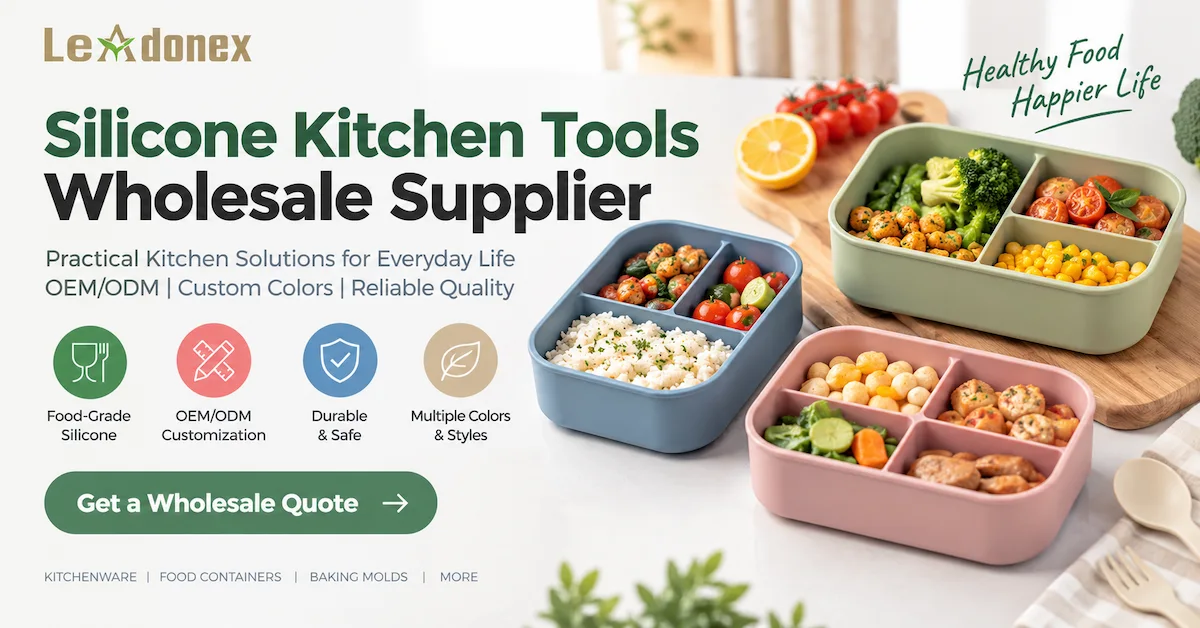
A silicone lunch box export supplier should help an overseas buyer control three things before shipment: what product is being purchased, how the finished goods will be inspected, and how the approved configuration can be repeated in future orders. That is more useful than receiving only a product photograph, unit price, and general statement that customization is available. Leadonex currently presents silicone food containers within its Kitchenware & Molds range, including foldable lunch box configurations that can provide a starting point for importers developing meal-prep, office lunch, food-storage, or private-label kitchenware collections. The purchasing process should then convert the selected product into a controlled specification covering dimensions, capacity, components, color, branding, packaging, use conditions, inspection points, and commercial terms.
For international buyers, this distinction becomes particularly important because problems discovered after the goods arrive are much more expensive to resolve than questions clarified during sampling. An export project should therefore be managed around approved references rather than generic promises such as “same quality,” “food grade,” or “export standard.” The supplier and buyer should be able to identify exactly which sample, specification, artwork, packaging version, and order configuration define the shipment.
Which Buyers Need an Export-Oriented Silicone Lunch Box Supplier?
A silicone lunch box export supplier is most relevant to importers, kitchenware distributors, private-label brands, supermarket buyers, online retailers, promotional-product companies, and lifestyle brands purchasing for repeated overseas distribution. These customers have different priorities. An importer may focus on consistent specifications, carton information, shipping coordination, and reorder stability; a private-label brand may place greater emphasis on color, logo, packaging, and product differentiation; an online retailer may need parcel-resistant packaging and accurate product configuration; while a chain retailer may require controlled labeling, barcode information, packaging dimensions, and repeatable presentation across larger replenishment orders.
The model is less suitable when the buyer has not yet defined the required product type, destination market, intended use, target quantity, or basic packaging format. A request for “your cheapest silicone lunch box” does not provide enough information for a meaningful export comparison because price changes with structure, component configuration, customization, packaging, quantity, and development requirements. Buyers should first review the Leadonex product range and identify whether an existing food-container platform is suitable before deciding how much customization is actually needed.
Start with the Lunch Box Application Before Selecting a Model
Lunch boxes used for office meals, school lunches, meal preparation, compact kitchen storage, outdoor dining, and travel do not create exactly the same product requirements. A commuter may prioritize compact storage and accessory organization, while a meal-prep collection may need larger capacities or different compartment layouts. A private-label retail line may place greater emphasis on coordinated colors and packaging, and a travel-oriented product may need particularly clear information about how the container should be carried and stored.
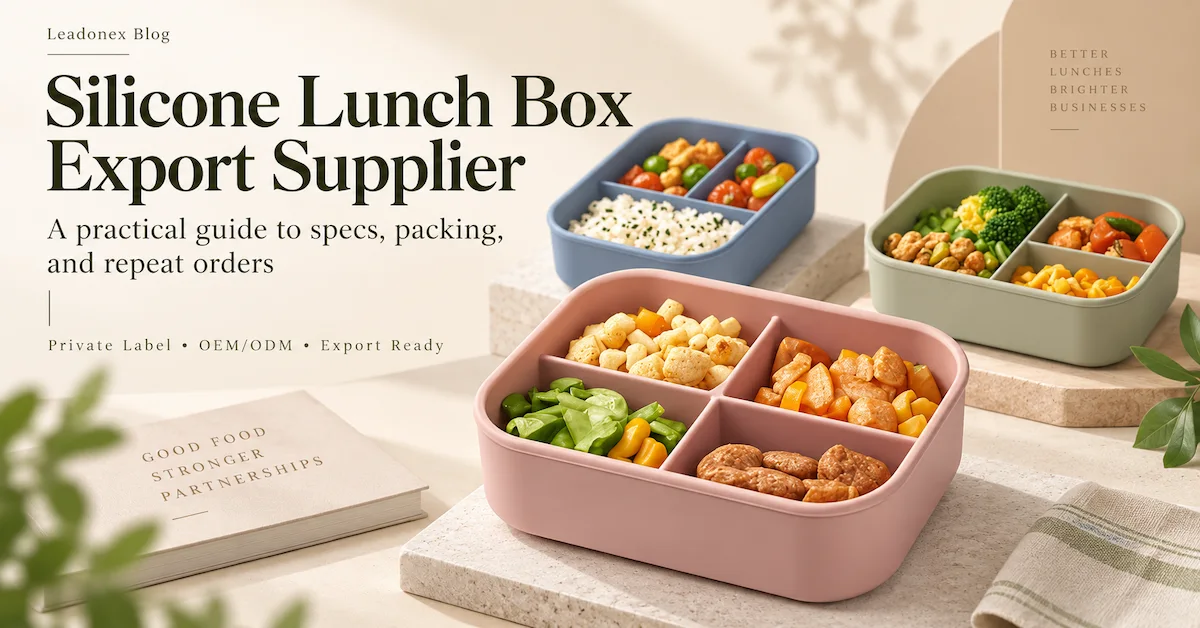
Leadonex currently shows several silicone food-container formats, including a rectangular foldable lunch box. The published product information describes a collapsible format with side closures and a lid vent, which makes it a useful example of why importers should evaluate the complete structure instead of looking only at capacity. A buyer evaluating this configuration should confirm the expanded and folded dimensions, usable capacity, closure operation, lid construction, vent use, component materials, packaging format, and any intended heating or cleaning conditions for the exact version being ordered.
Build a Purchase Specification Before Comparing Export Quotations
The most effective way to compare suppliers is to make each quotation refer to the same specification. Otherwise, two prices may represent products with different materials, dimensions, accessories, packaging, or inspection requirements. Before asking for a final bulk price, create a product sheet that identifies the agreed characteristics and marks unresolved items separately.
| Specification Area | What the Buyer Should Confirm | Recommended Approval Reference |
|---|---|---|
| Product identity | Product name, internal SKU, supplier reference, revision | Approved product sheet |
| Dimensions | Expanded dimensions, folded dimensions where relevant, critical measurements | Drawing and approved sample |
| Capacity | Usable volume under the agreed measurement method | Product specification |
| Components | Container body, lid, closures, vent, cutlery or other accessories | Component list |
| Materials | Material description for each relevant component | Supplier material information |
| Color | Standard color or agreed color reference | Approved physical sample |
| Branding | Logo method, location, dimensions and artwork | Branded sample and artwork |
| Function | Folding, lid fit, closure, vent or other relevant functions | Functional sample |
| Packaging | Unit packaging, labels, inserts, carton quantity | Approved packaging sample |
| Inspection | Appearance, dimensions, function and packing checks | Written inspection criteria |
This document should evolve during sampling but should be controlled once the final sample is approved. That prevents information from an early quotation, an old drawing, or an unapproved sample from being accidentally used as the mass-production reference.
Check Materials at Component Level, Not Only the Main Silicone Body
The phrase “silicone lunch box” does not necessarily mean every component uses the same material. Depending on the design, a product can contain a silicone body together with a lid, closures, vent parts, utensils, reinforcement, or other accessories. That is why buyers should ask a silicone lunch box export supplier for component-level information rather than relying on one general material statement.
Leadonex’s current rectangular foldable lunch box page describes its container around a food-grade silicone construction, but an importer should still confirm the exact specification and supporting documents for the version being purchased instead of extending one page description across the entire product range. The same principle applies to BPA-related, temperature, freezer, microwave, dishwasher, or other use claims: determine what product or component the statement covers, under which conditions, and what information supports the final claim before placing it on retail packaging.
This component-level approach is particularly important for products supplied with lids or utensils. A cleaning or heating instruction suitable for the silicone body should not automatically be copied to every accessory unless those accessories have been confirmed for the same condition.
Evaluate Lunch Box Workmanship Through Functional Checks
A product sample should be treated as a functional approval tool rather than simply a color sample. For a foldable lunch box, buyers should repeatedly expand and collapse the container, observe whether the folding sections behave evenly, check the rim and corners, confirm how the lid seats, operate the closures, inspect the vent where applicable, and evaluate the container on a flat surface. If the design includes cutlery or other accessories, check the complete set rather than inspecting only the main container.
Appearance requirements should also be written in practical terms. Inspect color consistency, surface marks, deformation, edges, flash, contamination, logo appearance, assembly, and packaging condition. Comments such as “make the quality better” give the supplier little objective guidance. A more useful sample report identifies the problem, its location, the expected result, and whether the issue is critical for approval. This allows corrections to be checked again on the next sample and eventually incorporated into bulk inspection.
How Should Importers Compare Different Silicone Lunch Box Formats?
Not every lunch box should be evaluated by the same selling point. A compact foldable container, a compartment lunch box, and a configuration with integrated cutlery solve different purchasing needs. Leadonex’s existing food-container selection provides several formats that buyers can use as references when establishing a range. The comparison below uses published configurations where available and turns them into purchasing questions rather than assuming one option is universally better.
| Product Direction | Main Configuration | Purchasing Advantage | Key Points to Confirm | Suitable Sales Direction |
|---|---|---|---|---|
| Rectangular foldable lunch box | Collapsible container, lid, closures and vent described on product page | Space-saving storage direction | Folded size, capacity, lid fit, vent instructions, component materials | Office lunch, meal prep, compact storage |
| Single-compartment foldable lunch box with knife and fork | Single compartment with supplied cutlery | Creates a more complete portable-meal configuration | Cutlery materials, accessory storage, set inspection, packaging | Commuting, portable dining, retail sets |
| Multi-compartment lunch box project | Different food sections within one container | Separates meal components | Compartment volume, overall footprint, lid interaction | Meal prep, school and portion-focused collections |
| Custom private-label configuration | Existing or modified structure with customized branding | Stronger brand differentiation | Tooling requirement, color, logo, packaging, MOQ | Private-label kitchenware brands |
For a new configuration not shown as an established catalog product, submit the requested structure through Leadonex’s customization service and treat it as a development project rather than assuming it is immediately available for bulk supply.
Define Quality Control Before Production Instead of After Shipment
Export quality control works best when the buyer and supplier establish acceptance criteria before mass production. The inspection plan should identify important dimensions, appearance requirements, functional checks, accessory counts, packaging checks, labeling, and carton requirements. A reference sample alone is useful but not always sufficient because some characteristics are difficult to judge visually.
For example, “same as sample” does not explain how a dimensional variation should be treated or what happens if a closure functions but feels noticeably different from the approved piece. A written standard turns the sample into part of a wider approval system. The supplier can then inspect against defined criteria, while the importer can use the same criteria for pre-shipment inspection or incoming checks.
Documentation should also be reviewed before the product reaches the shipping stage. If the target market or buyer requires particular material or product information, communicate that requirement during development. Do not assume that a report associated with one product automatically covers every size, color, component, or use condition.
Export Packaging Should Protect Both the Product and the Retail Presentation
Packaging for an export order has two jobs: protect the goods during transport and deliver the presentation expected by the sales channel. Buyers should therefore specify the unit pack, retail pack where applicable, product label, barcode, instructions, inner packing, carton quantity, carton dimensions, gross and net weight reporting, and any other information needed by their logistics or receiving team.
A collapsible product creates an additional purchasing question: should the item be shipped in its collapsed form, expanded form, or another packing configuration? The answer may influence retail presentation, carton utilization, product shape after storage, and warehouse handling. Rather than assuming that the smallest packing volume is always the best solution, evaluate both logistics efficiency and product presentation.
Private-label buyers should approve final packaging artwork against the actual product version. Product names, materials, use instructions, quantities, country-specific text, barcode data, and any performance statements should match the approved specification. A packaging file should have a controlled revision just like the product drawing.
Plan Export Lead Time by Milestone, Not by One Single Number
A reliable schedule should distinguish development time from production and shipping preparation. Leadonex describes its OEM/ODM process around requirements, product development, sampling, production, inspection, and delivery. For an importer, those stages should be converted into a project timeline that identifies who must approve each milestone before the next stage begins.
The schedule may include product selection, specification confirmation, custom-color development, tooling where required, sample production, sample revisions, packaging artwork, final sample approval, mass production, inspection, carton preparation, and shipment readiness. The actual time depends on the exact project, so buyers should avoid applying a lead time from one product page to every lunch box order.
Capacity should be treated in the same way. Ask whether the available production window can support the actual quantity, number of colors, packaging variations, and requested shipment date. A factory-wide production figure does not by itself tell an importer when a particular customized order can be completed.
Clarify MOQ at the Product, Color, and Packaging Level
MOQ is most useful when the buyer understands what it applies to. An order containing one lunch box in one color is commercially different from a range containing three structures, four colors, two packaging versions, and several logo variations. Ask whether the minimum applies per model, per color, per packaging version, per set, or to the combined purchase.
The same silicone lunch box export supplier may therefore have different practical minimums for an existing standard product, an existing product with custom branding, and a newly developed configuration. Instead of asking only “What is your MOQ?”, provide an assortment table showing expected quantities by variant and ask the supplier to identify which combinations are feasible. This makes it easier to reduce unnecessary SKUs during a first launch while preserving the option to expand colors or configurations after sales data becomes available.
Compare Total Landed Purchasing Risk, Not Just Factory Unit Price
A low unit price does not automatically mean a lower-cost import.Product development, tooling, samples, logo setup, retail packaging, testing, inspection, carton configuration, freight volume, and rejected or inconsistent goods can all influence the commercial result. Buyers should therefore make sure each quotation covers the same scope before comparing numbers.
A foldable lunch box that reduces packing volume may offer a logistics advantage, but the real benefit should be evaluated with the approved packing method and actual carton data rather than assumed from the product shape alone. Likewise, a more complex lunch box with closures, vent components, or included cutlery may have a different inspection workload and packaging requirement from a simpler container.
Ask each supplier to state what is included, what is excluded, which costs are one-time development costs, and which will repeat with every order. For importers, commercial clarity is a form of risk control because unexpected costs often appear when the project scope was never completely defined.
Use OEM/ODM Customization to Build a More Defensible Product Line
Private-label buyers do not always need a completely new lunch box mold. In some projects, an existing product can be differentiated through color, branding, packaging, accessory combinations, or assortment design. In others, dimensions, compartment layouts, capacities, external geometry, or functional structures need to change and may require more extensive development.
Leadonex presents OEM/ODM services and a dedicated customization process for buyers requiring more than standard product selection. Its published OEM/ODM material discusses customization involving size, color, structure, logo, packaging, and product development. Buyers should confirm which options apply to the exact lunch box before treating those possibilities as part of a final quotation.
A practical development strategy is to separate customization into three levels: branding changes that do not materially alter the product, configuration changes based on an existing platform, and new structural development requiring engineering or tooling. This helps buyers understand why two apparently similar private-label projects can have very different development costs and schedules.
Prepare Export Documents and Shipping Information Before Goods Are Finished
Importers should clarify shipment-related information early enough that production is not delayed by administrative details at the end of the project. Required commercial documents vary by transaction, market, product, shipping mode, and customer procedure, so the buyer should provide its documentation checklist rather than assuming every export order uses exactly the same set.
At minimum, purchasing and logistics teams normally need the commercial information required to identify the goods, quantities, packing configuration, carton details, and transaction. If the buyer needs additional product documentation, origin-related information, test records, declarations, special labels, or customer-specific forms, these requirements should be communicated before shipment preparation.
The important principle is traceability: the product name and configuration used in purchasing documents, cartons, labels, and any supporting paperwork should refer to the same approved product. Inconsistent naming creates unnecessary problems for warehouse receiving, customs brokers, retailers, and future reorders.
How to Send a Useful RFQ to a Silicone Lunch Box Export Supplier
A detailed RFQ reduces quotation errors and shortens the number of clarification rounds. Start with the product link, drawing, sample, or reference image. Then state the target country or region, expected quantity, desired capacity, dimensions if already defined, number of compartments, required accessories, colors, branding, packaging, sales channel, and intended order timing. If particular documentation or product claims are required, identify them before sample development.
For an existing Leadonex design, buyers can begin from the silicone kitchenware range and identify the selected product in the inquiry. For a modified or newly developed lunch box, use the customization page to explain the changes. When the purchasing specification is ready, contact Leadonex with the projected quantity and commercial requirements so the quotation can be based on a defined project rather than an unspecified request.
Frequently Asked Questions
1. How do I evaluate a silicone lunch box export supplier?
Evaluate the supplier on product specification control, sample approval, component information, customization capability, quality requirements, packaging, export communication, and repeat-order consistency. The best comparison is between suppliers quoting the same clearly defined product rather than different configurations that happen to look similar.
2. What should I confirm before ordering a foldable silicone lunch box?
Confirm expanded and folded dimensions, usable capacity, component configuration, lid fit, closures, vent design where applicable, materials, color, branding, packaging, and the use conditions relevant to your sales claims. Review these points on the final sample before bulk production.
3. Can Leadonex supply different silicone lunch box styles?
Leadonex currently lists several silicone food-container directions, including foldable lunch box formats within its Kitchenware & Molds section. Buyers should confirm the currently available models and specifications for their project rather than assuming every configuration is always available.
4. Can I customize the color and logo for an export order?
Leadonex describes color, logo, packaging, size, and structural customization within its OEM/ODM services. The exact options, method, development requirement, and order conditions should be confirmed for the selected lunch box before approving the project.
5. Is there one MOQ for every silicone lunch box?
Buyers should not assume a universal MOQ. Minimum quantities can depend on model, color, packaging, branding, accessories, and whether the project uses an existing design or requires new development. Submit the actual quantity breakdown when requesting a quotation.
6. How should I approve a pre-production sample?
Compare the sample against a written specification covering dimensions, components, function, color, logo, surface quality, accessories, and packaging. Record any requested correction clearly, then identify the final approved sample and document revision before releasing mass production.
7. How can I control quality on repeat orders?
Keep the approved specification, sample, artwork, color reference, packaging file, and inspection criteria under revision control. Reference them on every reorder and require approval before significant materials, components, tooling, or packaging specifications are changed.
8. What packaging information should I request for an export shipment?
Request the unit-pack format, units per carton, carton dimensions, gross and net weight information, labeling, and any retail packaging requirements relevant to your sales channel. Final values should be confirmed for the actual order rather than estimated from another model.
9. How far in advance should I place a silicone lunch box export order?
Lead time depends on whether the order uses an existing configuration, custom branding, special packaging, new tooling, sample revisions, or additional documentation. Ask for a milestone schedule covering approval, production, inspection, and shipment readiness instead of relying on one generic number.
10. What information should I send Leadonex for a quotation?
Provide the selected product or reference design, destination market, expected quantity by variant, size or capacity requirements, colors, logo artwork, packaging needs, accessories, required documentation, and desired shipment timing. You can submit these details through the Leadonex contact page.
Conclusion
Selecting a silicone lunch box export supplier is not simply a matter of finding a container at an attractive factory price. Importers and private-label brands need a supplier relationship that converts an approved product into a controlled export order covering specifications, components, samples, packaging, inspection, commercial conditions, and repeat-order references. Leadonex’s existing Kitchenware & Molds range, OEM/ODM services, and customization support provide starting points for buyers evaluating standard or customized silicone lunch box projects. A qualified silicone lunch box export supplier should be able to work from a clear RFQ, identify unresolved requirements before production, and help maintain the same approved product definition through sampling, bulk production, packing, and replenishment. Before requesting a final quote, prepare your target market, product configuration, quantities, colors, branding, packaging, and required shipping information, then contact Leadonex with the complete purchasing brief.