
What should a silicone cookware private label supplier provide?
A credible silicone cookware private label supplier should provide a project-specific response that covers product fit, material and food-contact evidence, molding or tooling route, branding, packaging, sample approval, quality inspection, quotation assumptions, and repeat-order control. The buyer should be able to see what is confirmed, what is recommended, what is still open, and what evidence will be supplied before bulk production.
That standard matters because “private label” can describe very different purchases. One brand may need an existing foldable lunch box with a new color, logo, and retail package. Another may need a new food container structure, new mold, market-specific documents, and a coordinated product family. Both may use the same search phrase, but they do not require the same supplier response or commercial model.
For buyers comparing suppliers, the most useful first question is not “Who has the lowest price?” It is “Can this supplier turn my product promise into a controlled, repeatable SKU?” Start by reviewing Leadonex’s Kitchenware & Molds product range, then use the product information to prepare a supplier brief rather than requesting an unscoped catalog quotation.
Why a private-label supplier is different from a wholesale seller
A wholesale seller can often offer finished products from an available range. A private-label supplier must coordinate the product with the buyer’s brand, market, packaging, and repeat-order requirements. The supplier may still begin with a standard product, but the commercial value comes from controlling the changes and documenting the approved version.
| Buyer requirement | Wholesale response | Private-label response |
|---|---|---|
| Product identity | Shows available items and standard variations. | Maps the selected SKU to a brief, drawing, revision, and use case. |
| Material claim | May state a general material description. | Connects the material, food-contact parts, market, test scope, and final product. |
| Branding | May offer a label or standard package. | Controls logo method, color, artwork, labels, package, and approval files. |
| Repeat order | Reorders a product by a commercial name or image. | References the approved sample, material, mold, artwork, inspection, and revision. |
This does not mean every private-label order needs a new mold. It means the supplier should classify the project correctly. Existing-product private label, modified-platform development, and fully custom OEM each have different evidence, risk, cost, and approval requirements.
Step 1: define the product before comparing suppliers
The supplier cannot give a meaningful answer if the buyer uses only a broad category name such as “silicone cookware.” That phrase may include food containers, lunch boxes, baking molds, cooking utensils, storage products, and molded kitchen accessories. Each direction has different critical features and different failure risks.
Write a one-sentence product brief before contacting a silicone cookware private label supplier: “We need a [product] for [customer and application], sold through [channel] in [market], with [fixed features], [brand requirements], [package], and [quantity assumption].” This sentence is short, but it prevents the supplier from quoting a different product from the one the brand intends to sell.
| Product direction | Critical buyer questions | Evidence to request |
|---|---|---|
| Foldable food container or lunch box | Capacity, lid fit, folding behavior, stability, cleaning, accessories, and package volume. | Approved sample, dimensional record, function check, component list, and package sample. |
| Baking mold | Cavity geometry, demolding, wall sections, nesting, shape detail, and retail protection. | Drawing or approved sample, appearance criteria, material evidence, and packaging test plan. |
| Cooking utensil | Grip, edge, handle construction, food-contact area, logo location, and set logic. | Function sample, component specification, branding file, and assembly inspection. |
| Coordinated collection | Shared color, logo rules, package hierarchy, SKU roles, and replenishment plan. | Range artwork, master color, set specification, golden samples, and change-control record. |
A buyer who sends a clear product definition gets a more useful supplier response. A buyer who sends only a reference photo may receive a price that excludes the lid, logo, package, testing, or required structural changes.
Step 2: classify the private-label route
Ask the silicone cookware private label supplier to classify your project as an existing-product private label, modified platform, or new development. This single classification clarifies how much engineering and tooling are actually required.
| Route | Typical change | Main approval risk |
|---|---|---|
| Existing product private label | Logo, color, label, set composition, and retail packaging. | The buyer assumes a standard item includes custom features that were never quoted. |
| Modified platform | Dimensions, compartments, accessories, lid, texture, or selected structural details. | A “small change” affects mold, function, price, or lead time. |
| New development | New geometry, tool, material decision, sample, branding system, and package. | The buyer releases tooling before the function, evidence, and commercial model are clear. |
Leadonex’s public customization information describes new molds, 3D modeling, structural optimization, feasibility analysis, CNC precision machining, mold life testing, multi-cavity mold design, and mold maintenance. These capabilities are relevant to development work, but the supplier should still explain which requirement in your drawing needs which tool or process.
Step 3: require a material and food-contact evidence path
“Food-grade silicone” is not a complete procurement specification. The buyer should identify every food-contact part, intended use, destination market, color or pigment, non-silicone component, and customer-facing claim. A lid, valve, insert, adhesive, print, coating, or accessory can change the evidence required for the finished product.
Leadonex’s public OEM/ODM information discusses ordinary silicone rubber, food-grade silicone rubber, medical silicone rubber, HTV solid silicone, and LSR liquid silicone rubber. It references FDA, LFGB, and DGCCRF food-grade standards. The customization page also lists FDA, LFGB, and RoHS-related material wording and states that REACH, PAHs, and phthalates are tested by SGS. These are official website statements, but they should be matched to the final SKU, formulation, component set, market, and report scope.
| Evidence question | Why it matters | Buyer record |
|---|---|---|
| Which parts touch food? | A finished product can contain multiple materials or components. | Component list and food-contact map. |
| Which market and standard apply? | FDA, LFGB, DGCCRF, and other requirements are not interchangeable claims. | Destination, claim wording, document scope, and issue date. |
| Does the report match the final product? | A raw-material document may not prove finished-product compliance. | Sample identity, formulation or material reference, and finished-product applicability. |
| What performance may be claimed? | Temperature, cleaning, folding, sealing, storage, and use instructions need support. | Approved instructions and product-specific validation. |
The public website does not publish one universal certificate number, expiry date, test scope, hardness, or temperature range for every private-label cookware SKU. It presents a general silicone product range of -40°C to +230°C, but that statement should not be copied into every product listing without project-specific confirmation. A responsible supplier helps narrow a claim to the evidence that supports it.
Step 4: connect the product to the right molding and tooling route
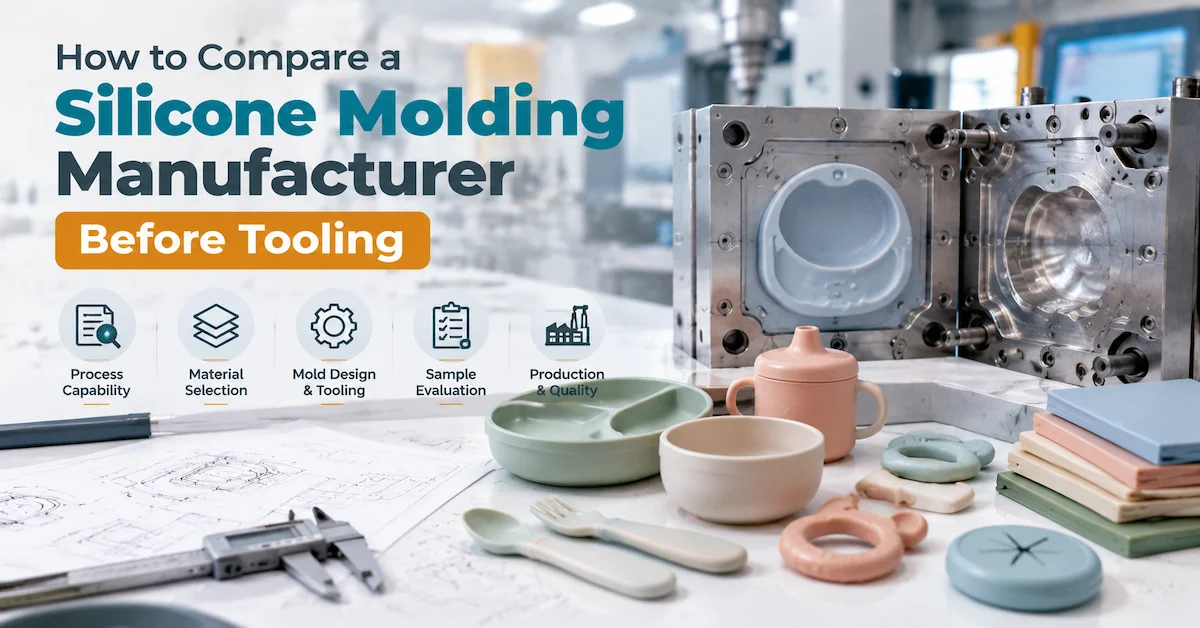
A private-label supplier should explain the process recommendation in relation to the product, not use a process name as a sales label. Geometry, wall sections, undercuts, inserts, cavities, color plan, demolding, surface appearance, and inspection requirements all influence the route.
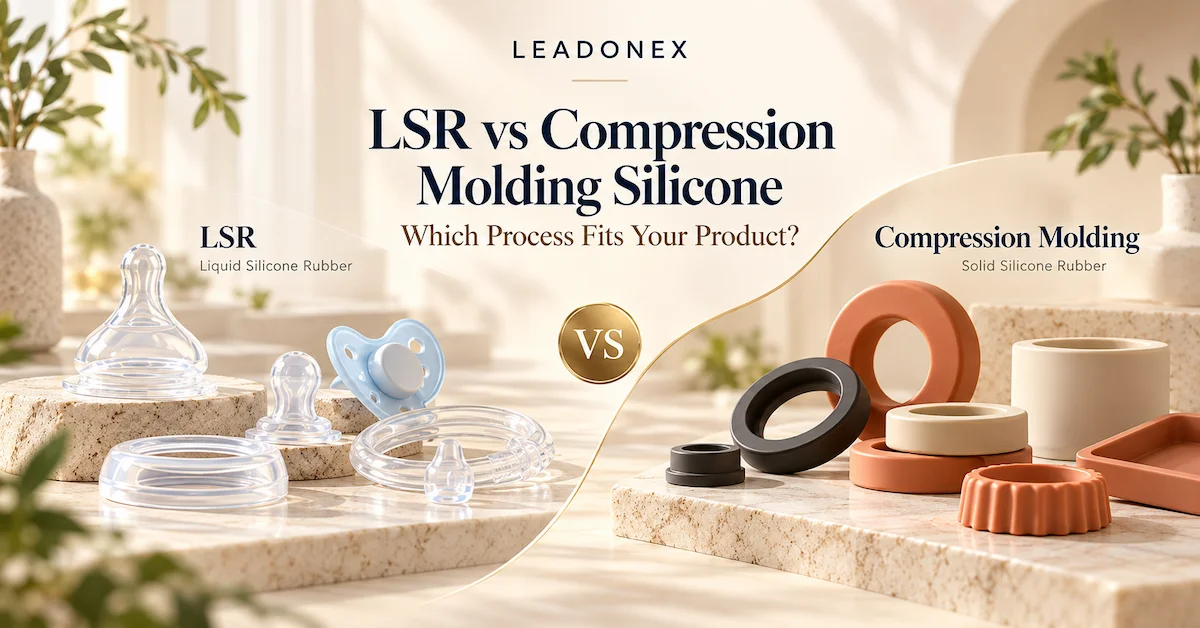
Leadonex publicly lists silicone rubber compression molding, liquid silicone rubber molding, precision co-injection drip molding, silicone fabric coating and curing, printing, assembly, precision cutting, and packaging-related services. A buyer should ask which of these is relevant to the chosen SKU and what the sample is intended to prove.
Questions for a compression-molded product
- Where will the parting line, flash, trimming, and logo appear?
- Which wall areas, edges, cavities, or interfaces are critical to function?
- How will color, surface texture, and appearance be checked?
Questions for an LSR or integrated component
- Why is LSR or another route suitable for this geometry and volume?
- What does the tool control, and which features remain sensitive to material or process variation?
- How will inserts, secondary components, curing, and assembly be inspected?
Do not assume that LSR automatically means better compliance, lower cost, or faster production. Do not assume compression molding is automatically basic or unsuitable. The right choice is the one that can meet the approved product requirement with a clear quality and commercial explanation.
Step 5: test whether the supplier can reproduce your brand
A private-label supplier is responsible for more than making a silicone part. It must reproduce the visual and commercial identity of the SKU. That includes the logo method, position, size, color, texture, pattern, accessories, package hierarchy, labels, and any difference between a retail unit, master carton, and set.
Leadonex’s public customization page describes Pantone color customization, dual-color and marble silicone options, embossed logos, printing, labels, and packaging. These are useful capabilities to discuss, but they are not a substitute for an approved artwork file, physical color reference, package proof, and inspection standard.
| Brand element | Required supplier deliverable | Release test |
|---|---|---|
| Logo | Artwork, method, size, location, surface, and durability assumption. | Visual match, position, clarity, and approved sample. |
| Color | Pantone or physical reference, color name, acceptable range, and batch method. | Physical comparison against the master reference. |
| Packaging | Artwork, labels, barcode fields, inserts, dimensions, carton, and assembly. | Package proof, quantity check, protection, and SKU identity. |
| Set logic | Product combination, accessory rules, color relationship, and retail configuration. | Set completeness and cross-SKU consistency. |
If a supplier cannot explain how the approved brand system will be controlled in production and replenishment, the buyer may be purchasing a one-time customization rather than a private-label supply program.
Step 6: make sample approval a formal decision gate
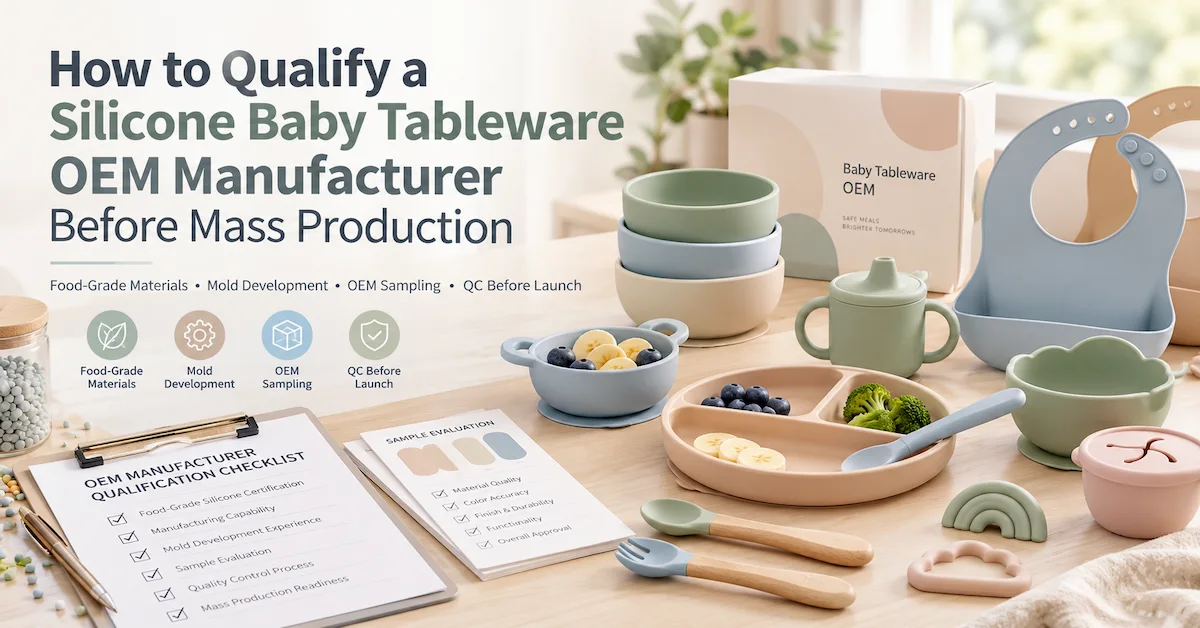
The sample is not only a marketing preview. It is the first opportunity to test whether the supplier understood the product brief. Approve the sample against a written record that covers identity, material, color, dimensions, appearance, function, branding, components, and packaging.
Leadonex’s public OEM/ODM workflow lists Requirement Analysis, Design & Development, Sample Making, Mass Production, Quality Inspection, and Delivery Service. Its customization page describes prototypes, tooling, molding, curing, demolding, initial QC, post-processing, cleaning, packaging, and final QC. A buyer should convert those stages into approval decisions rather than treating the workflow as a general promise.
| Sample gate | What to inspect | Approval record |
|---|---|---|
| Identity | SKU, revision, material, color, tool, sample date, and components. | Sample approval sheet with revision reference. |
| Appearance | Flash, bubbles, stains, deformation, surface, parting line, logo, and color. | Golden sample and defect limits. |
| Function | Lid fit, folding, rebound, stability, demolding, grip, sealing, or use-specific checks. | Test method, result, open action, and approval owner. |
| Package | Retail unit, insert, label, accessory, carton, quantity, and protection. | Approved package sample and artwork revision. |
The customization page states 7-15 days rapid sampling. Treat that as a public service statement, not a universal promise for every project. Confirm what starts the count, whether an existing tool is used, how many revisions are included, and which material, color, logo, and package approvals are part of the sample stage.
Step 7: compare the quality system, not the phrase “strict QC”
A silicone cookware private label supplier should explain what is inspected, when it is inspected, who owns the decision, and what happens when a product fails. “Strict QC” is a description of intent, not an inspection plan.
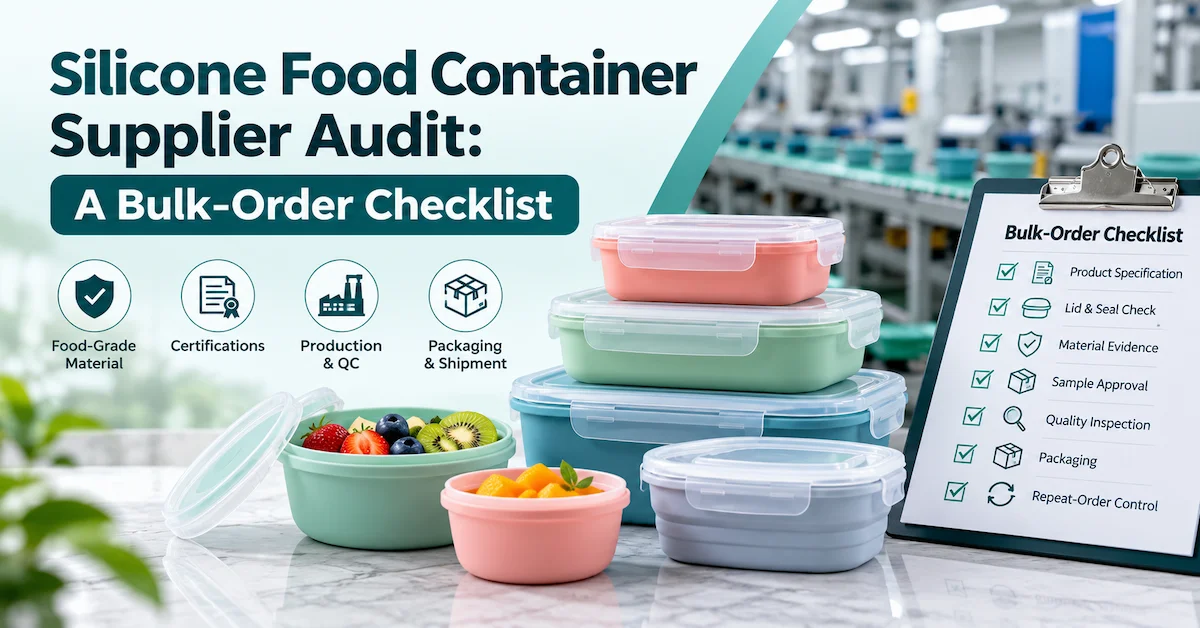
For a food-contact silicone product, the inspection plan may include raw-material identity, color preparation, dimensions, wall areas, cavity size, appearance, flash, bubbles, stains, deformation, logo position, assembly, function, packaging, and final quantity. The correct checks depend on the SKU. A foldable container and a baking mold should not automatically use the same quality checklist.
| Control point | Example buyer requirement | Evidence or output |
|---|---|---|
| Raw material | Approved material form, grade, color, and food-contact scope. | Material reference and applicable documents. |
| Molded part | Dimensions, wall areas, cavities, flash, bubbles, and surface quality. | Measurement record and defect criteria. |
| Function | Fit, folding, rebound, grip, sealing, demolding, cleaning, or stability. | Defined test, pass/fail result, and corrective action. |
| Brand and package | Logo, color, label, barcode, accessory, quantity, and package identity. | Approved artwork, sample, inspection record, and final release. |
Leadonex’s public customization information references raw-material testing, dimensional measurement, physical-property testing, environmental aging testing, process inspection, and full-process quality control. Buyers should ask which checks apply to their product and whether the result is a supplier record, a finished-product report, or a third-party document.
Step 8: make the quotation comparable
The lowest unit price is often not the lowest project cost. A quotation for private-label silicone cookware should state what is included in the product, tooling, branding, packaging, testing, inspection, quantity, and delivery assumptions. Otherwise, buyers may compare a standard bulk item with a fully developed private-label SKU as if they were equivalent.
| Quotation line | Assumption to state | Why buyers compare it |
|---|---|---|
| Product | Material, weight, dimensions, components, process, and quantity basis. | Confirms that suppliers priced the same SKU. |
| Tooling | New tool, modification, cavity plan, maintenance, and commercial terms. | Separates standard-product cost from development cost. |
| Branding and packaging | Logo method, color, artwork, labels, retail package, carton, inserts, and assembly. | Shows whether the quote is retail-ready. |
| Evidence and inspection | Material reports, finished-product testing, inspection, sample retention, and records. | Prevents compliance and quality work from appearing after the order. |
| Commercial terms | MOQ, sample, lead time, payment, delivery basis, and change assumptions. | Makes the supplier response actionable for purchasing. |
Leadonex’s public website does not publish one universal MOQ, price, tooling fee, sample fee, payment term, or mass-production lead time for all silicone cookware. Request these items for the exact product, variants, package, destination market, and schedule. If a supplier cannot state what its price assumes, the price is not yet a reliable comparison.
When requesting a quote, include your reference image or drawing, dimensions, intended use, food-contact parts, market, material preference, color, logo method, packaging, quantity by variant, evidence needs, and target schedule. A supplier can recommend open technical decisions, but it should not silently decide them inside a final price.
Step 9: verify capacity and repeat-order control
Capacity is useful only when it is connected to the actual SKU. A supplier’s general production figure does not prove that one mold, one color, one package, and one delivery window are available for your order. Ask how product weight, mold cavities, cycle, trimming, printing, assembly, packaging, and inspection affect the project plan.
Leadonex’s customization page states a daily production capacity of up to 38,000 sets, a 15,300-square-meter factory area, 135 employees, and more than 10,500 customized silicone product projects. These are public company statements. They should support due diligence, not be treated as a guaranteed capacity allocation for an individual private-label SKU.
Repeat-order control is equally important. Keep the approved sample, released drawing, material reference, master color, mold identification, logo artwork, package files, inspection standard, reports, and revision history together. Every reorder should reference the same revision. Any change to material, tool, color, accessory, label, package, market, or quantity should be reviewed for its effect on function, compliance, price, and approval.
| Repeat-order reference | What it protects | Buyer action |
|---|---|---|
| Golden sample | Shape, feel, color, appearance, logo, and function. | Retain and identify the approved revision. |
| Material and color record | Material substitution and batch-to-batch color drift. | Reference the approved material and physical color standard. |
| Artwork and package files | Wrong logo, label, barcode, accessory, carton, or package quantity. | Use revision-controlled files for each order. |
| Inspection standard | Different defect limits or missing functional checks. | Reference the release plan and record nonconformities. |
A practical supplier scorecard for private-label cookware
The following scorecard is a buyer-side evaluation tool, not an official Leadonex rating or an industry certification. Its purpose is to prevent a supplier from receiving a high score only because it offers a low unit price. Score evidence, not adjectives.
| Evaluation area | Evidence required | Suggested weight |
|---|---|---|
| Product fit | Relevant product direction, application understanding, and clear SKU definition. | 15% |
| Material and evidence | Food-contact parts, market scope, material route, test or document applicability. | 20% |
| Tooling and process | Feasibility explanation, mold route, process fit, and development controls. | 15% |
| Sample discipline | Sample schedule, revision control, testing, golden sample, and approval gate. | 15% |
| Brand and packaging | Logo, color, labels, package, assembly, and retail-ready control. | 10% |
| Quality and repeatability | Inspection plan, nonconformity handling, batch control, and reorder reference. | 15% |
| Quotation clarity | MOQ, price basis, tooling, schedule, testing, package, payment, and delivery assumptions. | 10% |
The scorecard should be completed after each supplier answers the same RFQ. A supplier with an incomplete evidence response should not be treated as equivalent to one that has supplied a clear, product-specific record.
What should you send in your RFQ?
A useful RFQ helps the supplier recommend a feasible route and helps the buyer compare the response. Send the following information when available, and mark unknown fields as open questions rather than silently leaving them out.
| RFQ section | Include | Supplier response |
|---|---|---|
| Product and application | Product type, use case, customer, channel, market, and reference images. | Feasibility comments and product route. |
| Technical requirement | Dimensions, capacity, components, material preference, color, function, and use conditions. | Material, process, tooling, and open questions. |
| Brand and package | Logo artwork, color reference, label language, retail package, carton, and accessories. | Branding method, package recommendation, and sample scope. |
| Commercial requirement | Initial quantity, variants, annual estimate, sample need, target schedule, and destination. | MOQ, quotation, sample, schedule, and delivery assumptions. |
Leadonex’s public customization page describes a one-stop service covering design, prototyping, molded silicone contract manufacturing, printing, packaging, materials, structure, function, shape, size, color, logo, pattern, and labels. For a product-specific review, the best next step is to send the brief through the company’s OEM and ODM service page or contact route.
Frequently asked questions
What is a silicone cookware private label supplier?
It is a supplier that provides silicone cookware or kitchenware for sale under the buyer’s brand and can coordinate the product, material, branding, package, quality release, and repeat-order requirements. The exact scope may range from an existing product with a logo to a fully custom product with new tooling.
Is private label the same as OEM?
The terms overlap but are not identical in every quotation. Private label often starts with an existing product or platform and adds brand identity. OEM may include a buyer-specific structure, tooling, material, or functional development. Ask the supplier to define the route for your exact SKU.
What documents should a supplier provide for food-contact cookware?
Request documents and tests that match the final material, finished product, components, destination market, production revision, and intended claim. Factory-level certifications and raw-material statements should not automatically be treated as finished-product evidence for every SKU.
Do I need a new mold for private-label silicone cookware?
Not necessarily. Logo, color, label, package, and set changes may use an existing product. Changes to dimensions, cavities, lids, compartments, handles, wall sections, or integrated functions may require mold modification or new tooling.
Which silicone process should a supplier recommend?
The process should be selected from the product geometry, material, wall behavior, tooling, volume, appearance, and inspection requirements. Leadonex publicly lists compression molding and LSR molding among its capabilities, but the correct route requires project-specific engineering review.
How can I compare two private-label supplier quotations?
Compare the same product definition, material, tooling route, branding, package, testing, inspection, quantity, MOQ, schedule, payment, and delivery assumptions. A lower unit price is not comparable if it excludes development or retail packaging.
Does Leadonex publish a universal MOQ?
The public pages reviewed for this guide do not publish one universal MOQ for all silicone cookware. Ask for the MOQ and price basis for the exact product, colors, packaging, tooling status, and quantity plan.
Does Leadonex publish a universal production lead time?
The public customization page states rapid sampling of 7-15 days, but it does not establish one universal mass-production lead time for every private-label cookware SKU. Confirm the schedule after the product, tooling, material, color, package, quantity, and approval conditions are defined.
Can I request custom colors and packaging?
Leadonex publicly describes Pantone color customization, dual-color and marble options, embossed logos, printing, labels, and customized packaging. The final color reference, artwork, package configuration, and inspection standard still need project approval.
What should I send for a supplier review?
Send the product type, application, target market, drawing or reference sample, dimensions, components, material preference, food-contact parts, color, logo, packaging, quantity, testing needs, and target schedule. Mark unknown specifications as open questions so the supplier can recommend a feasible route.
Conclusion
The best silicone cookware private label supplier is not simply the company with the broadest product catalog or the lowest first quotation. It is the supplier that can connect your customer use case to a defined SKU, appropriate material evidence, a feasible molding route, controlled branding, an approved package, a written sample gate, a product-specific inspection plan, transparent commercial assumptions, and a repeat-order reference.
For Leadonex, the public evidence supports a conversation around Kitchenware & Molds, custom silicone products, OEM/ODM development, molding, tooling, branding, packaging, and quality control. The exact product, documents, MOQ, price, tooling terms, schedule, and market scope must still be confirmed for the buyer’s project.
The most useful next step is to send a complete RFQ rather than ask for a generic price list. Include the product reference, application, market, material and food-contact requirements, quantity, color, logo, package, required evidence, and target schedule so the supplier can respond with a comparable private-label route.