
Short answer: Neither process is universally better. LSR is often considered when a project needs liquid injection, repeatable dosing, thin or detailed geometry, automated production, or a complex multi-component design. Solid silicone compression molding is often considered for thicker, flexible, or relatively stable shapes where a preformed silicone charge and heated mold fit the product and order plan. The correct choice depends on geometry, material, tolerance, surface, color, tooling, quantity, application, and evidence requirements.
For an LSR vs compression molding silicone decision, ask the manufacturer to compare both routes against the same drawing or reference sample. Approve the process only when the proposed material, mold, sample, inspection plan, packaging, and commercial assumptions describe the product you intend to sell.
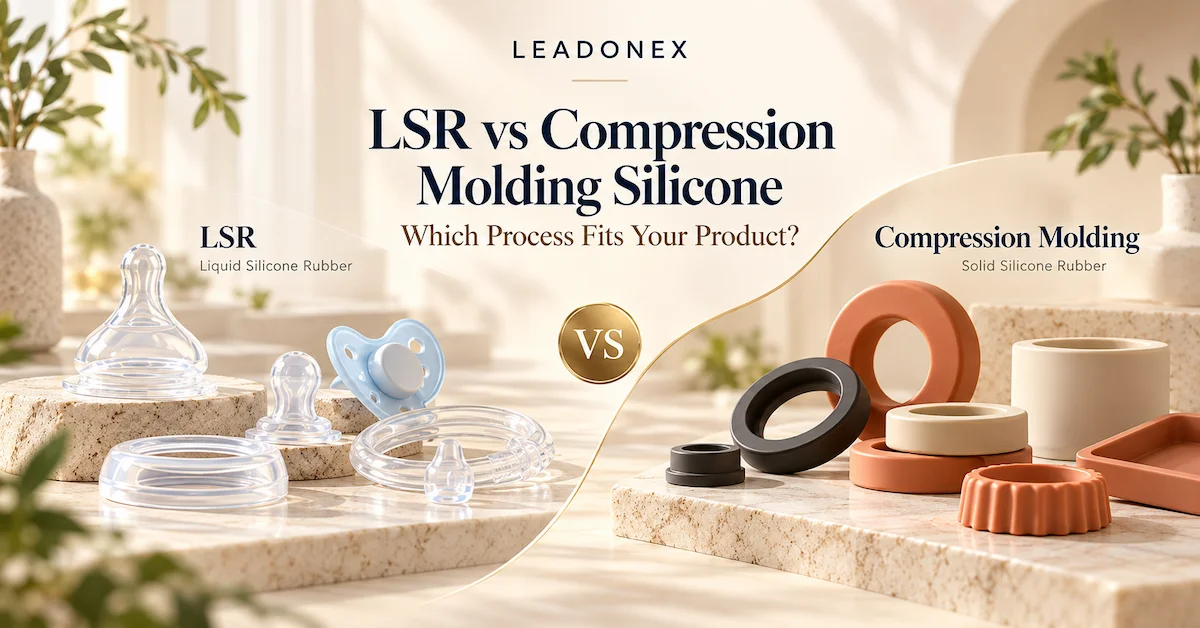
LSR vs compression molding silicone: what is the buyer deciding?
The real purchasing question is not simply which technology sounds more advanced. It is: Which silicone molding process can produce this exact part with acceptable function, repeatability, tooling cost, material evidence, and production control? That question belongs to Commercial Investigation and RFQ Intent because the answer affects the mold investment, sample approval, launch schedule, unit economics, and future replenishment.
LSR and solid silicone compression molding can both produce useful silicone products, but they are not interchangeable labels. They use different material forms, loading methods, mold layouts, production controls, and process assumptions. A supplier that offers both routes should explain the trade-off instead of quoting the first process that comes to mind.
This guide is intentionally narrower than a general silicone manufacturing overview. It helps a buyer compare the two routes before tooling, before committing to a custom mold, and before approving a production sample. It also separates general process principles from what Leadonex publicly states about its own capabilities.
The six inputs that should control the comparison
| Input | Why it matters | Buyer evidence |
|---|---|---|
| Part geometry | Thickness, undercuts, ribs, openings, inserts, and flexible zones can change process fit. | Dimensioned drawing, 3D file, or reference sample with critical features identified. |
| Material route | Liquid and solid silicone require different preparation, dosing, loading, and curing controls. | Material description, grade or standard requested, color, and evidence scope. |
| Functional demand | Sealing, flexing, grip, food contact, heat, cold, and repeated cleaning create different acceptance criteria. | Use environment, critical performance, care instruction, and market claim list. |
| Volume and mix | Cavity count, automation, changeovers, colors, and annual demand affect the commercial choice. | Target quantity, SKU mix, replenishment pattern, and launch plan. |
| Appearance | Parting lines, flash, color boundaries, texture, gloss, and surface marks affect retail acceptance. | Approved color reference, surface standard, logo artwork, and cosmetic defect photos. |
| Evidence and market | The same material claim may not cover every color, component, construction, or destination market. | Product-specific reports, declarations, labels, and destination-market requirements. |
What is LSR molding?
LSR means liquid silicone rubber. In a typical LSR route, two liquid components are metered, mixed, delivered into a mold, and cured inside the tool. The equipment and mold are designed around controlled liquid flow, injection, temperature, venting, and curing. The exact formulation, machine setup, mold architecture, and process window depend on the product and the requested material evidence.
For buyers, the important point is not the acronym. It is the way the liquid material enters and fills the mold. LSR may be a strong candidate when the design includes thin sections, detailed features, repeatable small parts, integrated sealing areas, or a production concept that benefits from metered injection. Those are selection considerations, not automatic guarantees. The manufacturer should confirm them against the drawing and sample.
Potential LSR advantages to investigate
- Liquid material can support controlled injection into detailed mold cavities when the tool and process are designed for it.
- The process may be suitable for repeatable small or thin components, but the final result still depends on material, tool, venting, curing, and inspection.
- Automation and metered material delivery may be relevant to high-repeat production plans, subject to the manufacturer's equipment and capacity review.
- LSR can be considered for integrated seals, soft-touch details, or multi-component designs when compatibility and tooling are confirmed.
- A liquid route may simplify some part geometries while increasing the importance of equipment, tool, dosing, and process-control review.
Questions a buyer should ask about LSR
- Which LSR material or grade is proposed, and what evidence applies to the final product?
- What are the critical flow, venting, curing, and demolding considerations for the design?
- How will the supplier control component ratio, color, lot traceability, and material changes?
- Does the tool require a cold runner, special insert, multi-cavity balance, or another feature that changes cost and maintenance?
- Which finished-part dimensions and physical properties will be checked on the first article and during production?
A common mistake is to treat LSR as a universal premium option. It is a manufacturing route, not a blanket quality certificate. The supplier still has to prove that the material, tool, curing, surface, tolerance, color, and inspection plan fit the part.
What is solid silicone compression molding?
Solid silicone compression molding generally uses a prepared solid silicone charge or preform placed into a heated mold. Pressure closes the mold, the material fills the cavity, and the part cures under controlled heat and time. The specific loading method, preform design, mold layout, curing condition, and finishing steps depend on the product.
Compression molding is often considered for thicker flexible products, stable shapes, broad surfaces, mats, bowls, covers, seals, and other parts where a solid silicone charge and heated tool make commercial sense. It can also support complex products, but the tool and part design must account for material flow, flash, parting line, demolding, and variation.
Potential compression-molding advantages to investigate
- The process can be suitable for thicker or relatively stable shapes that can be loaded as a solid silicone charge.
- Tooling and production decisions can be straightforward for some products, but the cost and repeatability depend on cavity layout, material, and part complexity.
- It can support a broad range of consumer silicone products, including kitchenware, baby products, pet products, and outdoor items, when the design and material are appropriate.
- The buyer can often evaluate the process clearly through first-article measurements, flash standards, surface review, and functional sampling.
- A compression route may be practical when the required geometry does not need liquid injection and the order plan does not justify a more complex setup.
Questions a buyer should ask about compression molding
- How will the solid silicone charge be prepared, identified, colored, and loaded into the mold?
- Where will the parting line appear, and how will flash be trimmed and inspected?
- Which areas of the product are sensitive to deformation, shrinkage, or thickness variation?
- How will cavities, inserts, logos, textures, and multi-color boundaries be controlled?
- What does the supplier define as an acceptable first article, and which dimensions are critical?
Compression molding is not automatically a low-cost or low-precision option. The finished result depends on the mold, material preparation, loading, curing, trimming, measurement, and operator or equipment controls. Compare the full process rather than the process name alone.
LSR vs compression molding silicone: side-by-side buyer comparison
The table below is a general sourcing framework, not a promise that every project will follow the same pattern. A qualified manufacturer should confirm the result for the actual geometry, material, tool, quantity, and destination market.
| Comparison point | LSR molding | Solid silicone compression molding | Buyer decision |
|---|---|---|---|
| Material form | Liquid two-component material delivered through a metered injection system. | Prepared solid silicone charge or preform loaded into a heated mold. | Ask which material route best matches the part and evidence requirements. |
| Geometry | May suit thin, detailed, or integrated features when the tool and process are designed for them. | May suit thicker, flexible, or stable shapes with a suitable charge and tool. | Review thickness, undercuts, vents, inserts, and demolding before choosing. |
| Tooling | May include injection, runner, dosing, venting, and multi-cavity balance considerations. | May focus on charge placement, compression, parting line, flash, and demolding. | Approve a tooling drawing and revision path, not only a unit quote. |
| Automation | Can be considered where metering and injection automation support the order plan. | Can use equipment or operator-controlled loading depending on the product and setup. | Ask for actual equipment, cavity, changeover, and capacity assumptions. |
| Appearance risks | Color, flow marks, venting, registration, and surface variation may need review. | Flash, parting line, charge placement, surface, and color variation may need review. | Set a photo-based cosmetic standard before production. |
| Commercial review | Equipment, tool, material, maintenance, and production assumptions can affect the quote. | Tool, material preparation, trimming, labor, cavities, and inspection assumptions can affect the quote. | Compare total project cost, not only unit price. |
The practical answer to LSR vs compression molding silicone is therefore conditional. LSR may be a better starting point for one product, while compression molding may be better for another product in the same category. The process should follow the part and the business case, not the other way around.
Need a process recommendation for a custom part?
Compare custom molding options →Which products may fit LSR or compression molding?
Product category is a useful starting point, but it is not enough to choose the process. Two products sold under the same category can have different walls, details, functions, and evidence needs. Use the following examples as discussion prompts for an engineering review.
| Product or application | Process question | Evidence to approve |
|---|---|---|
| Baby tableware | Does the selected route produce smooth edges, stable geometry, cleanable surfaces, and reliable fit for the intended use? | Material and food-contact evidence, dimensions, function, cleaning review, packaging, and age guidance. |
| Food containers and lids | Can the process hold the sealing interface, lid fit, flexible wall, and repeated opening requirements? | Fit, leakage or closure review, capacity, material scope, temperature use, and care instructions. |
| Kitchen tools and mats | How will the tool control thickness, handle interfaces, surface texture, flatness, and logo placement? | Heat or food-contact evidence where applicable, flatness, appearance, grip, and packaging. |
| Pet products | Does the geometry survive the intended handling, cleaning, chewing or feeding environment? | Material, dimensions, edge and tear review, function, and use limitations. |
| Seals and industrial accessories | Which physical properties, compression behavior, chemical exposure, and dimensional tolerances are critical? | Engineering specification, material data, test plan, critical dimensions, and change control. |
Leadonex presents custom silicone applications across baby products, kitchenware, pet products, outdoor goods, home products, sports and health products, industrial accessories, and protective cases. Those application areas are part of the company's public positioning; they do not mean that one molding process, one material, or one certificate applies to every product.
For product teams, the right next step is to send the same technical brief to the manufacturer and ask for a process recommendation. A direct link to Leadonex's kitchenware and molds product category can help buyers review the types of silicone products presented publicly, while the final process still needs project-specific confirmation.
How tooling changes the LSR versus compression decision
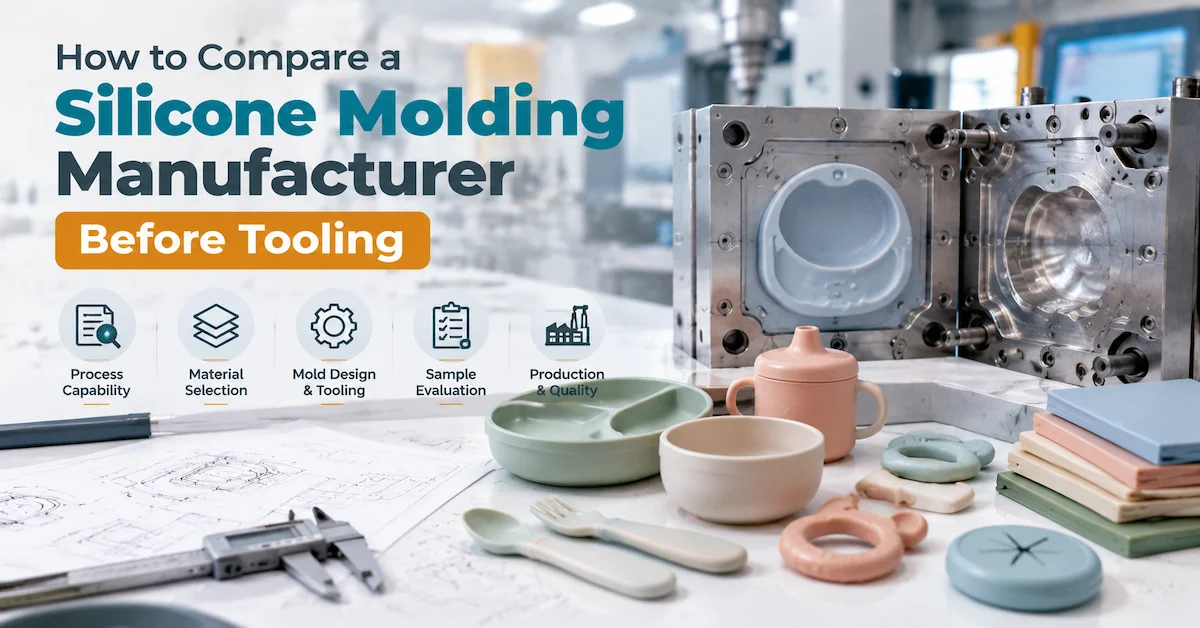
Tooling is the physical link between the selected process and the final part. A buyer should review the tool before approving the quotation, because the tool may determine parting lines, vents, cavity balance, inserts, surface texture, color boundaries, demolding, maintenance, and future change cost.
Tooling questions for both processes
- Parting line: Where will the mold open, and where might flash or a witness line appear?
- Venting: How will the tool manage trapped air and visible surface defects?
- Demolding: Which features may need draft, an insert, a special release approach, or a design change?
- Cavities: How many cavities are proposed, and how will the supplier identify and compare parts from each cavity?
- Critical dimensions: Which measurements control fit, seal, assembly, function, or retail appearance?
- Maintenance: How will the tool be cleaned, stored, repaired, modified, and re-approved?
- Ownership: What written terms govern tooling ownership, transfer, storage, and use for future orders?
Leadonex publicly lists CNC precision machining, mold life testing, multi-cavity mold design, and mold maintenance. The homepage also states a mold precision claim of up to +/-0.01 mm. That is a page-level official claim about mold precision, not a universal finished-product tolerance. Ask the engineering team which mold feature or measurement the figure refers to and how finished-part tolerances will be checked.
Official website fact: Leadonex publishes CNC precision machining, mold life testing, multi-cavity mold design, mold maintenance, and a mold precision claim of up to +/-0.01 mm.
Buyer verification still required: Confirm the tolerance for the specific mold feature, the finished-part tolerance for every critical dimension, the measurement method, the inspection equipment, and the acceptance standard for the approved SKU.
Compare cost without choosing the wrong process
A process comparison should include total project cost, not only unit price. LSR may require a different machine, injection setup, runner concept, or material-control system. Compression molding may involve charge preparation, trimming, operator handling, cavity layout, and appearance inspection. The lower quoted unit price can change when tooling, testing, color development, packaging, rework, or revisions are added.
Ask for an itemized quote
| Cost line | Why it can change | What to ask |
|---|---|---|
| Tooling | Cavity count, inserts, surface, runner or charge design, and revisions. | What is included, what triggers a change, and who owns the tool? |
| Material | Grade, color, additives, lot, evidence, and purchase quantity. | Which material and color assumptions are included in the quote? |
| Sampling | Number of samples, revisions, tests, and engineering changes. | What is the approval gate before mass production? |
| Quality and reports | Inspection level, test scope, market, color, components, and report type. | Which documents are included and which require separate confirmation? |
| Packaging | Bag, box, insert, label, barcode, carton, assembly, and artwork. | Does the quoted price include retail packaging and packing inspection? |
| Production and delivery | Quantity, SKU mix, capacity allocation, destination, and shipping method. | What are the MOQ and lead time for this exact configuration? |
The Leadonex website does not establish a universal MOQ, price, tooling fee, or mass-production lead time for every silicone molding project. Those fields should be requested for the exact part, material, tool, quantity, packaging, and destination. A transparent quote is more valuable than a low quote that omits the approval work.
What Leadonex publicly says about its molding capability
Leadonex identifies the company behind the brand as WUYI JUCHENG INDUSTRY AND TRADE CO.,LTD and presents the business as a food-grade silicone products OEM/ODM manufacturer. Its public customization information describes design, mold, molding, post-processing, inspection, packaging, and delivery support. A buyer can use this published capability set as the starting point for a process-fit discussion.
The public website lists liquid silicone injection, solid silicone compression, silicone extrusion, two-color and multi-color molding, precision co-injection drip molding, and silicone fabric coating and curing. It also describes 3D modeling and rendering, structural optimization, material selection recommendations, feasibility analysis, CNC precision machining, mold life testing, multi-cavity mold design, and mold maintenance.
The public OEM/ODM workflow is presented in six stages: Requirement Analysis, Design and Development, Sample Making, Mass Production, Quality Inspection, and Delivery Service. For a new project, the buyer should ask what document is produced at each stage and what approval gate stops an unapproved revision from entering production. More detail about the published workflow is available through the Leadonex OEM/ODM process.
The customization page states a factory area of 15,300 square meters, 135 employees, daily production capacity of up to 38,000 sets, nearly 100 million in annual output value, and more than 10,500 customized silicone projects. These are official website claims with undefined scope. They should not be converted into a guaranteed capacity allocation or delivery date for a buyer's specific LSR or compression-molded product.
Official website fact: Leadonex publicly lists both LSR molding and solid silicone compression molding, alongside design, tooling, inspection, packaging, and delivery services.
Official website claim requiring confirmation: Public pages list factory figures, certifications, testing references, a mold precision claim, and rapid sampling information, but do not provide every certificate number, expiry date, report file, product scope, or production allocation.
Buyer recommendation: Ask for the process recommendation, material evidence, tooling drawing, sample record, inspection plan, and commercial quote for the exact product and destination market.
Need the full design-to-delivery workflow?
Review the OEM/ODM process →How to approve the first sample
The first sample should be treated as a production reference, not as a marketing photograph. The buyer should know which process, material, color, tool revision, and post-processing steps produced the sample. Without that information, a visual approval can be difficult to repeat.
Sample approval checklist
- Identity: Record SKU, sample date, color, material, mold revision, cavity if applicable, and supplier reference.
- Dimensions: Measure critical interfaces, openings, wall thickness, flatness, sealing surfaces, and assembly points.
- Appearance: Check parting line, flash, surface texture, color, logo, boundary registration, bubbles, marks, and contamination.
- Function: Test sealing, flexing, grip, release, fit, assembly, or other product-specific performance.
- Cleaning and care: Confirm that the intended cleaning method and temperature statement fit the final construction.
- Packaging: Place the approved part in the proposed package and check protection, labels, barcode, and carton assumptions.
- Revision control: List every change from the original design and identify whether a new sample or report is required.
Leadonex's public process describes sample making, functional testing, and quality verification before mass production. The buyer should still ask for the project's sample record and sign-off method. A general process statement cannot substitute for a labeled sample tied to a drawing and material record.
Quality control for an LSR or compression project
The quality plan should follow the selected process. For LSR, the buyer may need records related to material lots, component ratio, color, cavity balance, curing, and injection conditions. For compression molding, the buyer may need records related to solid material preparation, charge placement, curing, flash, trimming, cavity identity, and dimensional variation. The exact checkpoints should be agreed with the manufacturer.
| Inspection point | LSR questions | Compression questions | Record |
|---|---|---|---|
| Incoming material | Are the liquid components, color, lot, and storage status identified? | Is the solid silicone charge, color, lot, and preparation status identified? | Material or incoming inspection record. |
| First article | Are flow, surface, curing, dimensions, and cavity differences acceptable? | Are charge placement, flash, surface, curing, and dimensions acceptable? | First-article sheet with photos and revision. |
| In-process | How are material delivery, color, cavity, curing, and appearance checked? | How are loading, curing, flash, trimming, cavity, and appearance checked? | Process inspection and nonconformance record. |
| Final release | Does the final product match the approved material, dimensions, color, packaging, and reports? | Does the final product match the approved charge, dimensions, flash standard, color, and packaging? | Final inspection report and packing photos. |
Leadonex publicly describes raw-material testing, dimensional accuracy measurement, physical-property testing, environmental aging testing, and full-process inspection from raw materials to finished products. These published categories are useful for an RFQ. They do not establish a universal defect rate, inspection level, test result, or report scope for every customer product.
Material evidence and compliance: compare the final product, not the acronym
The words LSR, food-grade, FDA, LFGB, or BPA-free do not by themselves complete a buyer's approval file. The evidence must match the final material, color, component, surface, construction, product use, and destination market. If the product includes a lid, insert, printed area, adhesive, metal part, or another material, the review should cover those elements as applicable.
Leadonex's public customization information states that engineers can recommend materials based on requirements such as tensile strength, tear strength, standards, and application. It also refers to FDA, LFGB, and RoHS-related material references, and to REACH, PAHs, and phthalate testing by SGS. Selected product pages list ISO9001, BSCI, and FDA test-report references. Public pages do not provide every certificate number, expiry date, report file, or product scope.
For a serious LSR vs compression molding silicone comparison, request an evidence matrix with these fields:
- Product or sample reference.
- Material name, grade, color, and lot where applicable.
- Test or declaration type, issue date, issuing body, and scope.
- Destination market and intended use.
- Final sample or revision connected to the document.
- Buyer approval status and any open evidence gap.
This approach protects the buyer from using a general website phrase as if it were a product-specific compliance result. It also gives the manufacturer a clear list of what must be confirmed before packaging or marketing claims are finalized.
OEM and ODM workflow for process selection
The process choice should be made inside the OEM/ODM workflow, not as an isolated equipment decision. Leadonex publicly describes a six-stage workflow. The buyer can use it as a practical approval map.
| Stage | Process-selection question | Buyer approval output |
|---|---|---|
| Requirement Analysis | What are the part, application, market, quantity, material, and evidence requirements? | Complete product brief and RFQ baseline. |
| Design and Development | Which route gives the best balance of geometry, function, mold, and repeatability? | Design review and proposed process. |
| Sample Making | Does the selected process produce the approved dimensions, surface, color, and function? | Labeled sample and measurement record. |
| Mass Production | Can the approved material, tool, color, and process be repeated at the required scale? | Production plan and change-control record. |
| Quality Inspection | Which LSR or compression-specific defects and dimensions are checked? | Inspection plan and final release criteria. |
| Delivery Service | Do the product, packaging, labels, quantity, and documents match the approved version? | Packing list, shipping record, and after-sales route. |
For a fuller view of the company and its public service scope, buyers can review the Leadonex company information. The page supports entity verification, while the RFQ and sample file should contain the project-specific technical evidence.
RFQ checklist: what to send before asking for a process quote
A supplier cannot compare LSR and compression molding accurately from a product name alone. Send one brief that lets the engineer evaluate geometry, application, material, tool, quantity, evidence, and packaging together.
- Part definition: drawing or 3D file, reference sample or photo, dimensions, weight target, critical interfaces, and use case.
- Application: food contact, baby feeding, pet use, sealing, outdoor exposure, industrial environment, heat, cold, chemicals, or repeated cleaning.
- Material: requested LSR or solid silicone route if known, grade or standard, color, hardness target if available, and evidence required.
- Function: seal, flex, grip, suction, fold, assembly, impact, pressure, or other critical performance.
- Tooling: cavity target, surface, logo, inserts, parting-line constraints, ownership, maintenance, and revision expectations.
- Quality: critical dimensions, appearance standard, defect classification, test responsibility, sampling, and final release records.
- Branding: logo method, artwork, color reference, texture, packaging, labels, barcode, and language requirements.
- Commercial plan: target order quantity, SKU mix, annual demand estimate, destination, launch window, and required delivery timing.
- Quote format: request separate lines for tooling, samples, material, testing, packaging, production, inspection, and shipping assumptions.
The purpose of the RFQ is not to force the supplier to choose the process you already prefer. It is to make the supplier explain the recommendation and identify what remains unconfirmed. A good response may recommend LSR, compression, extrusion, or a hybrid product architecture depending on the part.
FAQ: LSR vs compression molding silicone
Is LSR always better than compression molding?
No. LSR may fit certain thin, detailed, liquid-injection, or highly repeatable designs, while compression molding may fit many thicker, flexible, or stable shapes. The correct process depends on the exact part, material, tool, quantity, function, and evidence requirements.
Is compression molding only for low-volume products?
No. Compression molding can support commercial production, but the appropriate cavity count, equipment, loading, inspection, and capacity depend on the product and factory setup. Do not infer volume capability from the process name; request a project-specific production plan.
Which process is better for thin silicone parts?
LSR may be considered for thin or detailed parts, but this is not an automatic rule. Wall thickness, flow path, venting, tool design, curing, demolding, and the required tolerance all need engineering review. A supplier should prove the choice with a sample and measurement record.
Which process is better for silicone kitchenware or baby products?
Either route may be appropriate depending on the shape and function. The buyer should prioritize smooth surfaces, controlled dimensions, food-contact evidence, color, cleaning, packaging, and market requirements. Leadonex presents both LSR and solid silicone compression molding as public capabilities, but the exact SKU still requires confirmation.
Can LSR and compression molding use the same mold?
Do not assume they can. The mold design may need to match the material form, injection or loading method, runner or charge arrangement, venting, curing, and demolding requirements. Ask the manufacturer whether a tool can be shared, modified, or must be developed for one process.
Does LSR automatically have better tolerances?
No automatic tolerance should be assumed. Finished-part accuracy depends on material behavior, tool precision, process control, curing, measurement method, and the design. Request a tolerance table for the actual part rather than relying on a process label.
What certifications apply to LSR or compression-molded silicone?
The applicable evidence depends on the material, product, color, components, intended use, and destination market. Leadonex's public pages list selected FDA, LFGB, RoHS-related, REACH, PAHs, phthalate, ISO9001, and BSCI references, but public pages do not provide every certificate number, expiry date, report file, or product scope. Request current documents for the final configuration.
Does Leadonex publish a universal MOQ or delivery time?
The public pages used for this guide do not establish a universal MOQ or mass-production lead time for every LSR or compression project. Ask for the exact MOQ, sample timing, production lead time, packaging plan, and shipping assumptions for your configuration.
What should I send to get a useful comparison?
Send the drawing or reference sample, application, material and market requirements, critical dimensions, color and branding requirements, quantity, packaging direction, evidence needs, and delivery target. This allows the manufacturer to compare process fit instead of sending a generic catalog quote.
Conclusion
The best answer to LSR vs compression molding silicone is not a universal winner. LSR may be the better route when the product benefits from liquid injection, detailed geometry, integrated features, or a specific automation plan. Solid silicone compression molding may be the better route when a thicker, flexible, or stable shape can be produced efficiently with a prepared solid charge and a controlled heated mold.
The reliable decision comes from comparing the complete chain: part geometry, material, mold, process, sample, inspection, evidence, packaging, cost, and repeat-order control. Leadonex publicly lists both LSR molding and solid silicone compression molding, along with tooling, design, QC, post-processing, packaging, and OEM/ODM services. Those public capabilities support an initial technical discussion; project-specific tolerances, reports, MOQ, tooling terms, price, and lead time still need confirmation.
Prepare the RFQ with the part drawing, intended application, material route, critical dimensions, color, quantity, market, evidence, packaging, and target timing. Then ask the manufacturer to recommend the process and show the approval records that will control production.
Ready to compare the right process for your product?
Send the drawing, application, material requirements, target quantity, and packaging direction for a project-specific review.
Request an LSR or compression molding review →